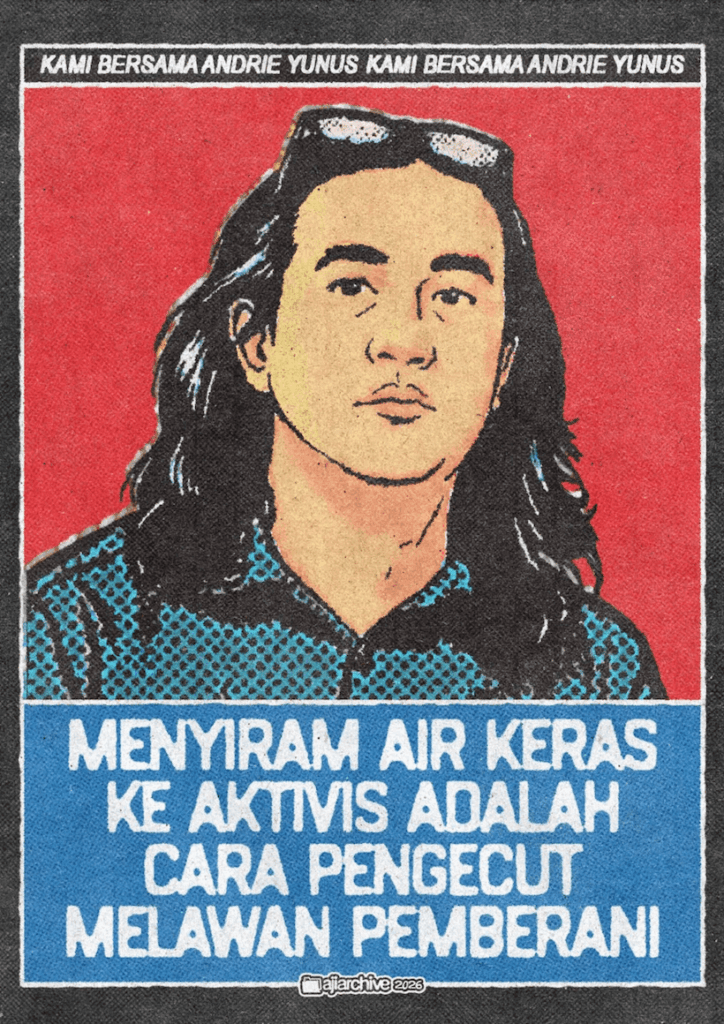
Andrie Yunus, Militarism, and State-Terrorism
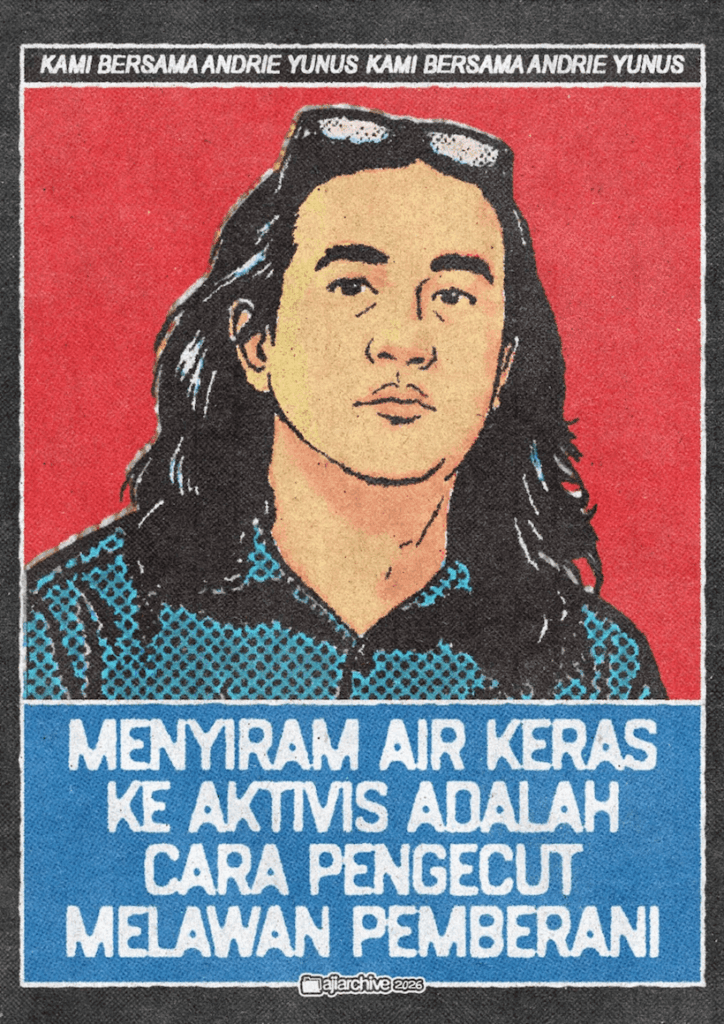
It is not without reason that activists from the civil society movement who are members of the Advocacy Team for Democracy (TAUD) from the start called for the case of acid attack on Andrie Yunus to be seen as an attempt at premeditated murder, instead of being seen as an ordinary act of violence or abuse. Apart from the fact that acid has been designated as a means of murder in many countries due to its extraordinary destructive power and lethality, the choice of the perpetrators to spray the face and not other areas of the body indicates that the aim of this attack was death, not merely to cause the victim to feel pain. The eyes, nostrils and oral cavity are the entrances to the internal organ storage space, and corrosive hard water will kill anyone if it manages to enter through these doors.
Andrie Yunus was doused with acid on March 12 2025 near midnight while riding his motorbike. As a result of the attack, Andrie Yunus suffered burns to 24%, or almost a quarter of his entire body, including his eyes, part of his face and chest, as well as both hands. From the CCTV footage, it can be seen that he was being followed from behind by two people who were also riding a motorbike, and as soon as the two people managed to get ahead of Andrie, they immediately turned around and doused the corrosive liquid in his face.
Since then, the assumption that this was an ordinary accident has been immediately broken. Andrie was clearly targeted, and the attack was certainly planned. Moreover, acid is not something that is easy to obtain. The perpetrators have to buy it first, then prepare it while figuring out how to carry the liquid without hurting themselves. Three weeks after the attack, an independent investigation conducted by TAUD succeeded in producing new findings. The Indonesia National Army (TNI)’s official residence in South Jakarta is strongly suspected to be the headquarters where the attack was planned and coordinated.
State-Terrorism and Silencing as Political Will
Less than 24 hours after the attack occurred, a number of CCTV videos recording the attack from various angles were distributed to the public. The videos were spread widely on social media and clearly recorded the moments of the attack. In one video, for example, Andrie appears in the camera frame, followed by two motorbikes which then overtake him and turn around and splash the liquid on Andrie Yunus' face. This incident happened in just a matter of seconds in a video lasting more than two minutes – and the rest was Andrie Yunus' endless, heartbreaking screams as he jumped off the motorbike, took off his helmet and slammed it on the asphalt, took off his clothes and writhed his body in response to the pain of who knows what kind.
For people who know Andrie Yunus personally, the video makes them unable to hold back tears. For people who don't know Andrie Yunus in person, the video makes them think that this is a risk in being too critical of the State. The comments that appear in the comments columns on social media – apart from containing sympathetic messages for Andrie Yunus – also contain fear.
At that time, there were only two parties who received the CCTV footages, namely the TAUD team and members of the police. TAUD, of course, doesn't want the videos to spread. Apart from not wanting to spread terror, the spread of this video could be a wild ball for the investigation. So, TAUD can be eliminated from the list of parties who distributed the video, leaving only one other party.
On the same day, exactly the day after the attack occurred, President Prabowo said he would 'control' observers who did not like the success of his government and were not patriotic. He admitted that he had intelligence data about observers who often criticized him, including claiming to know all the motives behind the criticism and who was supporting the critics.
If we see Prabowo's statement as a signal to silence anyone who is critical of his government, then Andrie Yunus is certainly part of the parties who will be silenced by him. Andrie Yunus is a human rights defender who has dedicated his life over the last few years to human rights advocacy work. Since his university days, continuing as a public lawyer at LBH Jakarta, until now as Deputy Coordinator of KontraS, he has been heavily involved in advocacy against abuse of power and state authoritarianism in various forms.
In many waves of demonstrations, such as #EmergencyWarning, #DarkIndonesia, #TolakRUUTNI, and the last wave of demonstrations in August - September 2025, Andrie Yunus involved himself with TAUD in advocating for the release of so many demonstrators who were arrested, beaten by the police, and criminalized—including anarchists. Specifically for the last wave of action mentioned, he was also part of the Fact Finding Committee, carrying out independent investigations including violations and excessive use of force by State officials.
Therefore, it would be too naive if we saw these pieces of fact as a coincidence. The attack on Andrie Yunus, Prabowo's statement that he openly wanted to "control" different voices, as well as the terror that was deliberately spread to create fear, are the political attitudes of State administrators to continue to perpetuate State-terrorism, and are part of a larger political will to show their alignment not with social justice, but with State authoritarianism–the desire to make it a single, absolute and indisputable entity.
Aside from fear, what is then produced by the State through the police and military is a confusing mix of information. About a week after the attack, the police and army said they had carried out separate investigations, with completely different findings. The police announced two perpetrators, while the army said there were four perpetrators, all of whom were completely different. According to the police, the perpetrator's initials are BHC and MAK. Meanwhile, according to the army, the perpetrators were active members of the military intelligence agency (BAIS) with the initials NDP, SL, BWH and ES, and surprisingly admitted to having detained them, and stated that they would take them to military court.
This action is an attempt to deceive the public. Some believe that the army has done a good thing by recognizing the involvement of its members and taking the initiative to bring them to military justice. But quite a few also see this as an attempt to repeat the impunity that has existed and been attached to military institutions.
First, the internal investigation which was carried out behind closed doors makes it impossible for us to know whether the four suspects were actually involved or not. Second, military justice, which hides behind internal secrecy, is also carried out behind closed doors, making it impossible for us to see the process and results. All of these internal mechanisms are the right infrastructure to fabricate cases, and hide who the real intellectual actors are behind these events.
The lack of public oversight means that cases tried in military courts often result in light sentences and create a situation of impunity for this institution–and this situation is one of the reasons why it is important to continue to express the idea of anti-militarism.
Militarism and Repeated Violence
History records that militarism has been a serious problem across the ages. Since at least 1965 under the New Order government, the military has been the main actor in human rights violations, destroying thousands of people who were deemed to be opposing the interests of the State. Assassination attempts by the State against anyone who challenges its stability have occurred throughout history. The excuse of "political stability" or "national stability" has become an excuse for the anti-criticism of the State to silence voices that are considered discordant, or not in accordance with the interests of owners of capital and power. Unfortunately, so far these efforts have generally been successful. Since at least 1965 until now, history records that many people have lost their lives because they dared to oppose power.
The 1965 Massacre began with the domination of the narrative and then the manipulation of history by the Army which at that time was commanded by Soeharto regarding the involvement of the Indonesian Communist Party (PKI) in the murder of 6 Army Generals to create hatred towards all people who were considered communists, making it legitimate to carry out murder, exile and various forms of human rights violations and other discrimination against them. This event was marked by the massacre of 500,000 - 3,000,000 people who were considered affiliated with the PKI and its wing organizations, not including imprisonment without legal process, the exile of thousands of people to Buru Island, prohibiting people who were abroad from returning to Indonesia and making them live in political exile abroad.
The 1965 Massacre was the event that made Suharto, who was previously an Army General, become President. After this incident, the privilege of military groups in Indonesian state governance became even more pronounced.
From 1982 to 1985, the military carried out the Mysterious Shooting operation to create national stability, carried out by shooting all those considered criminals as a form of extrajudicial killing. Carried out without any judicial process and judging a person's criminality based solely on their appearance, mysterious shootings were carried out on those with long hair and tattoos. It is never known the exact number of people who died. Some sources estimate that 2000 to 8000 people were killed in the operations carried out by this army.
The Talangsari incident that occurred in 1989 was the murder and torture of Islamic groups in Lampung carried out by soldiers under the command of Hendropriyono. This incident is a manifestation of Soeharto's P4 program which is a single interpretation of Pancasila which is the "foundation of state ideology", where critical Islamic groups are considered as Islamist groups that are contrary to Pancasila and must be eliminated. In essence, the Talangsari incident was Suharto's attempt to eliminate people who opposed and were critical of his government, so that they were considered dangerous for "political stability".
The incidents above are only some of dozens of serious human rights violations that have been determined by Komnas HAM which determines the military as the party that should be responsible, and impunity has always been a way out for them from that responsibility.
The most barbaric manifestation of impunity is when one of the people who should have been most responsible for at least two human rights violations in the past when he served as an active military officer, now becomes president. Prabowo is the person whose nose is best pointed out for the massacre of hundreds of East Timorese citizens at the Santa Cruz cemetery in 1991, when Timor Leste was still part of the Republic of Indonesia. Prabowo is also the one who should be responsible for the kidnapping of 13 pro-democracy activists before the collapse of the New Order, as well as for the riots in May 1998. What allowed him to still run for electoral contests 4 times until finally becoming president in 2024, was impunity.
The things above also show that resistance to militarism is nothing new. While the 1998 Reformation was finally seen as a victory against militarism because it succeeded in disbanding ABRI and separating the TNI and Polri, efforts to return the military to the civilian realm through the revision of the TNI Law in 2025 were the turning point in that victory, giving rise to civil society resistance which can be seen in previous article on this website.
The effort to return the military to the civil sphere through the ratification of the revised TNI Law is opposed by various elements of civil society because it also has a direct impact on the life of the working class. One of them, in the midst of limited employment opportunities, the ratification of the revised TNI Law opens the way for active military officers to occupy positions in jobs that should only be available to civilians.
Andrie Yunus is one of the people who has spoken out loud in opposing the revision of the law. Just before being doused with acid, Andrie Yunus had just finished recording a podcast entitled "Remilitarization and Judicial Review of the TNI Law." A year earlier, he broke into a closed meeting held by the DPR to discuss the ratification of the revised TNI Law in early 2025. Since then, he and KontraS have often received threats and intimidation regarding his rejection of this law–which apparently resulted in an attempted murder attempt against him.
Referring to PPAS' solidarity statement, without ever presenting himself as an anarchist, Andrie Yunus' consistency in defending the working class and rejecting regulations that weaken the position of civilians and the working class should be seen as work defending the interests of the working class–as has always been the core tenets of struggle of anarcho-syndicalism.
And in the end, if we agree that the attempt to assassinate Andrie Yunus was not based on personal reasons but rather his work, then the attempt to assassinate Andrie Yunus was an attempt to assassinate the work of resistance to police brutality and militarism which has always been a tool of the State to perpetuate the interests of capital owners and exploitation of the working class.