Bangladesh’s July Revolution: Another 1979 Iran Revolution?

Karl Marx once said that “History repeats itself, first as tragedy, second as farce”. If the Islamo-leftism within the 1979 revolution of Iran was a tragedy, the “July Revolution” Bangladesh against long-time leader Sheikh Hasina’s Awami League regime has potential to become a farce by having tremendous resemblance to the 1979 Iran’s stolen revolution — not only in how it commenced, but also in where it’s moving to. Even though there is no doubt that the “July Revolution” of Bangladesh emerged due to the discontent the increasingly authoritarian rule of Sheikh Hasina, the “July Revolution” itself brings more fear and massacres than peace and equality for the religious minorities and the indigenous minorities inside Bangladesh.
Bangladesh society is polarised by two divisions that have historical roots: pro-liberation and anti-liberation. Pro-liberation camp is largely in support of 1971 independence war against the ethnic cleansing conducted by the Pakistan Army against the Bengali people living in Bangladesh (formerly known as East Pakistan). The pro-liberation camps mostly make up of nationalists who are moderate Muslims in general, and the secular progressive wings. The pro-liberation camp was historically supported by India when it comes to geopolitics simply because the anti-liberation camp is highly composed of those who are pro-Pakistani and pro-Caliphate Islamist groups such as Jamaat-e-Islami.
Instead of healing such sensitive polarisations, Sheikh Hasina exploited them to consolidate power by using the political image of her father Sheikh Mujibur Rahman who was the revolutionary figure within the Bangladesh liberation movement. During the “July Revolution,” she accused the students who were protesting against the quota system under which around 30 percent of government jobs were reserved for descendants of freedom fighters from the country’s 1971 liberation war against Pakistan as the “Razakars”. The Razakars militia were the pro-Pakistan paramilitary group that played a role in ethnic cleansing against the Bengali people along with the Pakistan Army. The students pushed back by owning the word “Razakars” with slogans such as “Asked for rights and became a Razakar” and “Who are you? Who am I – Razakar, Razakar?”. As a result, even the statues of once a national hero Sheikh Mujibur Rahman were destroyed, since the protesters considered the influence of Sheikh Mujibur Rahman being appropriated by Sheikh Hasina. However, it’s unknown and difficult to record whether the destructions were mainly done by the pro-democracy students or the anti-liberation camp supporters from Islamist groups such as Jamaat-e-Islami.
After Sheikh Hasina sought asylum in India, Muhammad Yunus, the Nobel Peace Prize winner, led the interim government. However, for some people, situations are getting worse. Despite reports from both local rights groups such as Ain o Salish Kendra (ASK) and international bodies such as United States Commission on International Religious Freedom (USCIRF), the Interim government of Muhammad Yunus is in denialism by claiming that the attacks were politically driven to the Awami League supporters, not against the Hindus racially. However, such massacres against Hindu and other religious minorities are not the first times where the Hindus are being targeted inside Bangladesh. Following the general elections of 2001, where Bangladesh Nationalist Party won the election, hundreds of Hindu families were reportedly driven off their land by groups affiliated to the BNP-led coalition who, in some cases, allegedly burnt their homes and raped Hindu women according to Amnesty International.
Despite all the authoritarian traits and drawbacks, Awami League being the centre-left secular political party, managed to get the support from most of the populations within religious minorities such as Hindus, Christians, and Buddhists inside Bangladesh. Thus, for almost every opposition party ranging from the main opposition party pro-liberation Bangladesh Nationalist Party to anti-liberation Islamist groups such as Jamaat-e-Islami, Hindus and other religious minorities are conflated as Awami League supporters.
In Bangladesh, it has become a norm that Hindus and other religious minorities are being targeted by being told not to vote as religious minorities especially Hindus conventionally vote for the Awami League. During the 2014 general elections, the execution of Abdul Quader Mollah from pro-Pakistan Jamaat-e-Islami party for crimes committed during Bangladesh's independence war in 1971, sparked riots that vandalized hundreds of homes and shops owned by members of Bangladesh’s religious minorities especially the Hindu community. According to Ain o Salish Kendra (ASK), there were 3,679 attacks on the Hindu community alone between 2013–2021, excluding the counts of attacks against Christian, Buddhists, and other indigenous tribals. Nowadays, the 2026 Bangladeshi general election are expected to be held in February 2026. There were 258 incidents of violence against minorities in the first half of the 2025 alone according to the Bangladesh Hindu Buddhist Christian Unity Council (BHBCOP), the largest minority rights organization inside Bangladesh. Nevertheless, the attacks are not limited to Hindu as well as other religious minorities and it always extends to secular activists, humanists, and atheists. Ahmed Rajib Haider, a well-known atheist blogger and a secular activist, was brutally murdered in 2013 by an Islamist terrorist group known as "Ansarullah Bangla Team," which was later revealed to be a close associate of the Islami Chhatra Shibir which is a student branch of the Jamaat-e-Islami political party.
In 2026 Bangladeshi general election, given that Awami League is now banned from participating, Bangladesh Nationalist Party, the centrist party aligned with Western powers, will be mainly challenged by the Jamaat-e-Islami. Even though Bangladesh Nationalist Party had historically allied themselves with Islamists and conservative fractions such as Jamaat-e-Islami in the past, it seems to have a strategy to use persuade the secular and liberal voter base of Awami League during the 2026 Bangladeshi general election. On the other hand, aligning with the political messages of Jamaat-e-Islami, groups like Hizb-ut-Tahrir marched to demand Islamic caliphate or 'Khilafat'. Ironically, National Citizen Party, the political party led by the student activists who organised the “July Revolution”, was marginal and decided to form an alliance not with more centrist BNP but with Islamist Jamaat-e-Islami which publicly stated women as unfit for leadership and accused women working as prostitutes. This highlights how the early democratic goals of the student-led movement have been superseded by a tyrannical theocratic agenda. This transition mirrors how the "Islamo-leftism" stole the 1979 Iranian Revolution from the secular left, where such coalition ultimately devolved into a fascistic and despotic regime.
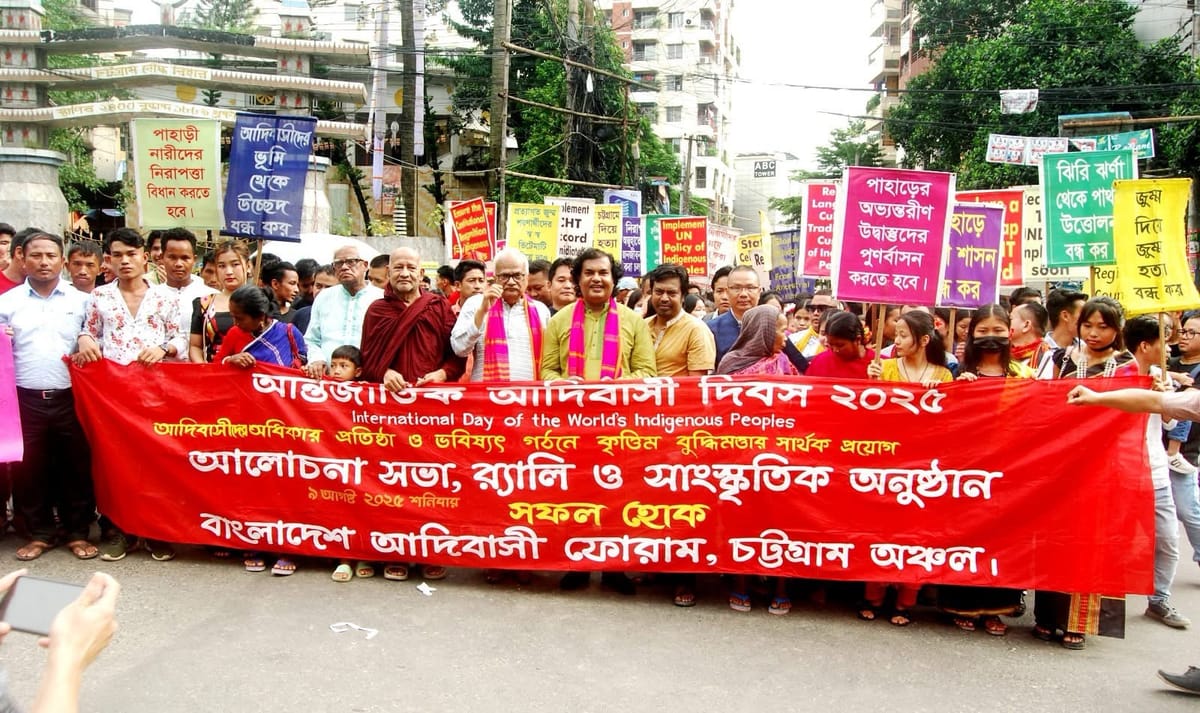
More importantly, the indigenous Jumma people that are approximately 1% of the country’s population, living in Chittagong Hill Tracts who faced the violations of Bengali settlers are erased from the political spotlight. The colonialism of Bengali settlers and the Bangladesh state against these indigenous tribals of CHT were considered as “genocide” according to International Work Group for Indigenous Affairs. However, since the independence, Awami League was the only party during all these years that offered limited inclusion for the indigenous communities and other minority groups, ranging from education quotas and access to affordable housing. Nonetheless, for the indigenous Jumma people, regardless of which party has the ruling power, the Bangladesh state as a whole failed to implement the 1997 Peace Accord, and is still conducting state sponsored settlements and forced Islamisation towards them. Conferring to the Parbatya Chattagram Jana Samhati Samiti (PCJSS), a political organization of the indigenous Jumma people of the Chittagong Hill Tracts (CHT), there were 268 human rights violations in 2025 alone towards the indigenous population living in the area.
In 1951, Hindus were 22% of the population of the East Pakistan (contemporary Bangladesh). By 1974, it decreased to 13.4% and now in 2020s, Hindus are about 8%, a tremendous drop in population over 70 years, reasons ranging from exodus to massacres. Parallelly, the original indigenous Jumma population composition of 98% in 1971 which included indigenous tribes namely Chakma, Marma, Tripuri, Tanchangya, Chak, Pankho, Mru, Bawm, Lushai, Khyang, and Khumi also decreased vastly to 49.94% according to Population Census 2022.
The current trend in Bangladesh is concerning given the remarkable similarities to the Iranian Revolution of 1979, in which the public rebellion against Shah Mohammad Reza Pahlavi was eventually appropriated by Ayatollah Khomeini's Islamist movement. Since religious and ethnic minorities are already suffering the most from the violence by paying the price for this political shift with their lives, the apparent hijacking of the "July Revolution" by Islamists poses an urgent and deadly threat to the nation's pluralism and secularism.