Preconditions and Prospects for a Second American Revolution

Perhaps now, more than ever, intellectual observers of American politics and the wider public are troubled by the prospect of a second American Civil War. The increased political polarization with President Trump looking to impose executive authority over state authority and the sharp ideological divide between democratic and republican constituencies make it seem as if the country could rift at any moment. However, what I believe Americans should really be thinking about is the prospect, not of a second civil war, but a second revolution. Crises of ideological legitimacy and political polarization can and do precipitate civil wars, but they also precipitate revolutions, where a revolution is defined as the overthrow of the existing social and, or political order. The United States, like many other countries around the world, was famously founded by a revolution in which colonies of Great Britain revolted against the monarchial mother country to establish a (at the time semi) democratic republic.
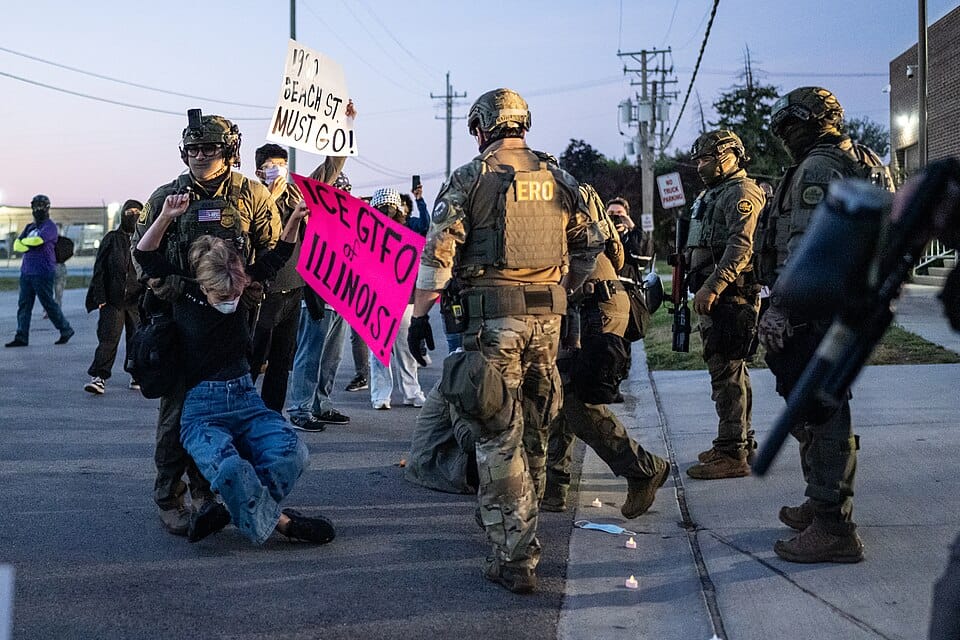
A year into the second Trump term I believe revolution is much more of an imminent possibility than civil war. Yes, the battle lines between the republican controlled federal administration and various red states and the democrat opposition with their various blue states have been drawn, but as loud as the MAGA cult is, it just does not represent a significant portion of American citizens. Trump's approval ratings are in the doldrums as his administration mismanages cost of living, terrorizes communities with ICE, and alienates itself on the international stage. Protests against the administration's attempt at illiberalizing American democracy have continued apace since its first days in power and the president's surge of ICE officers to speed up the process of turning America into an ethnocracy have generated in recent weeks massive demonstrations across the country including strikes on the part of organized labor and student lead demonstrations.
This kind of legitimacy crisis moves America dangerously into territory fit for a revolutionary upsurge. The basic ingredients for revolution according to scholars of revolution are widespread disillusion among both the public and elite where they come to believe that the system no longer works for them. These conditions are what create the motive social force leading to mobilization on the part of masses and elites. Italian Communist social theorist Antonio Gramsci analyzed legitimacy in a social system in terms of hegemony. Hegemony refers to the basic ideological grease for the wheels of social order. The dominant cosmological and social narratives handed down from leaders, the media, and the education system needs to serve the function of imbedding values in the different social classes that lead them to identify the existing social structure and mode of production with their own material interests. The breakdown of ideological hegemony thus opens the door for new narratives to be articulated by counterhegemonic social forces which have the capability to express the material interests of the exploited and marginalized classes in the restructuring of the social order.
Trump's attempts at illiberalization are rapidly convincing both elites and masses that, at the very least his administration, isn't working for them. While everyday people protest former security and intelligence officials have posted on social media reminding security personnel of their duty to resist unconstitutional orders (a key event in revolutionary processes is the abandonment of a regime by its security personnel). Thus, the floodgates are being opened for counterhegemonic social forces to express counterhegemonic narratives, whether they be oppositional voices in government, or the mainstream media lamenting the process of illiberalization, or protestors and civil rights groups opposing the repressive force of the state and the process of building ethnocracy, or organized labor flexing its muscle in solidarity with the protest movement.
Obviously, the other shoe has yet to drop. Trump has managed to hallow out a huge portion of the guardrails on executive power in his second term without provoking a much-feared constitutional crisis. For the time being the administration is only paying for its actions on the domestic and global stage with increasing animosity among the public and the international community. Trump has mostly been able to continue his ICE initiative despite regular complaints from lower courts. Liberal intellectuals are therefore still counting on the authority of the courts to reign in both the administration and its opposition in the streets to restore law and order. Such an approach is one of regime stabilization against revolutionary possibilities.
None the less, governments around the world have recently been subject to waves of protest movements that have sometimes completely ousted the existing regime. No doubt these countries are usually less important on the world stage and ultimately less socially stable than the United States, but the current administration seems to be breezing through surplus social stability. All of this is symptomatic of the conditions for revolution heightening globally as the global capitalist class expands its outsized control of the national state in ways that increase inequality and poverty, while decreasing the availability of crucial social services. This brings us to the broader concern of the conditions for the collapse of the capitalist world-system; increasing polarization which in turn decreases the ability of elites to continue to extract wealth from the lower strata of the population. Immanuel Wallerstein referred to such a situation as a "bifurcation" in the world-system, where neither the ruling, or oppressed classes see the system as working for them any longer and contended that the world-system entered such a bifurcation at the outset of the late 20th century as a result in the decline of the real production of goods and services relative to financial speculation.
Ultimately, unless we want to entertain the baffling delusion that the status quo ante is just fine, we need to consider the ultimate question of what ideological direction should guide counterhegemonic forces and narratives. Revolutions have been a constant feature of the modern world where one state has been tipped over after another to establish a new one. None of these revolutions, however, have constituted what socialists refer to as a social revolution; one where antisystemic social forces uproot the modern world-system and replace it with an alternate modernity. The United States, Britain, and France were established as constitutional forms of government by revolutions which actually paved the way for these powers to take the lead in developing the modern world-system, rather than doing anything to uproot it. First steps in social revolution were taken most importantly by communist and fascist movements in the 20th century. The ideological vision behind fascism was an anti-humanistic vision aimed the annihilation of the commercial and international political norms of the capitalist world-system in order to replace it with a revitalized and totalistic national community purified of alien elements. Fascism represented the nationalist, ethnocentric, and rational-scientific aspects of the capitalist geoculture turned in on itself and was thus annihilated by the leading forces of the world-system after carrying out the industrialized slaughter and state terrorization of national minorities across Europe. As a result, fascism retains a geoculturally irrelevant, but still deadly counterculture space for itself that occasionally manifests in hate crimes and terrorist attacks. Fascism as a counterhegemonic force is both spent and represents the ideological height of inhumanity.
The communist antisystemic social movement was guided by a radical humanist vision of a new industrial modernity organized on the principles of free association and rational allocation of social wealth according to the needs of all human individuals. From the 1860s onward communism rapidly concentrated ideological an organizational power in the hands of those within the movement pursuing what Wallerstein called the "two-step strategy'; take state power and then change society. The communists attempted to establish a centralized political power, largely through communist political parties and regimes, which carry out social engineering toward the communist future, while deploying repressive force against counterrevolutionary elements. The ultimate fruit was existing socialism, a form of political economy modelling itself on the Union of Soviet Socialist Republics with various modifications across time and space.
While at one point in the 20th century covering a quarter of the globe existing socialism was little more than an extremification of the 20th century model of state engagement with the capitalist world-economy in which social spending and protectionism were expanded with a view to economic development. Under existing socialism state directed capitalism took a neomercantilist approach in which public ownership of all industries and planning by the "nomenklatura" state bureaucracy was used to insulate the communist party-state's economy from world market competition in order to give it a competitive advantage. This was paired with a totalitarian ideology of repressive social mobilization under the auspices of charting the path ultimately to a communist society. In this way existing socialism often mirrored the bureaucratic inhumanity of the fascist regimes. Shifts in the world-economy away from developmental statism and the intolerable quality of life under existing socialism forced its collapse in popular uprisings and in some cases dramatic reforms taken on by communist regimes themselves. Today what we might call centralist communism persists among globally marginal socialist movements both in a form which is straightforwardly apologetic of existing socialism and in myriad forms which hope to construct centralized communist political powers without the totalitarian consequences of 20th century communism. The bankruptcy of centralist communism was simply, as Wallerstein put it, its central assumptions were wrong. Instead of empowering the working class and peasantry of the world to abolish class distinctions an bring about networks of rational free associations directed toward human development centralized political power required the communists to put expedience over their ideological goals and make post-hoc ideological adjustments later. Ideologically bankrupted, centralist communism no longer has a third of the world's population behind it and few among the masses will be willing to mobilize in its name after its 20th century collapse; the most success it has seen in recent decades has been stagnating Maoist insurgencies in countries such as India, Nepal, Peru, and the Philippines that typically fail as a result of lack of foreign backing.
In order to preserve itself the communist political power had to erect top-down mechanisms of command and obedience that mimicked the militarized hierarchical structure of all other major institutions in the capitalist world-system. World social transformation was thereby put off inevitably for the day-to-day bureaucratic concerns of repressing opposition and class struggle, enjoining the workers and peasants to go back to work in order to expand industry and the communist regime's economic dynamism, and balancing military competition with the other state powers against world-economic integration. This outcome was in fact predicted by the decentralist wing of the communist movement which was marginalized from the 1860s on. Anarchist Communists who insisted that communism could only be the product of the immediate demolition of all forms of centralized political power on the grounds of its elitist, self-reproducing nature, organized themselves into a geoculturally more marginal, but still international mass movement. In observing the failures of centralist communism new forms of Marxism (the version of communism which ideologically guided the centralist communists) such as council communism, councilism, Marxist-Humanism, and autonomism cropped up that groped toward the Anarchist Communist position.
The biggest geocultural success for Anarchist, or decentralist communism, was the social revolution in the Spanish Civil War from 1936-9 in which a millions strong mass movement took control of Spain's economically crucial regions under the leadership of the Anarcho-Syndicalist CNT-FAI labor associations. These regions were put under administration by urban worker cooperatives and agricultural peasant collectives allowing the working masses of the movement a high degree of self-determination and self-mobilization against the right-wing forces of general Franco. The movement was ultimately defeated by those forces because of a lack of international support from an international revolutionary movement and compromise by Anarchist leaders with the Soviet backed Republicans who often sabotaged and limited worker-peasant control. International Anarcho-Syndicalism, represented by the exile CNT immediately after the war, and especially since by the International Workers' Association which the CNT was a member of during the war, practiced self-criticism and recognized the crucial failures of the Anarchist leadership and today maintain the collective memory of what went wrong and right during the revolution.
With centralist communism and fascism in geocultural oblivion, the bifurcation of the capitalist world-system, steady erosion of the MAGAfied state's ideological hegemony in what today is still the most politically and economically important state of the capitalist world-system, and the geoculturally marginal, but international Anarcho-Syndicalist movement waiting to implement the strategic lessons from 1936-9, the second American revolution has the potential to be the one that finally establishes a truly humane alternate modernity. Potential is an important word since there are no guarantees. As stated above the IWA amounts to perhaps thousands worldwide, when it would need millions to constitute the kind of international movement necessary to shift the bifurcation in the direction of what Anarcho-Syndicalist G.P. Maximoff called "the communization of society". Most counterhegemonic social forces at this juncture are either lacking an overall ideological orientation, or are dominated by national varieties of left-wing and right-wing populism which focus on moralistic discourses that lend to the extension of the democratic state's repressive mechanisms and the terrorization of minority groups and lack the class struggle perspective to keep the bifurcation of the world-system in focus. Plus, the threat of catastrophic climate change continues to loom with the only real countervailing force being rank and file environmental justice movements forcing decisions in various courts. As Wallerstein emphasizes, bifurcations are intrinsically unpredictable, history is not intrinsically on anyone's side, so the human subject must flex its agentic muscles in order to create a better world. This is the existential choice we all must make in the 21st century.
Sources
World-Systems Analysis: An Introduction, Wallerstein
Communism: A Very Short Introduction, Holmes
Socialism: A Very Short Introduction, Newman
The Rise and Demise of World Communism, Breslauer
Understanding Marxism, Boucher
https://redandblackanarchists.com.au/instrument-for-curating-ethnocracy/
https://redandblackanarchists.com.au/the-path-forward-for-gen-z/
https://redandblackanarchists.com.au/anarcho-syndicalist-faq/
https://redandblackanarchists.com.au/trade-wars-decline-across-the-board-2/
https://redandblackanarchists.com.au/black-vs-brown-understanding-and-responding-to-fascism-as-an-anarchist/
https://www.youtube.com/watch?v=TK4AL4-j0xs
https://www.youtube.com/watch?v=7iYoH4dpfkQ
https://www.youtube.com/watch?v=2JMwIq1OgyA
https://www.youtube.com/watch?v=dfh_QCFijnk
https://www.youtube.com/watch?v=Yd9gaiNUBuY
https://redandblackanarchists.com.au/the-basics-of-anarcho-syndicalism/
Western Marxism and The Soviet Union, Van der Linden
Anarcho-Syndicalism in the 20th Century, Damier
https://www.youtube.com/watch?v=VM1ljyykjMY
https://youtu.be/B-bhdv3OQ4M
https://redandblackanarchists.com.au/trumpism-an-anarchist-view/