The Abduction of Maduro Speaks to the Weakness of the United States

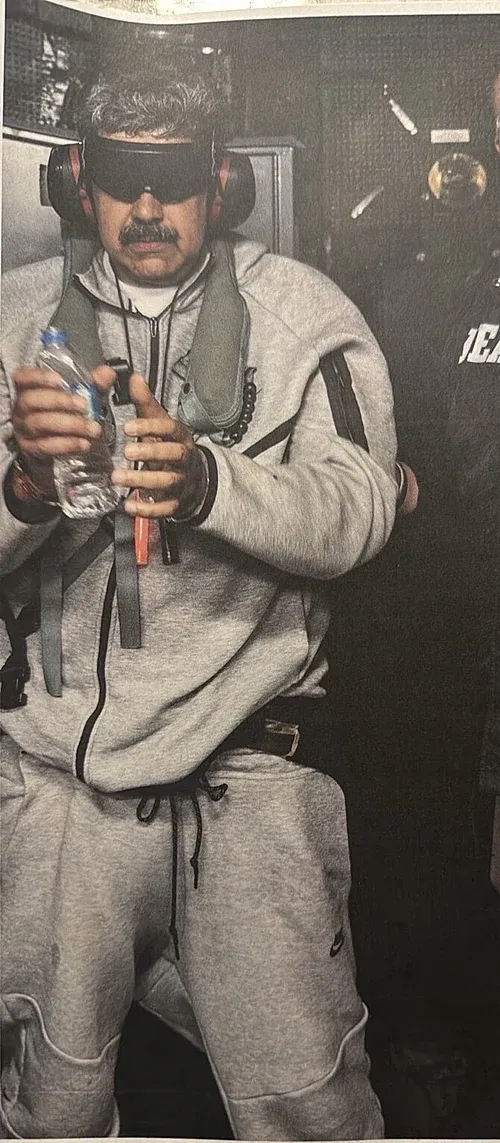
The United States has captured Venezuelan president Nicholas Maduro and his wife to try them in New York on drug trafficking. This was done via a large-scale military operation in which US forces bombed Venezuelan territory, at the time of writing it is unclear how many Venezuelans were killed. The abduction of Venezuela's sitting president follows months of the Trump administration stepping up its military presence of South America to historic levels and striking boats in Venezuelan waters killing well upwards of 100 people ostensibly in an effort to curb the entry of drugs into the United States, but without providing evidence that the boats were drug boats in what amounted to extrajudicial killings. Trump's remarks upon the abduction of Maduro seem to make it clear that none of this has been about drugs, stating that the United States will take an active role in Venezuela's oil sector going forward.
Ever since the coming to power in Venezuela of the "Bolivarian Revolution" the United States has mounted efforts at regime change. During the first Trump administration John Bolton was behind a failed coup to install an opposition leader as the president and topple Maduro after the former was electorally defeated. Documents have been made public outlining the United States plan to reassert itself in the region; to essentially get what it wants from any Latin American government it chooses. The Trump administration, after decades of coup attempts and crippling sanctions against the Chavez and Maduro regimes (regimes that took a hostile "anti-imperialist" posture to American power in the region), made the executive decision to simply snatch Maduro up in the night, as part of an initiative to impose total subordination to US prerogatives on Latin America.
Rather than speaking to US strength, the move in fact speaks to a generational evaporation of American geopolitical power. The US has failed since the beginning of the Chavez era to affect an actual regime change which would favor US interests. Likely knowing that a ground invasion would sap US resources and produce a chaotic outcome favorable to nobody, the Trump administration opted for an autocratically executed snatch and grab, leaving the Bolivarian administration in place with the hope of making it pliant to US demands. Accordingly, Trump has publicly cast aside any effort to install a new regime headed by opposition leader and Nobel lorette Gloria Machado. This speaks to just how incapable the United States really is of imposing its will even on a besieged enemy like Venezuela. The United States wanted a total regime change, but in failing to achieve this has been stuck with the daunting prospect of trying to apply brute force to the existing hostile regime. This is a far cry from the days of Cold War US backed regime change, it is a hallow imitation, a half measure.
The United States is in this position because it is no longer the hegemon of the world-system. After WW2 the United States, the only industrial power to emerge unscathed from the war and having defeated its generational geopolitical rival in the land power of Germany, was in a position to construct the geopolitical order in its own image. Every other state had to obey US directives around 95% of the time with Western Europe and Japan being reduced to US satellites and the erstwhile British Empire being reduced to the United States' junior partner. This hegemony is what allowed the United States to command Britain, France, and Israel to back off with simple presidential orders over the phone during the Suez Canal crisis.
The whole thing was premised on two realities. One was the leadership of the world-economy by US industries. The other was the existence of the Soviet Union as an ideological enemy, not to really combat, but to mobilize those under US control against. The first of these to unravel was US industrial leadership with US firms being beaten out by Western European and Japanese producers. Western Europe and Japan thus had to be promoted from mere satellites to partners of the United States with some sort of geopolitical power parity. Then, in 1991, the Soviet Union collapsed under its own weight. The west celebrated as if it had won an ideological contest, but what this really meant for the United States was that there was no longer any basis for the ideological mobilization of the world's states under US leadership, the cold war as a device for that mobilization was now spent.
The United States launched its wars in the middle east in the 2000s in an attempt by the Neoconservative Bush Jr. administration to reclaim US hegemony through brute force and intimidation, but to no avail. To quote social scientist Immanuel Wallerstein:
"The entire analysis of the neoconservatives turned out to be invalid. The war was not easily won. the reluctant allies (the erstwhile US satellites) were not intimidated into renouncing aspirations for independence, North Korea and Iran sped up their nuclear programs, recognizing that the reason the United States felt free to invade Iraq was that it did not yet possess nuclear weapons. And the Arab regimes were no closer to accepting an Israeli solution than they were before. In short, the entire endeavor had turned into a fiasco."
The Trump administration is simply repeating the machismo strategy, but this time in Latin America instead of the middle east. It appears to be more cognizant of the limitations of such a strategy than the Bush administration was, avoiding a costly ground invasion to dismantle the Bolivarian regime, for now at least. As we saw above, this is a further measure of the decline of US power. Trump's advisers are no doubt keenly aware of the failed adventures of their predecessors, having recently seen the Taliban, the group the United States drove out of power in Afghanistan, make a triumphant return upon the disintegration of the US installed Afghan government. So, pinched between a rock and a hard place, the Trump administration has seemingly launched a plot to intimidate Latin America by kidnapping the sitting president of a hostile regime, hoping to use this act as a springboard to control of Venezuelan oil. These machismo displays of force are typical of erstwhile hegemons clinging on to dear life for geopolitical power.
Chase-Dunn, Kwon, Lawrence, and Inoue put the point this way: "A more likely scenario for the next several decades is continued U.S. hegemonic decline and resultant economic and political/ military restructuring of the world-system. Here the scenario bears a strong likeness to what happened during the decline of British hegemony at the end of the 19th century, but with a few important differences. We have already seen some developments that are strongly reminiscent of the British hegemonic decline. The neoliberal "globalization project" was mainly a crisis-management response to a profit squeeze in manufacturing when Japan and Germany caught up with the U.S. after recovering from World War II. The rise of the neoconservatives and unilateral "imperial over- reach" was again crisis management in response to the obviously untenable position of the U.S. balance of trade that emerged after 1990. These and the rise of new economic competitors such as China and India are strong similarities to the earlier period of hegemonic decline. We have also mentioned the expansion of finance capital that was an important characteristic of the last phase of both British hegemony and of U.S. hegemony."
What Trump's advisors apparently don't understand is that if that machismo didn't work in the 2000s, there is no reason to expect it to work now. This action will give Latin American states even more reason to create alliances and institutions outside of the US orbit which can prevent a similar fate from befalling their leaders. It gives the rest of the world, enemies and allies alike, more reason to view the United States as a rabid dog unchained by the normal rules of geopolitics which will likely produce a pariah effect to the disadvantage of the United States. The more the United States hangs the prospect of more costly wars over its citizens heads the more unruly they will grow from the point of view of their leaders; this was demonstrated by opposition to both the Vietnam war and the 2000s mid-east wars. If human beings are to exit this dangerous geopolitical situation opposition to the erstwhile hegemon must grow, but not in the militaristic terms of competition between the United States and new contenders for the crown like China. Oppressed, marginalized, exploited, and downtrodden human beings must take this opportunity to organize and assert ourselves in favor of a world without the militaristic imperatives of the modern world-system. Otherwise, more of us will die to uphold the position of the rich and powerful.
Sources
https://www.youtube.com/watch?v=kaLChmzkGo0
https://truthout.org/articles/trump-is-gunning-for-war-in-venezuela-raising-fears-of-us-backed-regime-change/
https://www.youtube.com/watch?v=w6jdF6e0hLc&pp=ygUYdmVuZXp1ZWxhIGR3IGRvY3VtZW50YXJ5
Last of The Hegemons: US Decline and Global Governance, Chase-Dunn, Kwon, Lawrence, Inoue
Precipitate Decline: The Advent of Multipolarity, Wallerstein
The Eagle Has Crash Landed, Wallerstein
What Cold War in Asia? An Interpretive Essay, Wallerstein
https://www.youtube.com/watch?v=omjCJWdpWog&pp=ygUlYWxqYXplZXJhIGFmZ2hhbmlzdGFuIHdhciBkb2N1bWVudGFyeQ%3D%3D