The US Invasion of Venezuela and the Illusion of “World Peace”
The arrest done by the United States (US) under the Trump administration of Venezuelan President Nicolas Maduro and his wife through a military attack that devastated Caracas on 03 January 2026 is a form of political intervention by the US against countries that do not align with its geopolitical interests, including the interest in controlling natural resources. Trump openly stated that US companies would take over oil management in Venezuela, after justifying his actions as an effort to free Venezuela from the Maduro regime, which is accused as "a regime of narco-terrorism". What the US did to Venezuela is a repetition of US political intervention against countries considered its opponents, which has been carried out continuously in various other forms.
In 1965, the US intervened politically in Indonesia in an attempt to overthrow the Sukarno regime, which at the time was seen as close to communist countries. This effort resulted in the mass murder of millions of people deemed affiliated with the Indonesian Communist Party (PKI) and its affiliated organizations. This incident was later declared a gross human rights violation in 2012. After successfully replacing Sukarno with Suharto through this mass murder, Freeport, a US company, entered Indonesia in 1967 to exploit the land of Papua, a practice that continues to this day and is the reason behind countless other human rights violations.
Years later, the US did the same in Chile, in an attempt to overthrow the socialist government of Salvador Allende and replace it with Augusto Pinochet. Before the bloody military coup and Pinochet's eventual rise to power on September 11, 1973, graffiti was reportedly painted on walls in Santiago, Chile, reading "Jakarta Se Acerca" or "Jakarta is coming." The operation was later identified as "Jakarta Operation," as a repeat of what had been done in Indonesia several years earlier. The repetition apparently referred not only to the similarity in methods but also to the underlying motives. The US hated Allende's government because under Allende's administration, at least 350 factories, most of which were owned by US companies, were nationalized, including copper mines.
From what the US recently did to Venezuela under the Trump administration, to what the US did to Chile and Indonesia decades ago, everything was done for one reason only: control of natural resources, and investment – the same reason behind every colonialism that has occurred throughout the history of civilization.
The Failure of Nations
This repetition continues because there has never been a sanction mechanism from the international community capable of targeting the US, despite the fact that there is an entity created with the main purpose of maintaining global peace and security, with a mandate to impose sanctions. From the beginning, the United Nations Security Council (UNSC) which was established after World War II (WWII), was intended as an effort to prevent war, just as the United Nations (UN) was also formed after a similar initiative, the League of Nations, failed to prevent WWII.
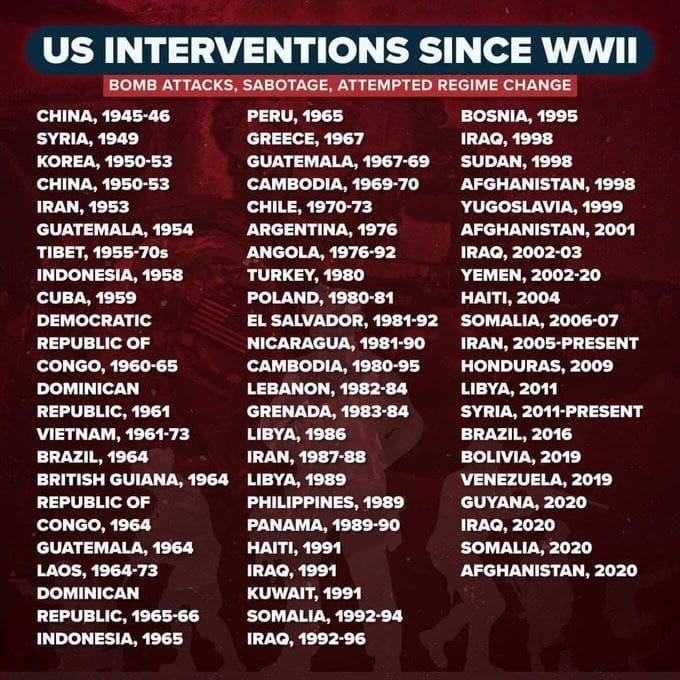
In fact, what the US has done in Indonesia, Chile, and most recently in Venezuela, are just three of the many US political interventions post-WWII. Various sources record at least 69 intervention attempts by the US from 1945 to 2020 alone, carried out in various forms such as bombing attacks, sabotage, and attempts to replace domestic political regimes. These US actions clearly violate international agreements enshrined in the UN Charter on maintaining peace and security, including the agreement to not interfere in domestic politics and not to attack other countries. However, the UNSC, which in the same document is mentioned as the only entity with the authority to impose sanctions on those who violate these provisions, has done nothing.
The problem lies in the institutional foundation of the UNSC, which has been problematic from the outset. Since the UN Charter, which serves as the basis for its institutional legitimacy, there has been inequality in the formulation of membership within the UNSC. Article 23 of the UN Charter states that 5 countries will always be permanent members of the UNSC: the US, the UK, France, China, and Russia. Currently, the provisions stipulate that the UNSC has 15 member states. With 5 permanent members, the remaining 10 member states will be elected on a rotating basis.
In its practice, to impose sanctions or other measures related to violations of the agreement to maintain world peace and security, the UNSC will issue a resolution. The requirement for a proposal to be adopted as a resolution is that it must be agreed to by at least 9 of the 15 member states. Unfortunately, the 5 permanent members of the UNSC have a power that the other 10 do not have: the right of veto. If even 1 of these 5 permanent members uses its veto, the resolution will never be created, no matter how much the other 14 members agree.
The rhetorical question then is: will the US, as a permanent member of the UNSC with veto power, allow the UNSC to issue a resolution to impose sanctions on it for an international agreement that it itself has violated?
After invading Venezuela and arresting Maduro, Trump then made public statements signaling that Mexico, Cuba, and Colombia would be the next US targets – and similar signals also was made by Trump almost a month before he carried out the threat against Venezuela, saying Maduro’s ‘days are numbered’ (Politico, 9 December 2025). And he hopes his fall will also bring down ‘the Cuban regime’.
Not long before Venezuela, Honduras also recently fell victim to US political interference. Ahead of Honduras's election on November 30, 2025, the US allegedly threatened tens of thousands of migrant worker families. In a phone message sent from a bank that handles remittances from abroad to approximately 90,000 migrant worker families in Honduras, the threat stated that if a left-wing candidate won the election, they should expect to lose their remittances in December from their family members working and living in the US. The outcome was predictable. The US-backed candidate won the election by a landslide.
Trump releasing these new signals exacerbates the situation and casts a dark shadow over the skies of Latin America. Reflecting on what has recently happened in these two Latin American countries, the US signals must be seen as a serious threat. Today, the Western Hemisphere is in the shadow of fear brought about by a new form of colonialism, manifested in the US's desire to dominate Latin America and strengthen its grip on the Western Hemisphere.
Unfortunately, we inevitably have to juxtapose these situations with the fact that the only entity mandated to maintain world peace is under the control of a country that never wanted world peace at all, and which today is the main culprit of the existing problems.
The existence of the UNSC as the sole entity maintaining world peace is the most tragic example of how nations around the world seek to establish themselves as the most relevant and legitimate entity in the role of safeguarding shared life, and then use this as an excuse to justify their role as the necessary entity, when they are unable to address the root of the problem. This is reflected in how the desire for power, which has always been the driving force behind all wars throughout history, has become an omitted variable in formulating solutions to these problems.
Ultimately, this is a historical failure, reflected in how these nations agreed from the outset that the sole entity intended to safeguard world peace from war would be concentrated in the hands of a few nations, which themselves have a long history of colonialism, which we know is always the cause of every war—leaving "world peace" a mere illusion.