Bolshevik Confusion and the Theoretical Bankruptcy of Anarchists

In the long and complex intellectual trajectory of political and social movements, a fundamental question has always come to the fore: which party, religion, philosophy, or ideology is genuinely capable of liberating human beings? In the realm of philosophical practice, the dialectical currents of the East and the West have given rise to a prolonged global confusion, because in the West, philosophy is understood as ontology, which has been misconstrued as an attempt to align with absolute truth, whereas in the East, philosophy has been viewed merely as a perspective. However, within the structural limits of their finite senses and neurological processes across ages, humans have only ever put forward increasingly advanced, subtle, and causally coherent theoretical models. Along this path of epistemological progression, traditional beliefs, ideological dogmatism, and stagnant dogmas have always served as the primary obstacles to human free intellect. Standing in direct opposition to this, kindling the flame of doubt is not only the primordial condition for acquiring knowledge, but also the sole tool for liberating thought from any dogmatist and materialist shroud.
Society and civilization are structurally established upon an illusion-bound belief, and the ordinary human mind feels comfortable organizing life within the safe haven of traditional and conventional beliefs, as this offers temporary relief from the blows of intellectual error or doubt. Yet, deep theoretical practice makes it clear that the utility of doubt is manifold greater than the indiscriminate permanence of belief; and linear idealism, which has taken deep root in human psychology for ages, has not only thwarted the ultimate aspiration for human emancipation, but has also turned the world of thought into a kind of confined prison. Escaping this confinement requires a structural transformation—one that is not merely a transfer of state power or capital, but rather brings about a radical change at every level, from the world of thought to the system of production.
The Structural Crisis of Marxism-Leninism and the Nature of Vanguardism
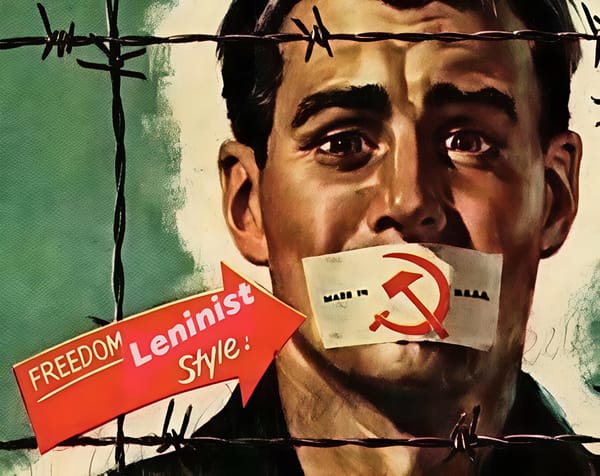
In light of this theoretical reality, no fundamental structural difference can be found between Marxist-Leninist or state-centric leftist factions and traditional dogmatism. The confined and centralized notion of the "vanguard party" nurtured within the theoretical framework of Marxism-Leninism is fundamentally opposed to the spontaneous liberation and decentralized power of the working class. Marxists-Leninists present themselves as the sole claimants of the inevitable course of history and absolute truth, and the blueprint they offer for societal transformation through an all-encompassing centralized state is, in the final analysis, just another name for ideological dogma or ossified intellect.
This party dictatorship or state-centric socialism is another form of exploitation where state bureaucrats replace capitalists as owners. From the religious belief groups prevalent in society to various political factions branded as "intellectuals" or "vanguards" in modern sociology—all are more or less victims of this ideological dogmatism. So-called revolutionaries or theorists are accustomed to viewing society through the lenses of specific political or party doctrines, and taking their own party concepts as absolute truth, they unthinkingly dismiss the independent self-organization, dissenting views, or criticism of the working class. Such bureaucratic dogma renders the pursuit of knowledge and free thought linear and rigid.
My practical experience with these parties in Bangladesh has been extremely bitter. Whenever I opposed the theoretical fallacies of Bolshevism and advocated for direct action and the control of the means of production through workers' own federal union or cooperative structures, these Marxist-Leninist parties condemned me as a CIA agent, a confused person, or suffering from an "infantile disorder." However, because my theoretical foundation was built on understanding our position from a historical perspective rather than depending on the mercy of any central political party or leader, I left the reformist parties, and they left me. Yet, some recent developments have astonished me—how these Leninist parties are receiving support from international anarchist groups, even though their policies and ideals lie at completely opposite poles.
Epistemological Bankruptcy and the Position of Anarcho-Syndicalism
When a specific ideology or party line is proclaimed as unquestionable truth, it denies the multidimensional dynamism of matter and disrupts its laws. Marxist-Leninist ideologies always seek to imprison the world and revolution within their own party frameworks, which amounts to epistemological bankruptcy. Anarcho-syndicalism by birth stands at the exact opposite pole of this bureaucratic and party authoritarianism, because the true progress of human civilization has not been achieved through the hand of any specific immutable belief or party leader, but rather by continually kindling the fire of doubt against established blind faith to unlock new horizons of knowledge and science. Thus, to this day, I view myself as an anarcho-syndicalist.
I believe that science does not operate in a vacuum or from a seat of unbiased interstellar space, and it has its own methodological paradigms or biases. Before achieving self-consciousness, the human brain must pass through a long biological and chemical process, the primary condition of which is the oxidation process occurring in the brain caused by matter. Although consciousness evolves through this biological process and the ego or claims of absoluteness of the individual gradually fade away, because society and human consciousness are constantly changing, when dialectics is turned into a structural tool of a political party or state and labeled with absolute truth, it is not merely a theoretical error, but equivalent to intellectual fascism. Anarcho-syndicalism never seeks to seize a state machine and forcefully issue commands to workers; rather, it believes that the state itself is an instrument of exploitation, and therefore the abolition of the state and a federation of independent workers' unions are its primary goals.
The Contradiction of International Workers' Solidarity and Theoretical Confusion
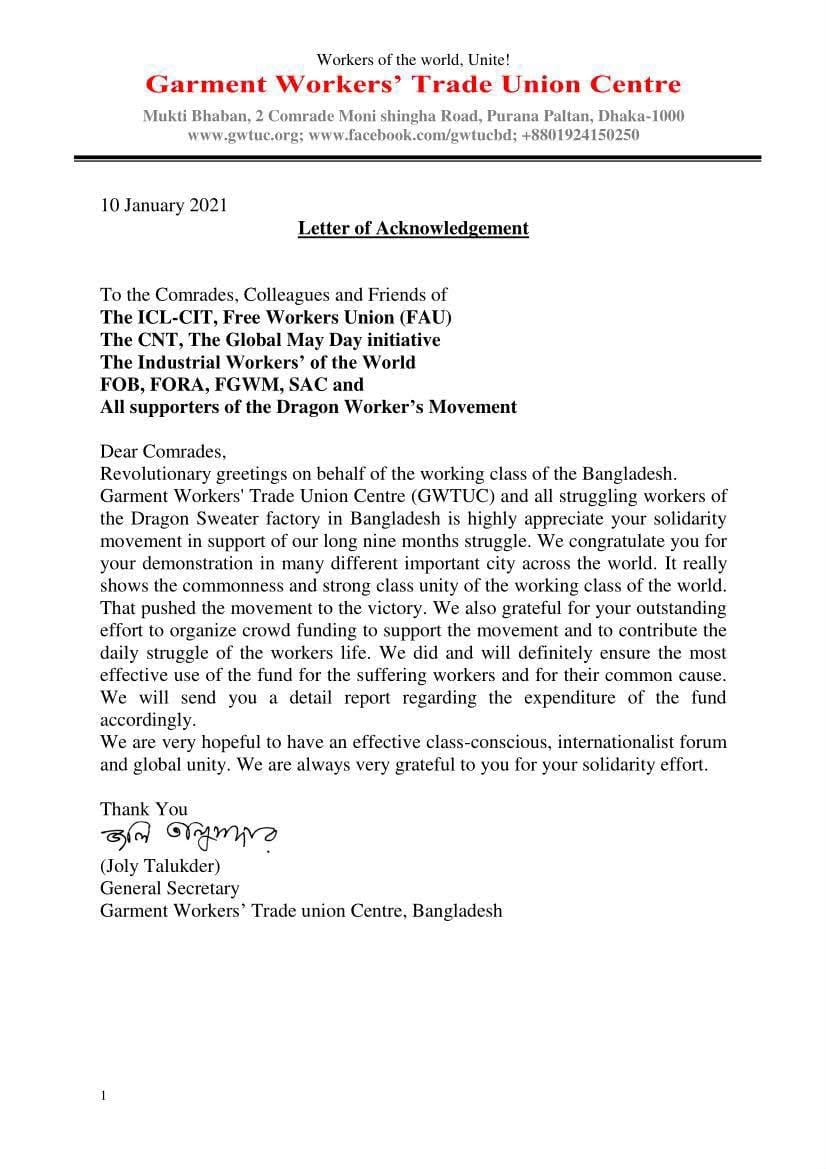
Against this backdrop, it is notable that when Bangladesh-based Leninist trade unions like the Garment Workers' Trade Union Centre (GWTUC) accept solidarity and financial assistance from international anarchist or radical syndicalist organizations (such as FAU, CNT, ICL-CIT, etc.), a profound theoretical contradiction and confusion arises. On one hand, Leninist parties believe in bureaucratic central leadership and the politics of state capture, while on the other hand, anarcho-syndicalist international networks fight for the establishment of a stateless, decentralized, and independent workers' federation. This contradiction is not merely theoretical; it severely damages the labor movement in practical terms as well.
Because varying senses create different experiences under the nuances of space, time, and environment, it is natural for different individuals to assign different values to the world. Consequently, arriving at an advanced, unified, and coherent theoretical model requires doubting one's own beliefs, learning from the experiences of others, and critically judging various theoretical models. Yet, Marxists-Leninists deny this multidimensionality and seek to impose a single party line, which is utterly incompatible with anarcho-syndicalist free social thought. They believe in a single linear and absolute model or formula for social transformation—such as capturing the bourgeois state, single-party dictatorship, and the eventual utopia of state dissolution. No matter how clear contemporary observation may seem, the past and future always oscillate across a vast spectrum of probabilities, and anarcho-syndicalism rejects this linear transition or the concept of state control, standing on an entirely distinct anti-authoritarian foundation by birth.
Party Line vs. Individual Freedom: Ideological Intolerance
From religious dogmatism to various political and theoretical doctrines—especially within the Marxist-Leninist party culture—a specific entrenched belief operates that makes them completely intolerant of differing views. In the Leninist tradition, the "party line" or the decision of the party's central committee is the final word, where the independent intellectual practice of ordinary workers is strangled in the name of party discipline. However, anarcho-syndicalist theory places maximum emphasis on independent thought and personal autonomy, where the purpose of skeptics is not to discover some absolute truth, but to find justified belief and subsequently transform that belief into an improved theoretical model through continuous revision based on new evidence.
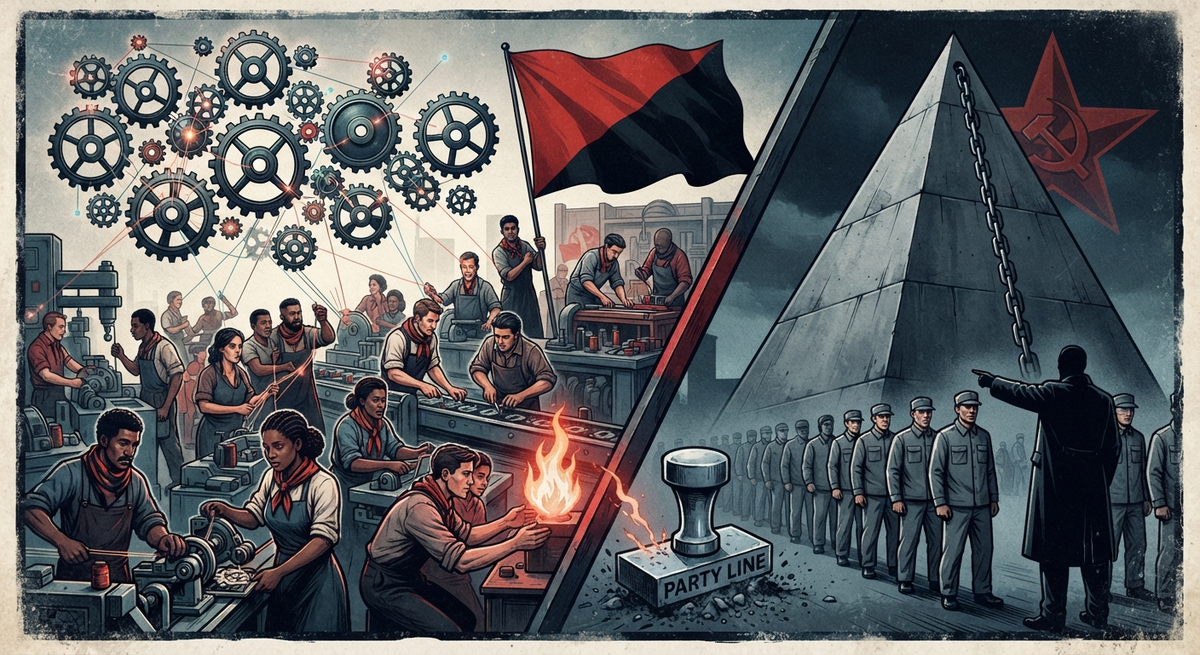
The way to escape Marxist-Leninist structural dogmatism and blindness is to embrace this scientific skepticism, because when Marxism-Leninism claims the course of history to be immutable and its own party as its sole proponent, it transforms into a form of historical fatalism. Conversely, for anarchists to support or assist any Marxist-Leninist group essentially means directly opposing the core ideals and free thought of anarchism. This dual-faced stance of anarchist and Leninist groups in the name of international solidarity confuses the global labor movement. These two currents can never merge theoretically or practically, because Marxists want to establish a top-down imposed central state power and bureaucratic control, whereas anarcho-syndicalism seeks to establish bottom-up decentralized federal democracy and the control of independent workers' unions.
The Illusion of State Power and New Forms of Exploitation
It is never possible to reach a stateless or classless society by utilizing the structures of the state, because the centralization of power invariably gives rise to a new exploiting class. Failing to realize this truth and lending support to or locking arms with Marxists-Leninists means, by extension, denying the core philosophy of freedom and autonomy inherent in anarchism. Consequently, religious superstition or the linear ideology and party vanguardism of Marxist-Leninist groups narrow human thought and obstruct the pursuit of truth, which is completely contradictory to the theoretical stance of anarchists or anarcho-syndicalists. True workers' liberation is only possible when the means of production are not handed over to a bureaucratic state, but come directly under the control of the workers' own federal framework.