IWA Campaign Against Wage Theft in Korea
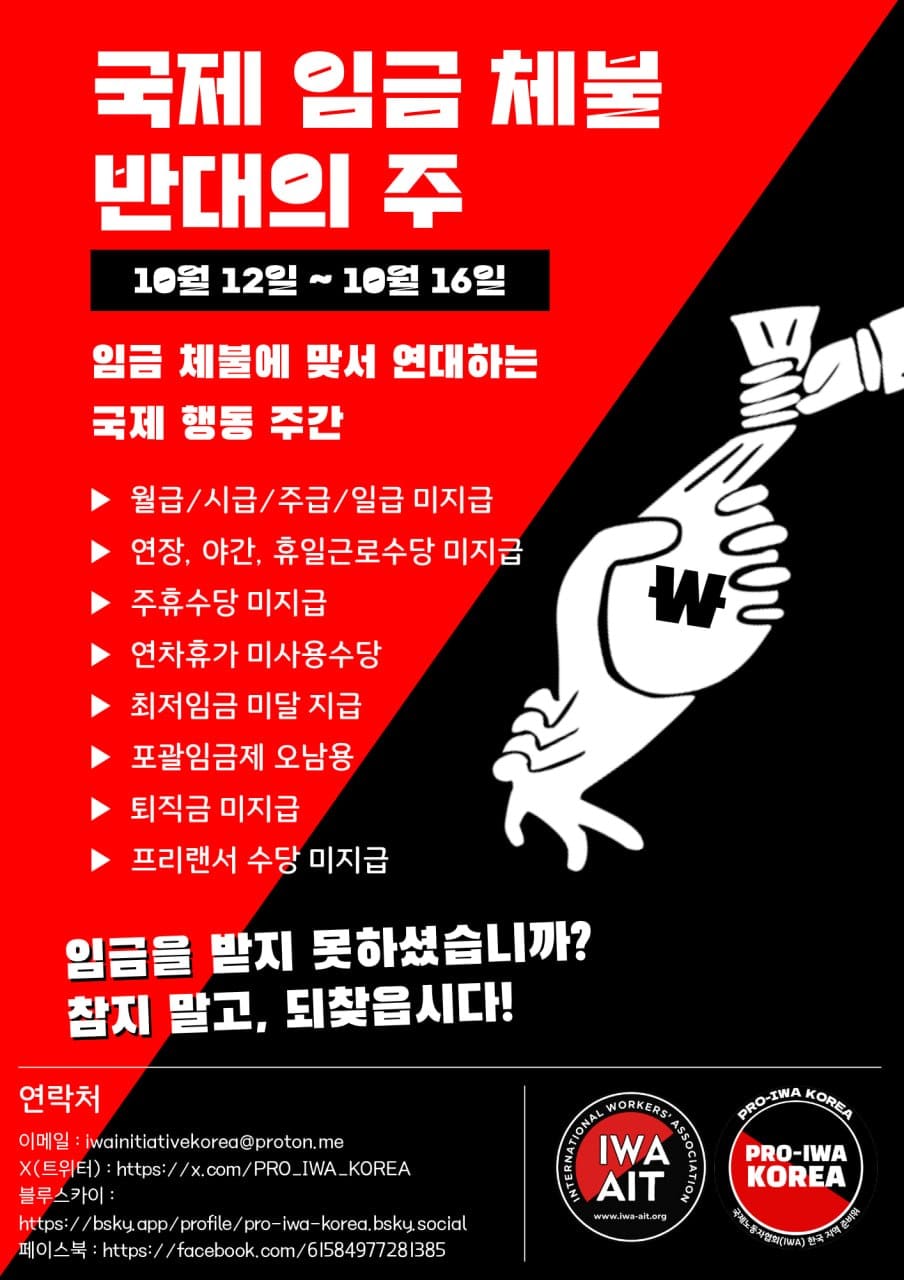
Every year in October, the International Workers' Association (IWA-AIT), a global federation of anarcho-syndicalist organizations, launches its annual campaign against wage theft.
This year's campaign will take place from October 12th to October 16th.
Officially launched in 2020 and celebrating its 6th anniversary this year, this campaign aims to expose all forms of wage theft that plague workers worldwide and encourages direct action to reclaim stolen rights.
Wage theft, in this context, is not simply about employers delaying salaries by a few days.
Any scheme or illegal practice used by employers under a capitalist system to reduce labor costs and maximize profits constitutes wage theft, not just wage delay.
These acts of wage theft occur across borders and, in particular, in South Korea, subtle forms of capital exploitation and structural wage theft continue to this day.
First, there is the deprivation of rights disguised as legal compliance. This refers to the practice of forcing workers, even those under the supervision and control of employers, to become "sham freelancers" or enter into service/civil contracts to save on labor costs and avoid obligations related to four major social insurance programs and severance pay.
Even the courts have recognized a de facto employer-employee relationship in some cases, such as with youth soccer team coaches and sports instructors, and have ordered the payment of vacation pay and severance pay regardless of the contractual title. However, capital continues to exploit loopholes in contractual arrangements to steal workers' legal rights.
Second, there is the normalization of unpaid labor. In IT, office, and manufacturing settings where working hours can be clearly defined and accurately measured, the practice of deducting overtime, night shift, and holiday pay under the guise of a "comprehensive wage system" is a prime example.
The Supreme Court has repeatedly affirmed that comprehensive wage agreements are invalid when working hours can be accurately measured. Recently, the Supreme Court also rejected the notion of an implied comprehensive wage agreement for intern doctors and recognized their right to overtime pay.
Despite this, employers manipulate work records or simply do not keep them, effectively exploiting workers' hard labor for free on a daily basis.
Third, there are illegal practices targeting vulnerable groups such as young people and those new to the workforce. Unlawful "unpaid probationary periods" are often imposed on young people and those new to the workforce who lack knowledge of labor laws, resulting in the exploitation of their labor without compensation. Even reductions in wages during the probationary period, as stipulated by the Minimum Wage Act, are only permitted under strict conditions, but these are often ignored in practice.
Furthermore, exploitation occurs by imposing illegal penalties and reducing wages for migrant workers who are vulnerable due to their precarious immigration status.
Although the Labor Standards Act prohibits penalties and discrimination based on nationality, cases of employers forcing these illegal contracts by exploiting vulnerabilities in immigration status or employment relationships are also problematic.
Finally, there is a subcontracting structure designed to evade responsibility.
The multi-layered subcontracting structure, involving main contractors, subcontractors, and staffing agencies, is a facade created by the main contractor to avoid legal responsibility for workers.
When subcontractors go bankrupt or abscond, leaving unpaid wages, the main contractor often claims that "it was only a contract between the subcontractor and the worker," effectively shirking their responsibility. While the current Labor Standards Act Article 44 and the revised Wage Claim Guarantee Act partially stipulate joint and several liability for the direct superior contractor, the national legal system narrowly recognizes the main contractor's responsibility, leaving loopholes for the main contractors to exploit.
As a result, the livelihoods of subcontracted workers are left vulnerable to structural risks.
How have workers around the world fought back?
Branches of the IWA in Spain, Poland, Australia, and Slovakia, among other countries, have not relied solely on complex court rulings or decisions by national agencies.
This is because legal and national systems often favor employers or are designed to delay action, exhausting workers.
Instead, workers have chosen direct action.
This includes:
* Continuous protest picketing in front of businesses that withhold wages and publicizing information about these businesses.
* Boycott campaigns targeting businesses and consumers that deal with unscrupulous employers.
* Activating strong mutual aid networks between workers in the field.
Through these direct actions, IWA branches have achieved numerous victories, recovering stolen wages for precarious workers, subcontractors, and migrant workers that were ignored by the legal system.
These struggles have not only resulted in the recovery of stolen money but have also empowered workers to regain confidence in their ability to organize and make decisions for themselves, independent of employers and the state.
The following are translations of the IWA's 2024 and 2025 reports into Korean:
https://drive.proton.me/urls/87C6JJB9ZR#B2EjyPIlN3jy
https://drive.proton.me/urls/2EFN4TQFC0#Ij0cw6rjM8wu
To our worker comrades in South Korea
Practice small acts of solidarity in your workplace.
Today, many workplaces in South Korea are experiencing wage theft through practices such as comprehensive wage systems, sham self-employment, and legal exceptions for businesses with fewer than five employees.
Although the IWA preparatory committee (now an affiliated organization) in South Korea is currently small and may not be able to immediately launch large-scale labor unions for direct action, we want to share the lessons learned from the struggles of our comrades around the world with Korean workers.
The most powerful weapon against wage theft is not relying solely on the state or lawyers, but solidarity with your fellow workers.
Record: Every time you start work or arrive at the workplace, take photos, record working hours, record the employer's instructions, and record deposit details. Share this detailed information with your colleagues.
Don't be silent: This is not just your problem. Talk to your colleagues to see if they are experiencing similar problems in the same workplace.
Speak out together: Employers are not afraid of isolated individuals. However, they are afraid of collective direct action by workers standing together.
The society we dream of is not simply one where workers receive fair wages from "good" employers. It is a society that transcends the capitalist system, which destroys workers' lives and the environment for profit, and where workers, as the producers, manage the workplace themselves and care for each other.
Let's start by speaking out against even the smallest and most unjust wage theft in our workplace, on this International Day of Action against Wage Theft.
The IWA Korea Preparatory Committee will always extend a hand of solidarity to your efforts.
In solidarity with workers around the world!
International Workers' Association Korea Preparatory Committee (PRO-IWA KOREA)
Contact: iwainitiativekorea@proton.me
X (formerly Twitter): https://x.com/PRO_IWA_KOREA
Facebook: https://www.facebook.com/profile.php?id=61584977281385#
Bluesky: https://bsky.app/profile/pro-iwa-korea.bsky.social