Struggle: Marxist vs. Anarcho-Syndicalist
A brief critique of Marxist theories of the 'dictatorship of the proletariat', 'vanguardism', and 'moral-idealism'.

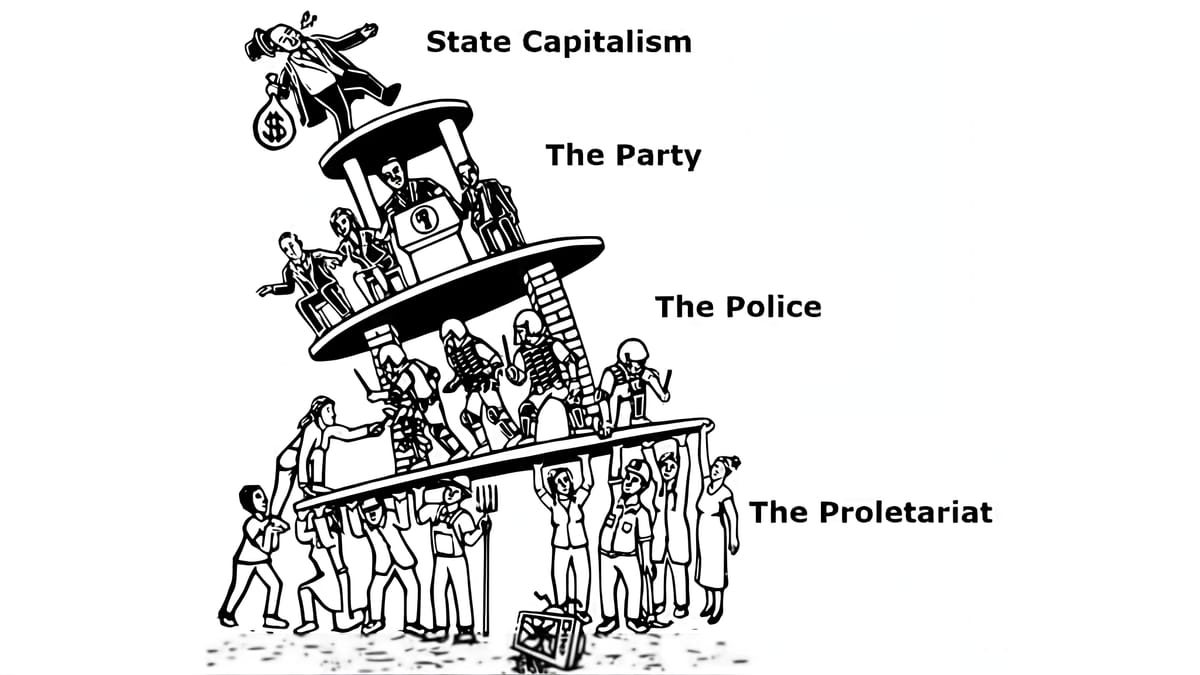
In the long trajectory of classical socialist politics, the concept of capturing the state and the theory of the dictatorship of the proletariat were established as the mainstream of the leftist movement. However, against the backdrop of modern political and social crises, their effectiveness has today come face-to-face with a profound question. The struggle against capitalism cannot conclude simply by dismantling one center of power and establishing a new one, because the inherent bureaucratic and coercive character of the state apparatus is fully capable of devouring and usurping the core ideals of any revolution. Throughout various chapters of history, whenever state power has been seized through a vanguard party or a specific political organization, it has been observed that the grand promise of liberation with which the working class took to the streets ultimately degenerated into a rigid party and bureaucratic dictatorship. Today’s political and theoretical crisis highlights the reality that this traditional and centralist path of capturing the state is not only irrelevant, but also counterproductive to the comprehensive emancipation of the exploited people.
In classical Marxism and Leninism, the concept of the dictatorship of the proletariat assumes that after destroying the bourgeois state apparatus, building an interim workers' state is imperative, because the state is fundamentally a class instrument of the exploiters. According to proponents of this theory, in order to transition to socialism, workers must also seize the state through coercion, take state power into their own hands, and manage society. Yet, in practical and historical reality, severe flaws in this concept have been repeatedly exposed. The state is inherently a co-opted, mechanical, and coercive institution; imagining that one can reach a classless and stateless society through its internal structure by taking control of it is nothing more than a political utopia or a chimera. History testifies that whenever supreme state power has been concentrated in the hands of a specific party, group, or leader, that power has ceased to ensure the collective liberation of the working class and instead begun to protect the interests of a special political and bureaucratic privileged class. Power becomes authoritarian and egocentric by its very intrinsic rules, leading to the emergence of a new ruler in place of the exploited.
Facing this structural crisis, when this centralist arrangement of state seizure begins to fail one by one within Marxist-Leninist or radical leftist streams—especially across various political camps following renowned theorists like Shibdas Ghosh—or when the leader's arbitrariness and bureaucratic coercion become pronounced, theorists begin to place excessive emphasis on the practice of "morality" and "self-purification." According to their narrative, cadres or comrades must possess flawless moral character so that no coercive or power-hungry mentality develops within the leadership. Yet, the cruel spotlight of reality strikes right here, because many such revolutionary activists and theorists are seen sacrificing their personal lives, family comforts, and the golden hours of their youth entirely while remaining confined within a strict circle of rigorous morality and rules. In this relentless and mechanical pursuit of theoretical purity, only skeletal frameworks remain of their bodies and minds, yet they can never attain the desired egalitarian morality or a free human society devoid of the lust for power. The root cause of this is that the problem is by no means one of personal moral lapse, but rather entirely structural. In a system or structure that itself stands upon the centralization of power, the expansion of dominance, and coercion, it is impossible to permanently eradicate the mentality of coercion and repression from an individual through thousands of moral lectures, because fundamental structural flaws can never be corrected solely by the excellence of individual character.
When we imagine a situation outside of this degenerated structural system—where the majority of the world's workers are not yet comprehensively prepared for revolution, but at that very moment, the working class or toiling masses of a specific country spontaneously unite and create an unimaginable and irresistible situation—a new horizon of revolution unfolds. In this state, the workers' collective resistance, strikes, boycotts, gheraos, and their soaring unified voices shake the foundations of the bourgeois state, forcing the state to surrender to their economic and social demands. In other words, it is entirely possible to establish the massive social hegemony and moral authority of the working class in society without directly capturing the state apparatus, which completely devalues the illusion of traditional state power. When millions of working people collectively begin to control production, distribution, and the overall wheels of society, there is no separate need for the command or decree of any state or general, because this real, collective influence and solidarity of the workers is history's only unstoppable force.
To make their revolution successful and meaningful under these conditions, globally revolutionary workers must not remain confined within the borders of their own country; simultaneously, they must build a powerful global network or international solidarity and openly reveal the living results of their domestic struggle to the world. They must share a real and concrete experience with workers in other parts of the world—how united workers can permanently halt the cruel wheels of capitalist exploitation and oppression. This international interaction and mutual exchange of experiences can transform the isolated struggle of a single country into a stepping stone for the liberation of the global proletariat.
The traditional Marxist concept of state seizure and party dictatorship has historically proven to be bankrupt and ineffective, bringing chains instead of liberation and offering nothing other than the spiritual sacrifice of cadres. In contrast, the core theme of the decentralized workers' movement is the permanent abolition of the state and the direct transfer of the burden of societal management into the hands of the producers themselves. Abandoning the illusion and delusion of capturing the state, the united resistance of toiling people, spontaneous movements, and the expansion of their economic and social dominance at every tier of society constitute the only logical and definitive path for the liberation of the exploited. The ultimate emancipation of the proletariat never comes from the whim of any leader, party decree, or bureaucratic fatwa; it comes solely and exclusively from the collective solidarity of the exploited people, international networks, and the irresistible expression of their independent power.