On the Question of Ethno-Nationalist Burmese Federal State: in Favor of Geographical Multicultural Federalism

Regarding "Bamar State"
Today, the political and federalist demand for a "Bamar State" has become a preliminary political and federal roadmap for a third-way coalition outside the NLD/NUG factions.
Why is a "Bamar State" Needed?
The political and federal demand for a "Bamar State" has emerged due to several reasons.
In the article "The Eight-State Principle Must Be Fundamental" published in the May 2022 issue of New Society Journal (Vol. 3, No. 10), the author Lun Nway Nyein from Democratic Party for a New Society wrote:
· "It is completely unacceptable for any single ethnic group to hold disproportionate rights or powers under any pretext. To be precise, it is unacceptable that the Bamar ethnic group has taken 7 units while other ethnic groups have taken less."
Similarly, quoting an interview on Federal FM titled "Why a Bamar State Should Exist" with Maung Saungkha, commander of the Bamar People's Liberation Army (BPLA):
- To establish an equal state-structure, a Bamar State must be included. This will foster an understanding of ethnic fraternity between Bamar and non-Bamar groups.
- The term "Pyi-ma" (Mainland) should no longer be used as it implies greater importance; instead, it should simply be called the "Bamar region."
Thus, I understand the political and federal demand for a "Bamar State" as an effort by other ethnic minority groups to check the political overreach and excess federal units claimed by successive rulers—from U Nu to U Ne Win, down to present-day leaders—who claimed to represent the majority Bamar ethnic group.
At the same time, when discussing the federal structure of the state alongside the "Bamar State," we can observe ongoing debates over whether the design should be purely ethnic-based, geographic-based, or an ethno-geographic hybrid model.
In an excerpt from Essential Interim Constitution in 2022 (Part 10) broadcast by NST, U Aung Htoo, an influential intellectual regarding the law (especially the constitutional laws) and the founder of the Legal Aid Network stated:
- “States flying a nationalist flag should be designated as "National States."
- “New states can be formed if other existing states accept them (e.g., Kachin, Shan).”
- “States inhabited by a diverse mix of different ethnic groups should be designated as ‘Multi-National States’ (e.g., Yangon Region).”
In a September 21, 2022 interview with CNI News, Saya Than Soe Naing, a former member of Communist Party of Burma who currently is a heterodox political commentator remarked:
· "Our country cannot be organized purely along ethnic lines, nor can it easily be divided purely by geography. We need to consider both factors together."
The Historical Concept of a "Bamar State"
To trace the concept of a "Bamar State" back through history, we must start with the Eight-State Shan Federal Proposal.
Around 1960, when the Shan Proposal was first presented to the public, U Tin Aye, a lecturer at the Yangon University Translation Department, was among its key proponents.
I also recall reading from past interviews that in 2013, Dr. Aye Maung, chairperson of the Rakhine Nationalities Development Party, discussed the eight-state concept at the Taunggyi Conference of the Nationalities Brotherhood Federation (NBF) in Shan State.
Furthermore, the concept of a "Bamar State" was reportedly deliberated during the first session of the Union Peace Conference held in Naypyidaw in 2016 (pro-military agenda).
"Bamar State and the Eight-State Model"
In the article "The Eight-State Principle Must Be Fundamental" in the May 2022 issue of New Society Journal (Vol. 3, No. 10), author Lun Nway Nyein wrote:
· "No ethnic group should hold excessive rights, power, or territorial units, whether formally or substantively. The Bamar ethnic group must take a single Bamar State, just like the other ethnic nationalities. This is what it means to base our system on the Eight-State principle."
Similarly, Dr. Aye Maung, chairperson of the Rakhine Nationalities Development Party, once remarked regarding the Eight-State Model:
· "To shape a genuine Union, the Amyotha Hluttaw (House of Nationalities) must function as an Ethnic Chamber. The seven administrative divisions should be merged into a single Mainland State."
Unpacking Bamar Chauvinism
We can approach majority Bamar oppression through three distinct lenses:
1. State-Based Bamar Oppression
This is straightforward. Successive military leaders who seized state power—from U Ne Win to U Than Shwe—forcefully claimed to represent the Bamar majority through the barrel of a gun. Consequently, Bamar people themselves have struggled under the banner of the pro-democracy movement to reclaim their representation from this military-bureaucratic apparatus. From this perspective, the genocides, atrocities, and human rights violations committed by consecutive military dictatorships were not carried out by the Bamar people, but rather by a military-bureaucratic class operating under the label of "Bamar," while the Bamar population itself was oppressed, suffered violence, and resisted.
Listening to BPLA Commander Maung Saungkha’s interview on Federal FM (April 2023) titled "Why a Bamar State Should Exist," a thought comes to mind:
- He pointed out that ethnic minority communities often say, "When the army enters, the Bamar are entering."
In reality, the Bamar public—represented by ordinary citizens—has sacrificed countless lives and shed much blood to demonstrate that the military (the military-bureaucratic class) and the Bamar people are not the same. Yet, Commander Maung Saungkha offered no further clarification on this distinction.
Historically, this military-bureaucratic class masqueraded as Bamar to evade accountability for its actions. It is heartbreaking that critics fail to realize that conflating the identity of the military-bureaucratic class with the Bamar people directly plays into the interests of that very apparatus.
We must highlight the distinction between the military bureaucracy and the Bamar population. Otherwise, hatred framed behind nationalist banners will never fade.
2. Cultural Chauvinism
This dimension is what gives Bamar chauvinism its distinct form. Slogans like "Bamar literature is our literature; Bamar language is our language" have spread beyond Bamar-majority regions into ethnic states. Furthermore, because Bamar-majority regions enjoyed greater socio-economic development, this reality evolved into a form of cultural hegemony.
Similarly, in historiography, the histories and cultural heritages of non-Bamar ethnic groups have undergone a process of Burmanization. This stemmed from the Bamar holding seven territorial units, coupled with their superior socio-economic position and the systematic Burmanization policies enforced by successive military regimes.
3. Individual-Level Chauvinism
Through state education and pervasive propaganda, individual Bamar citizens have been indoctrinated with chauvinist mindsets. Even if an individual enjoys ethnic food or has friends from ethnic minorities, they remain subconsciously shaped by chauvinism in terms of language, culture, and historical perspective.
In the same Federal FM interview, BPLA Commander Maung Saungkha correctly highlighted:
- "Although the Bamar suffered under the military dictatorship, they never had to flee war zones, never faced systemic discrimination, and never struggled to obtain national identity cards. Without proficiency in the Bamar language, however, social and educational advancement remains difficult for ethnic minorities."
The Common Enemy
In a news article published on February 19 by CNI News titled "Is Forming a Bamar State Possible?", Dr. Hla Kyaw Zaw from Communist Party of Burma noted:
· "An ethnic leader once said: 'It is our duty to utterly destroy the main common enemy; after that, we will resolve remaining issues among brothers and sisters.'"
In a September 21, 2022 interview with CNI, Than Soe Naing, a former Communist but currently a heterodox political commentator voiced a similar sentiment:
· "Only after the military dictatorship is dismantled and the 2008 Constitution is abolished can we sit down and negotiate. If we insist 'I won't stop until I get my state, and you get yours,' our country will never see peace."
In truth, this represents an evasive approach to an urgent problem. It completely ignores the political realities of Myanmar and reflects a short-sighted viewpoint.
The Given Political Realities of Myanmar
Under Myanmar's current political conditions, revolutionary principles vary significantly by region and nationalist framework.
In the mainland lowlands, the pro-democracy movement has flourished. In the highland ethnic areas—where people lack access to basic national symbols, native language recognition, historical dignity, and socio-economic opportunities—demands have centred on federalism, self-determination, and autonomy under their respective nationalist flags. Following the political shifts of 2021, these two streams appear to have converged.
However, neither mainland nor highland ruling classes (elected political parties, the military, ethnic armed organizations, or other political factions) have ever deeply addressed or provided real solutions to economic inequality, class divide, and class exploitation.
In other words, a fundamental aspect of Myanmar's political reality—the wealth gap and economic inequality—is inextricably linked both to federal self-determination under nationalist banners and to the pro-democracy movement in the lowlands.
Why Do Revolutions Happen?
Critically assessing the question "Why do revolutions happen?", they arise out of oppression, unbearable living conditions, national instability, and poverty. When a country or region prospers and every resident—indigenous or migrant—shares in its wealth, those who lack the privilege to study politics will remain trapped in the daily struggle for survival.
Ethnic Nationalists Among the Oppressed
A passage from Fukido's book Mahn Ba Zan and the Karen Revolution (pp. 196–197) offers a notable illustration:
· "My father—who opposed the subjugation of one race by another, firmly embraced multi-ethnic solidarity, and rejected both dominant-group chauvinism and narrow nationalism—was bitterly opposed to intermarriage. He believed intermarriage would give rise to a host of unwanted mixed-race issues."
We must recognize the reality that ethnic hatred and extreme nationalism can exist even among oppressed groups. The New Black Panther Party (distinct from the original Black Panther Party) was a Black nationalist group that fought white anti-Black racism. However, figures like Quanell X and other members harboured anti-Semitic and extreme Black nationalist views, leading former members of the original Black Panther Party to publicly disavow any connection with the new party.
Federalism and the Right to Secede
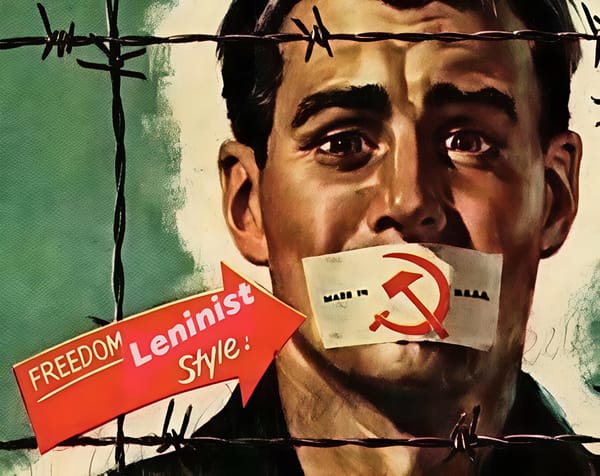
The assertion that federalism inherently includes the right to secede was first propounded by Joseph Stalin. This concept was later cited by Myanmar political leaders, including General Aung San.
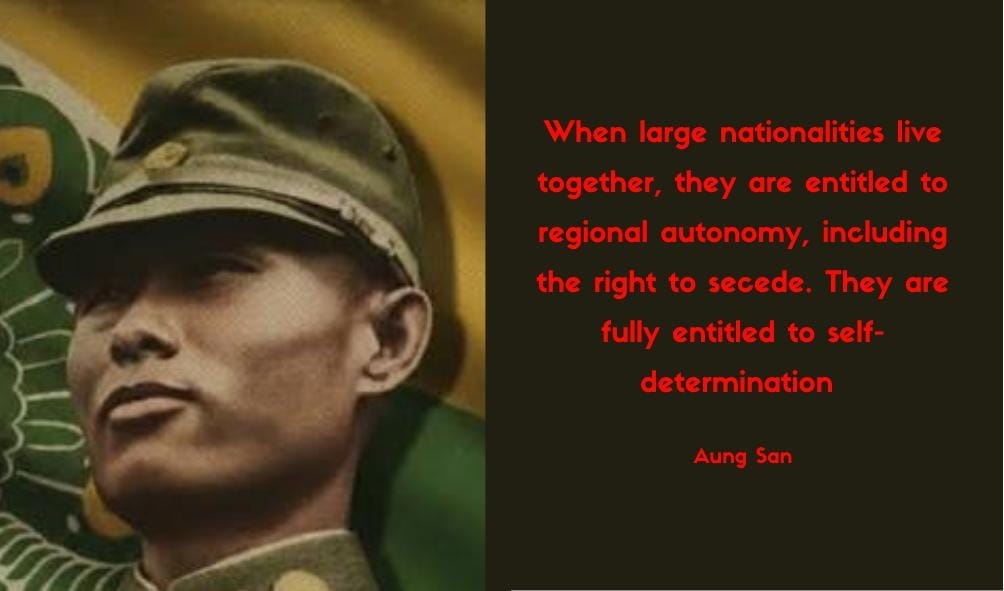
On May 20, 1947, during the AFPFL Preliminary Conference, General Aung San cited Stalin when discussing the right of self-determination:
· "When large nationalities live together, they are entitled to regional autonomy, including the right to secede. They are fully entitled to self-determination."
(Source: True Historical Events Compilation Committee, Ethnic Minorities Issue and the 1947 Constitution, Vol. 2, 1990)
The Burma Socialist Programme Party (BSPP) and U Ne Win—who seized leadership of the Bamar population by force under the guise of leftist socialism—also accepted Stalin's premise that federalism equals secessionism, taking an intensely anti-federal stance. The propaganda slogan "Non-disintegration of the Union is Our Cause" was incorporated into the "Three Main National Causes" and drummed into the public's ears daily before movie screenings in cinemas.
In an interview commemorating the 75th anniversary of the People's Democratic Armed Struggle, Comrade Po Than Chaung from Communist Party of Burma stated:
· "We will avoid anything that breaks up the country. If anyone tries to secede, we will persuade them to stay."
This line of thinking is similarly evident within the Communist Party of Burma (CPB). Modelling themselves after Mao Zedong's China and Stalin’s USSR, generations of CPB leaders—from Thakin Than Tun, Thakin Chit, and Thakin Zin to Comrade Po Than Chaung today—held views on union non-disintegration quite similar to those of military dictators Ne Win (of Burmese Way to Socialism) and Than Shwe. In effect, while the CPB and the BSPP were mortal enemies over political power, their underlying ideological assumptions regarding nationality issues were nearly identical. This is why non-Bamar ethnic groups used to say, "Red Bamar or Brown Bamar, they speak with one voice," reflecting the view that both factions shared a Bamar-chauvinist core.
This persistent "non-disintegration of the union" narrative continues to influence contemporary political groups like the NUG/CRPH, which claim to hold progressive revolutionary ideas yet maintain that federalism does not include the right to secede.
While older ethnic armed organizations scaled back secessionist ambitions after decades of failed military efforts, the Arakan Army (AA) has revived the demand. Under the slogan "Not an Arakan State, but an Arakan Nation," the AA stands today as a powerful force demanding a confederation beyond traditional federalism. This signifies the emergence of political demands far more radical than standard federal proposals.
The Historical "Bamar Lenin"
Left-wing ideas have long saturated Myanmar's political history. Yet, among these self-described progressive leftist politicians, none possessed a political vision robust enough to withstand 21st-century realities or withstand historical scrutiny. Thakin Ba Hein lacked this capacity, as did Thakin Than Tun, Thakin Chit, Thakin Zin, Thein Pe Myint, and others.
Until I came across Comrade Kyin Maung's critique of Thakin Soe in his Collected Articles, I believed that no 20th-century Myanmar revolutionary leader could meet 21st-century standards. Comrade Kyin Maung noted: "If the White-Flag CPB took one stance, Thakin Soe's Red-Flag group took the exact opposite. If the White-Flag CPB favoured a centralized unitary state, Thakin Soe advocated 'One Nationality, One Federal Unit.'"
This made me realize that a Bamar-led political force had indeed attempted to systematically integrate both national identity and class struggles. There is a vast gap between present-day political groups—who remain trapped in the anti-secession narrative and insist federalism excludes secession—and Thakin Soe's 20th-century political vision, which embraced a confederate foundation without abandoning class struggle.
Hence, BPLA's assertion that it is the first Bamar-representing armed force to advocate for a Bamar territory is at best a linguistic technicality; politically, it reflects a misunderstanding of history.
The Problem with Ethno-Based Federalism
An ethnicity-based federal system is outdated, impractical, and ultimately undermines unity among diverse ethnic groups. It risks reducing politics to populist identity battles where groups view each other as rivals for political power and representation. Factions that champion ethnic federalism behave much like neoliberals in economics—failing to address the root causes of systemic problems due to shallow political analysis.
If an ethnicity-based federal system is implemented, minority populations living within majority-dominated states will constantly struggle for political space. Trapping people inside ethnic identity politics will keep the public divided under nationalist banners for generations. It hinders the working class, farmers, and the impoverished across all ethnic groups from uniting against the local ruling class.
In a "Bamar State," non-Bamar ethnic minorities would likely come to view the Bamar majority and other minorities as political adversaries in the competition for representation and power.
The same dynamic would play out in "Kachin State," where non-Kachin minorities would view the Kachin majority in a similar manner. Interestingly, while Bamar constitute the nationwide majority, Bamar migrants in Kachin State exist as a local minority. When fighting for their political rights as a minority group against the Kachin majority, will they be viewed as colonial occupiers—akin to Jewish settlers in Israel/Palestine—or as ordinary migrant minorities? Under such intense ethnic friction, building cross-ethnic class consciousness would take decades.
Since revolutionary awareness is forged during periods of struggle, we must ask whether political forces pushing ethnic federalism—such as the BPLA, armed groups, NGO/CSO-funded activists, and paid researchers—will take responsibility for the working-class suffering that this system will cause.
A Kachin capitalist, elite, or bureaucrat shares far more structural interests with a Shan capitalist, elite, or bureaucrat than with a Kachin rickshaw puller. Conversely, a Kachin rickshaw puller shares far more in common with a Shan rickshaw puller. Having a wealthy Kachin in parliament or cabinet does nothing for the daily life of a Kachin rickshaw puller in a Bamar State. However, having a Bamar rickshaw puller in government would benefit that Kachin rickshaw puller immensely. Similarly, having an impoverished Kachin worker in the Kachin State government would benefit a Bamar migrant worker far more than having a Bamar tycoon in power.
Those who doubt this dynamic should consider historical precedents. On February 22, 1947, the KNU, Karen Youth Organization (KYO), and All Burma Karen National Association (BKNA) met and issued six demands:
- Allocate 17 Karen parliamentary seats across Insein, Bago, Hanthawaddy, Tharrawaddy, Pyapon, Dawei, and Myeik constituencies, and reserve 25% of Governor's Executive Council cabinet posts for Karen representatives.
- Reserve 25% of Constituent Assembly seats for Karen representatives.
- Permit the creation of an independent Karen National Army.
- Establish a Karen State with sea access within the Union of Burma.
- Guarantee proportional Karen representation across administrative departments.
- Conduct a population census after forming the Constituent Assembly.
Demands 1, 2, and 5 clearly reflect the historical cycle of identity-based seat allocation described above.
What Federalism and Confederation Should Be
Ethnic affairs researcher Khoon Mark Koban once outlined three levels of national identity:
- Union National Identity
- State National Identity
- Ethnic National Identity
During a Lemyethna “Four Corners Dialogue” panel discussion which I myself am a panellist, BPLA founder Maung Saungkha as a panellist, admitted himself: "I acknowledge that ethnic-based federalism is outdated, and that geographic/state-based federalism is the standard model we should aspire to."
True political leaders must strive to implement what should be, not merely what is convenient. In political theory, settling for short-term feasibility while placating the masses is called tailism. However, since the Bamar public largely rejects the concept of a "Bamar State," advocating for it cannot even be described as “true tailism” as it simply lacks popular backing.
Because a population develops revolutionary consciousness primarily during times of upheaval, political leaders should present radical, transformative visions during a revolution rather than recycled, step-by-step reformist models that failed before the October Revolution.
Borrowing from Lenin and Rosa Luxemburg, proposing step-by-step reformist paths during a revolutionary moment is opportunistic, politically naive, and counter-revolutionary. It dampens the public's revolutionary fervour. Claiming to lead the masses while dragging down their political momentum is a disservice to the revolution.
If we fail to present a proper geographic-based federal model now, it may take decades or centuries before another revolutionary moment arises to build one. Political groups advocating flawed models must account for the unnecessary division, hostility, and hardship their choices will inflict on ordinary people. Incrementalism sounds appealing in parliamentary politics, but during a radical revolution, it acts as a dead weight on the public's aspirations.
Minorities Within Minorities and Self-Determination
In an interview with The Irrawaddy titled "The Very Concept of a Mainland State is Flawed," Ko Mya Aye, an 88 generation ex-political prisoner and a well-respected liberal democrat made an insightful observation:
· "Do not fixate on rigid unit numbers like 14, 8, or 7. Within ethnic groups, there are always 'minorities within minorities.'"
He added:
· "Federalism cannot be designed according to one's personal preferences; it has established universal values. We must abandon the mindset of 'I give, you beg' and instead build a new Union together as equals."
"The Bamar State is a Placebo"
Re-evaluating "Bamar privilege" through Maung Saungkha's April 2023 Federal FM interview:
If ethnic nationalities no longer face:
- Military oppression operating under a Bamar label,
- War and displacement,
- Systemic discrimination,
- Barriers to obtaining identity documents,
- Restrictions on using their native languages in school curricula,
- Obstacles to writing their own history,
- Religious repression,
- Unequal citizenship rights under a federal structure, and
- A lack of full democratic rights—
Why would oppressed ethnic groups continue to rally under narrow nationalist banners?
If these core issues can be resolved, we could transition toward geographic-based federalism and self-determination rather than ethnic nationalism. Why spend time chasing the "Bamar State" placebo instead of tackling the root causes directly?
If Maung Saungkha's premise that "A Bamar State is required to eliminate Bamar privilege" holds true, then once the above mentioned Bamar privileges cease to exist:
- Will nationalist-flag federalism still be necessary?
- Will a Bamar State still be needed?
These remain critical questions.
From Class Struggle to Nationalism
In some political discussions, certain commentators displayed a sense of moral superiority, asserting:
· "Formerly, we also rejected identity politics. We changed our perspective after learning about the struggles of non-Bamar ethnic groups during the civil war."
As someone of mixed Bamar, Kachin, Shan, and Bengali heritage—who has never been fully categorized as "Bamar" by Bamar society—I reject this posturing.
Early in World War I, Mussolini was an anti-war, anti-nationalist (internationalist) socialist focused on class struggle and rejected the imperialist war. Later, after observing the wartime struggles of his fellow Italian people, he abandoned class politics, embraced identity-driven nationalism along with anti-imperialist national liberation war, and that transformed him from a socialist into a fascist. Turning away from class struggle to embrace identity politics is not a political upgrade—it is a downgrade.
Non-Reductionist Politics
Not all reductionism is bad, but because political forces are interconnected, true liberation requires an intersectional approach. Criticizing ethnic federalism or championing class struggle does not mean rejecting ethnic rights altogether, nor does it mean adopting the dogmatic postures of the BSPP or CPB.
In a DVB panel discussion titled "Nationalism: Trap or Way Out?", Kyaw Win, a former Communist Party member turned progressive liberal made a balanced observation:
· "Nationalism has deep historical roots and immense staying power. When analyzing it, we should not take a dogmatic side and completely dismiss the other."
We can build an egalitarian society that rejects all forms of oppression without setting class struggle and ethnic rights against each other. The Black Panther Party in the United States serves as an instructive example.
The Black Panther Party fought racism while promoting Black empowerment, yet they never abandoned class struggle. They allied with working-class white workers carrying Confederate flags to fight economic exploitation together. This demonstrates that class struggle and national identity are not mutually exclusive extremes.
As a Black Panther leader famously stated:
· "We don't fight racism with racism. We fight racism with solidarity. We don't fight capitalism with Black capitalism; we fight it with socialism."
Similarly, Thakin Soe's Red Flag Communist Party raised the slogan "One Nationality, One Federal Unit" while maintaining a focus on class struggle in the 20th century. Today, we must move past race reductionism, self-serving interest politics, and liberal elite paradigms (of careerist iNGOs and CSOs). Looking through an intersectional lens, we must stand in solidarity with the most oppressed, guided by principle and justice.
Conclusion
A "Bamar State"—and ethnic-based federalism in general—offers no long-term solution for the future. It acts like a temporary painkiller for an infected wound rather than the necessary surgery. It is a superficial remedy that fails to address root causes, remaining an unproven hypothesis.
From a strategic perspective, the call for a "Bamar State" is little more than astroturfing, and neoliberal political posturing.
Methodologically, whether a "Bamar State" should exist must be decided through self-determination by the people living within those prospective boundaries—not dictated by people residing outside those regions, whether Bamar or other ethnicities. Anyone who rejects this principle does not truly believe in self-determination.
Just as with a "Bamar State," every state and region in Myanmar retains the right to split, merge, or alter its status under the principle of self-determination. Only by respecting this core principle—even if it means acknowledging the ultimate possibility of the Union dissolving—can one truly claim to be progressive, genuinely pro-federal, and opposed to all forms of oppression.