The Bankruptcy of Capitalism and Religion, and the Revolutionary Journey of Anarcho-Syndicalism

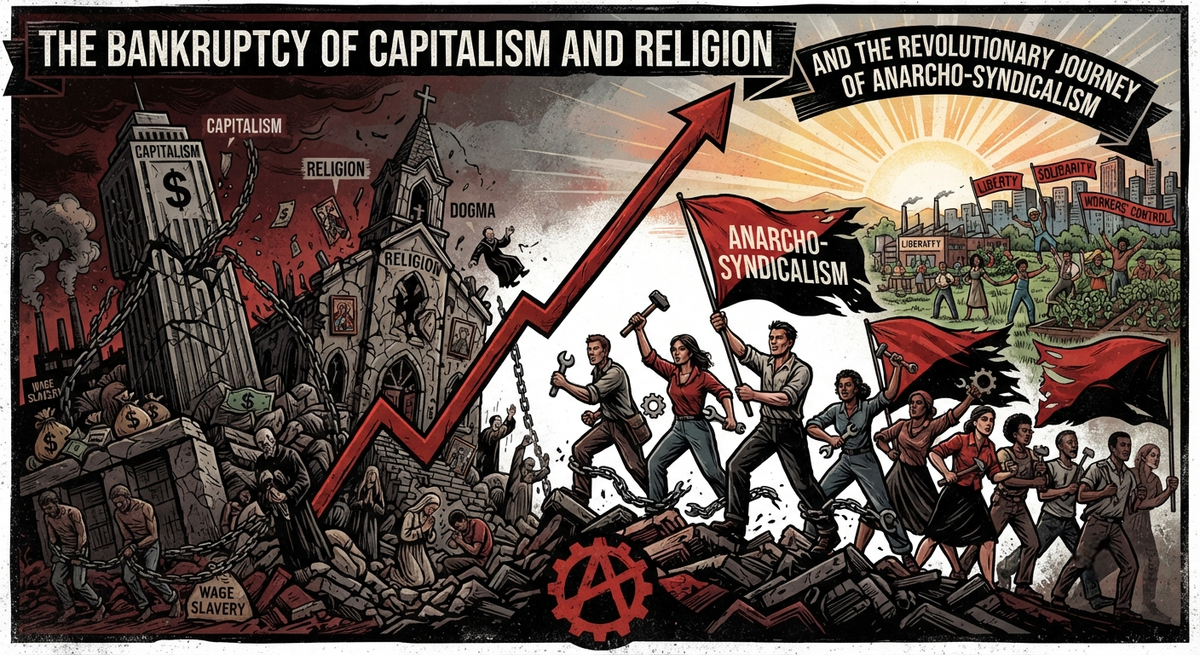
In the long historical trajectory of human civilization, two primary forces have most extensively controlled and shackled the human mind and society: capitalism and institutional religion. In this critical and complex era of the twenty-first century, both of these forces have reached the absolute limit of their all-encompassing failure. The mechanical profit-centrism of capitalism and the blind dogmas and opium of the fear of the hereafter propagated by religion have jointly cast human civilization into a bottomless abyss of endless emptiness and repression. From this historical and theoretical vacuum emerges anarcho-syndicalism, like an indomitable Promethean force. Interpreting anarko-syndicalism merely as a conventional political doctrine or an outline for a mere shift in governance power fails to capture its true depth. It is fundamentally an all-encompassing intellectual manifesto for liberating human existence from the primal and relentless crisis of being shackled by the triple chains of the state, capital, and religion.
Wherever profit-centric capitalism has commodified human labor and turned the human soul into a slave to machines, and wherever institutional religions have blocked the path of human worldly liberation and independent wisdom by shrouding it in the fear of the hereafter and unrealistic illusions, anacho-syndicalism steps forward with the message of a revolutionary perspective. The core objective of this philosophy is a cohesive theoretical transformation aimed at liberating human society—trapped in the nets of the primal struggle for existence, psychological repression, the commercialization of education, the tragedy of love, and religious superstition. Standing in opposition to the mechanical millstones of capitalism and the invisible prison cells of religion, anarko-syndicalism does not merely speak of the narrow boundary of economic rights; rather, it lays the philosophical foundation for humanity's total liberation, the re-establishment of self-identity, and the creation of a self-governed, egalitarian world order.
1. The Mechanical Millstone of Capitalism and the Commodification of Human Existence
The primary and fundamental machination of the capitalist mode of production and its derivative corporate culture is to completely transform human existence, reducing it merely to an economic productive force or an element of bone-breaking labor. From childhood, the way the younger generation is imprisoned in the mechanical chains of rote learning within the institutional factory called "education," driven behind the golden deer of GPAs, certificates, or degrees, and having their creative minds crippled, operates as a far-reaching economic exploitation machinery. This educational system does not create free-thinking humans; rather, it produces an army of loyal, low-wage corporate slaves whose sole purpose in life is to keep the profit wheels of the owning class turning and to sell themselves off according to market demands.
When continuous unemployment, the severe blows of inflation, the endless trap of student loans, and the humiliation of constant defeat in the struggle for survival combine with this, modern humans transform into the exact embodiment of Sisyphus from Greek mythology. Much like the endless and meaningless labor of pushing a stone up a mountain peak, the life of the modern working-class person has today been reduced to a futile daily struggle for mere survival. Individuals here hold no control over their own labor; they are merely minor spare parts of a larger production machine that can easily be replaced once worn out.
Simultaneously, the capitalist social system has also commodified human love and psychological longing. The pure and undefiled form of love that was supposed to blossom in human hearts as a remedy for primal loneliness has today been lost behind the glare and artificiality of market economics. That heavenly feeling of love—whether it be Platonic ideals or the immortal longing to love a beloved from afar—has now been reduced into a passing, cheap, and transient thrill wrapped in the commercial packaging of corporate culture. In the era of dating apps, Valentine's Day marketing, and social media likes and comments, love has transformed into a mere commodity for purchase.
When individuals become utterly disillusioned by this mechanical, self-centered, and loveless reality, the state and capitalist system push them toward the mirages of narcotics, pop-culture frenzies, the addiction of consumerism, or mechanical orgasms to provide temporary relief. However, these artificial veneers can never erase the internal primal loneliness and existential crisis within humans; instead, they deepen and intensify the crisis further. Individuals suffer from a deep sense of alienation within themselves, slowly turning them into mechanical puppets.
2. The Institutional Form of Religion, Patriarchal Repression, and the Prison of Superstition
On the other hand, the institutional forms of religion and their dogmas have consistently played a conservative, erroneous, and repressive role in this long journey toward human liberation. Since ancient times, under the guise of explaining the mysteries of the physical world and nature surrounding humans, religion has trapped them in a web of miraculous, unscientific, and immutable decrees that have brutally suppressed independent human thought, curiosity, and creative essence. Whenever religion has assumed an institutional form, it has transformed into a center of power, joining hands with the ruling class to bind ordinary people in the chains of mental subjugation.
In particular, the joint snare of the patriarchal social system and religious decrees imposing absolute control over women is one of the deepest tragedies in the history of human civilization. Society has long sustained through the guise of religion all psychological maneuvers—such as social certificates of chastity, blind and unscientific superstitions built around menstruation, barbaric practices like female genital mutilation prevalent in various cultures, and the labeling of women as subordinate property or slaves to men. By using various metaphors of heavenly scriptures and the terrifying fear of hellfire and divine punishment in the afterlife, all legitimate rights of humans in this earthly life, protests against injustice, and rebellious desires have been strangled to death.
Consequently, whenever individuals attempted to question this social exploitation using their intellect, conscience, and scientific vision, they were dragged before religious tribunals and branded as "atheists," "deviants," or "temptations of Satan." They were stripped of all social dignity or driven toward physical elimination. This strange and sinister alliance between religion and capitalism has cast humanity into an eternal conflict, where people on one hand desire the development of their free intellectual self, while on the other hand, the fear of religion and the greed of capital drag them down into the bottomless abyss of repression. Religion keeps humans dependent by making them lose faith in their own strength, trapping them in illusions of miraculous salvation, which ultimately serves the interests of the exploiters.
3. The Theoretical Foundation of Anarcho-Syndicalism and a Stateless Society
Upon the soil of this dialectical and harsh reality, anarcho-syndicalism initiates its historical journey as an indomitable alternative. Unlike Marxism or other centralized state-socialisms, anarcho-syndicalism does not believe in any compromises or bureaucratic illusions of seizing state power. Historical experience has proven that smashing the bourgeois state apparatus and establishing another all-encompassing centralized state in the name of the working class or revolution leads to the centralization of power and births a new bureaucratic ruling class, which ultimately continues to exploit ordinary people just as before.
The core philosophy of anarcho-syndicalism is that the state itself is a repressive, bureaucratic, and exploitative machine; therefore, true human liberation is impossible by keeping the state intact or merely changing hands at the helm. The state maintains oppressive institutions like the police, military, courts, and prisons for its own interests. Thus, rather than reforming or capturing the state, its main goal is its complete abolition and the establishment of a decentralized, self-governing society.
Anarcho-syndicalism relies directly on the direct solidarity, unions, or syndicates of the working class and ordinary people. Here, all means of production and distribution—factories, land, technology, transport, and social wealth—will not be monopolized by any capitalist owners or a central government, but will instead be managed directly under the cooperative and democratic control of producers and working people. Factory workers will themselves decide how production will be run, how profits will be distributed, and what the working environment will be like. There will be no intermediaries or capitalist exploiters. The full dignity and fruits of labor will rest directly in the hands of the workers.
4. Rejection of Political Intermediaries and the Movement for Free Intellectual Cultivation
In this philosophy, there is no need for political intermediaries, parliamentary farces, or so-called revolutionary leaders; instead, every individual becomes the full owner of their own labor and the definitive architect of their own destiny. Parliamentary democracy or political party-based governance is essentially a subtle corporate farce designed to deceive ordinary people, where only the faces of the exploiters change every five years while the fundamental structural form of exploitation remains unchanged. Anarcho-syndicalism completely rejects this parliamentary hypocrisy and calls for direct democracy, where ordinary people solve their problems through direct discussion within their respective workplaces and communities.
Anarcho-syndicalism seeks to uproot this vicious cycle of capitalist exploitation from its very roots, ensuring that no more humans have to endure the endless and meaningless agony of pushing stones up mountain peaks like Sisyphus. Rejecting the commercialization of institutional education, it demands an environment of free intellectual cultivation that molds individuals not into corporate robots, but into independent thinkers, rationalists, and creative beings. Anarcho-syndicalism advocates for a type of humane education where there is freedom to question, an unhindered flow of thought, and a harmonious relationship between humans and nature.
At the same time, anarko-syndicalism declares an uncompromising rebellion against all social superstitions, patriarchal oppression, and psychological repression carried out in the name of religion. This philosophy holds that social and economic liberation can never be complete without the psychological liberation of human beings. To free humans from the joint prison of religion and capitalism, one must cast off internal blind faith, fear, and dependency-driven mentalities, fostering an independent and rational mindset instead.
5. Conclusion: The Infinite Journey of Liberation
Therefore, when individuals stand at the threshold of self-realization, having pierced through the debris of this long-standing bankruptcy, hypocrisy, and failure of capitalism and religion, they perceive only a single, wide path of liberation—the egalitarian and free journey of anarcho-syndicalism. This is not merely a reconstruction of conventional political or economic theory; it is an incessant intellectual and revolutionary struggle to gloriously reclaim that naked and supreme "truth" hidden at the bottom of the well from the most ancient gardens of human civilization.
This is a struggle that bestows upon humanity its true human dignity, freedom, and the taste of eternal liberation. Breaking the artificial chains of capitalism and religion, when humanity can establish full control over its own labor, wisdom, and love, the true golden age of human history will dawn—where there will be no exploiters and no exploited, leaving only a free, egalitarian, and self-governing global human society.