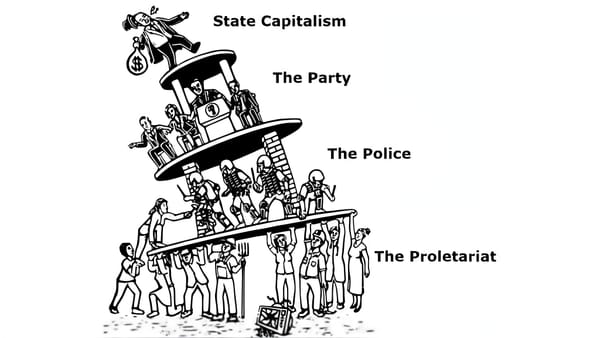
The Beast of History: The Basics of Politics and Antipolitics Part One
The basics of Rule and Anti-Rule

Theory of the political
It is often said that the personal is political. This is right in the sense that in our world our personal lives are facilitated by political processes reproducing the society we live in. It is wrong in the sense that politics is not a transhistorical reality which exists in every human society, nor is it the case that the average person in every society directly interacts with the political in the same proportion to ordinary people in every other society. Nonetheless, the modern globalized world is a political one. Most cultures are dominated by nation-states, which, in virtue of being nation-states and in virtue of existing in a context of ideological struggle, are characterized by a particular political teleology. That is, all nation-states are directed toward the realization of a particular social ideal, and it is this directedness which explains their characteristic institutions. So it is vastly important to have a basic idea of what the political at bottom is. Politics is not a modern phenomenon in and of itself. Ancient societies had politics, but in a different way. In ancient societies, politics was dominated by ethical considerations about how social groups were best to relate to the cycles of nature, supernatural forces, and communal traditions. There was no inkling of mass mobilization for the transformation of society into a more ideal state because there was no significant industrial control of natural ecologies, cultures were much more separated out from each other across the world, there were no broad enlightenment norms of thinking for oneself, rather than relying on authority and tradition, and politics was not separated out from the domain of religion whose purpose is to subordinate human activity to the activity of supernatural causes. With the development of modern industry via the capitalist world-economy and the consequent scientific revolution and enlightenment, masses of people began to be drawn into political battles over how society should be organized. This mass mobilization produced ideology defined as a framework which demands mass political action to bring about a more ideal social order. Politics was subsequently secularized (even in conditions of profound religious fundamentalism) such that social struggles presuppose the ability of human beings to transform nature and the social order on their own initiative. However, there were many societies that lacked any form of politics whatsoever. Hunter-gatherer tribes, in which all human beings lived for most of our species’ existence, had no politics. There was no particular process of social life that could be separated out from the others as a political process. All the affairs of society were conducted through the general cultural functions of the tribal community. A sphere of life identifiable as *political* only arose when significant social stratification and thereby class differences developed, making some people rulers and others ruled. Of course, in societies with politics, ancient and modern, the point of political processes is to conduct the management of general social affairs such as wealth distribution, property delineation, and social decision-making.This has often hoodwinked commentators into defining the political merely in terms of the management of social affairs. However, in conditions like the hunter-gatherer society, there is no specific area of social life dealing with the management of social affairs. This management is simply the spontaneous effect of the general social life of the community. Therefore, the most plausible general definition of the political, or politics, is the existence of a separate sphere of social life dedicated to the management of societal affairs.
To extract from this, we can define the ancient political and the modern political as such:
The ancient political — the management of societal affairs through a separate social sphere oriented toward the preservation of ethicoreligious order within natural-supernatural cycles.
The modern political — the management of societal affairs through a separate social sphere oriented toward the transformation of teleoideological order through mass-historical progression.
Theory of politicization
Modernity’s creation of the individual as separate from the social group meant that human subjectivity became more particularized than it had been in premodernity. In premodern societies, the individual functioned as part of an integrated group and was expected to serve it according to their rank and status while fulfilling its ethical and religious obligations. Modernity, however, created an additional layer of alienation by intensifying humanity’s experience of being open to the world.
Humanity’s separation from the natural world originally emerged through the cognitive evolution of ecstatic experience and imaginative thinking, combined with physiological abilities, such as bipedal movement, opposable thumbs, and the ability to regulate body temperature through perspiration. Together, these abilities allowed humans to develop complex rituals, tools, and social relationships. Unlike other animals, which are highly specialized for particular ecological niches, humans have relatively few fixed instincts and are therefore more open-ended and unfinished as a species. This places humanity in a unique position: a “nicheless niche” within a world structured around specialized niches. Humanity is therefore both a species of the whole Earth and, in a sense, a non-Earth species. Humans can create environments for themselves almost anywhere on Earth and even beyond it, while also being unable to fit completely into any single natural environment. This openness created a need for closure, belonging, and meaning, which was initially provided by religious cosmologies.
Modernizing forces disrupted these forms of belonging and pushed this openness into the individual. By turning everyone into a private individual, modernity intensified the human experience of having to construct one’s own identity and place in the world. In premodernity, alienation was resolved by fitting oneself into a collective we-subject. Under modernity, this alienation is intensified because the individual is instead expected to construct and maintain an autonomous I-subject. Humanity goes from experiencing time in diverging natural and social cycles to time as stretched out into a globalized linear line.
The malleability of the I-subject produces a permanent movement and transformation in the boundaries between different spheres of social life. This means that the arenas created by modern politics are constantly in flux, whereas in premodernity they were more fixed. Premodern societies did not generally expect social life to be continually transformed by the demands of mass political agency.
Thus, while the political has a premodern counterpart, politicization does not. Politicization emerges specifically under modernity, where continuous change becomes the expected condition of social life. Because political ideology is the native cosmology of the I-subject living in linear time, the resulting generic form of politicization concerns the explicit management of constant ideological conflict.
For simplicity, we will distinguish between two arenas of the modern political:
Civic-society arena — the sphere of ordinary social relations of out-rule, in which the general populace conducts its day-to-day lives as citizens engaged in work, leisure, association, and other forms of social activity. Informal forms of rulership reside within this arena, but formalized rulership does not, except when the administrative-society arena enters it to intercept, manage, or redirect politicization that has emerged within civic society toward a particular form of politicization, which we will explore later.
Administrative-society arena — the sphere of specialized social relations of in-rule, in which administrators, delegates, trustees, and other specialized political actors formulate and exercise governance.
It is expected and well understood that conflict will inevitably arise both internally and externally to these arenas, intruding upon modern social life and disrupting the ordinary functioning of day-to-day activities within both. But it is demanded that all ideological conflicts conform to reconstructing the existence of the two arenas.
We can therefore identify five forms of politicization, each of which answers two fundamental questions:
- How should the two arenas be reconciled with one another?
- Where should the inevitable emergence of conflict be directed in relation to them?
The arenas themselves are brought into existence through generic politicization. Their existence is therefore not itself the problem to be solved. The question is never how to make the two arenas exist, but rather what should be done with their given existence and with the conflicts that inevitably emerge within and between them.
These five forms of politicization are:
- Depoliticization
- Repoliticization
- Semipoliticization
- Nonpoliticization
- Antipoliticization
When these processes become sufficiently formalized and institutionalized to produce and sustain a distinct type of society, they can be rendered as corresponding political conditions:
- The depolitical
- The repolitical
- The semipolitical
- The nonpolitical
- The antipolitical
Thus, the five forms describe processes of organizing the relationship between the two arenas and the conflicts that pass through them. In contrast, their adjectival forms describe the mature social orders produced and sustained by those processes.
Depoliticization
Depoliticization — the removal and containment of ideological conflict from the civil-society arena by confining political contestation to the exclusive spheres of the administrative-society arena. Rather than eliminating the modern political, depoliticization displaces its burden onto those occupying privileged or exclusive positions within society, making them the conscious political agents responsible for confronting, managing, and containing ideological conflict. The people in the civil society arena are thereby relieved of the obligation to engage directly in political struggle. At the same time, the sources, means, and agencies of politicization are withdrawn from general society and concentrated among exclusive administrative actors. Depoliticization is therefore itself a form of politicization: it does not abolish the political but redistributes its burden, agency, and means of contestation. In this sense, depoliticizers can be understood as the “vampires of the political,” absorbing and concentrating the political energy of society while leaving the wider public politically disengaged.
Repoliticization
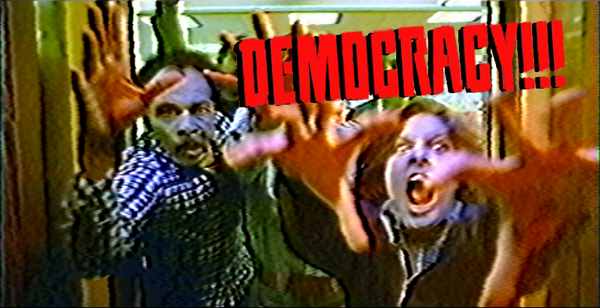
Repoliticization — the relocation and amplification of ideological conflict within the civil-society arena by defining the people within that arena as parties to a direct and irreconcilable conflict. The administrative-society arena is thereby tasked not with resolving the conflict itself, but with legitimizing, protecting, and providing the means through which the people can pursue their competing interests and confront one another. Repoliticizers can be understood as “mob-makers” or, continuing the monster metaphor, “zombie-horders of the political,” who continually seek to ignite polarization among the people by encouraging them to recognize themselves as protagonists confronting social antagonists who must be violently removed according to the dynamism of heroic political theatrics. A repoliticizing society is therefore one defined by exhaustive flashes of political brutality, through which recurring confrontation continually reinforces social bonds organized around dissensus rather than consensus.
From here, we can create two subtypes of repoliticization:
Nicene repoliticization — the attempt to attain victory over the political through repoliticization. Victory refers to the achievement of an anti-systemic utopian order in which the persistent ideological conflicts characteristic of the capitalist political order are ultimately overcome. Repoliticization is therefore understood as a transitional struggle whose purpose is to transcend the political conditions that make such conflict necessary.
Aresian repoliticization — the pursuit of permanent contest within the political through repoliticization. Permanent conflict refers to the conception of systemic politics as an enduring process in which the political community continually constitutes and reconstitutes itself through irreconcilable political contestation. Rather than seeking to overcome the political, Aresian repoliticization treats conflict as constitutive of political community itself: the community must continually build itself through the struggle among its competing interests, identities, and wills.
Semipoliticization
Semipoliticization — the management of ideological conflict through a plurality of legitimated interest groups, each permitted to exist and pursue its interests so long as it recognizes the legitimacy of other groups and remains oriented toward toleration, compromise, and consensus. The administrative-society arena is responsible for defining the permissible range and duration of political conflict, determining when interest groups may contest one another and when their contestation must yield to a peaceful settlement.
Civil society consequently functions as a swinging door between approaching repolitical and depolitical energies and spaces, as it allows political conflict to enter and circulate within society while continually regulating its intensity. Its objective is to keep political contestation within the bounds of agonism, neutrality, and ideally positive consensus, while preventing it from escalating into open antagonism, uncontrolled emotionality, or enduring dissensus.
Semipoliticization therefore neither suppresses political conflict entirely nor permits it to become unlimited: it institutionalizes conflict by making contestation legitimate only within administratively maintained boundaries of acceptable disagreement.
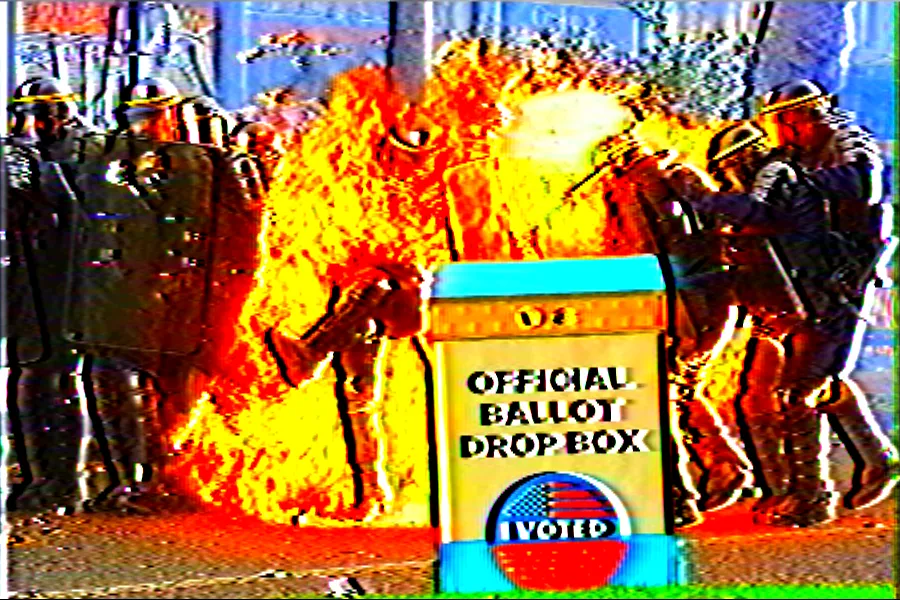
This produces the most interesting kind of public backlash from those who’ve lived decades under this system, as they’ve become witness to the, frankly, psychologically exhaustive, process of passive and active semipoliticization that can make anyone feel at times both less important and too important during a given part of the cycle. A cycle we will call the semipolitical a-swing and b-swing, or the calm down: it’s time to get seriously pragmatic about who you voted for and agitate up; it’s time to get seriously idealistic about your voting choices. This Marathon we call procedural elections. The reason pragmatic A-Cycle comes before the idealistic B-Cycle is because to have had these elections in the first place, you need to have had established a provisional overlapping consensus to then roll out onto the populace to take part in. Controversially and perversely, we will claim that semipoliticization is neither depoliticizing nor repoliticizing, which betrays many people who claim this system creates polarization, as well as many of those same people who also claim this system doesn’t care about them. This paradoxical antagonized-unimportant populace narrative can, funnily enough, only organically emerge in a society where they’ve felt neither depoliticism nor repoliticism, but only semipoliticism, as it creates a unique half-in/half-out feeling in people.
Civic pendulation — the cyclical movement of citizens between periods of political activation and political latency, particularly through the recurring sequence of electoral participation, waiting, and renewed participation.
Nonpoliticization
Nonpoliticization — the maintenance of existing boundaries between the civic-society and administrative-society arenas by keeping matters outside both political contestation and political noncontestation. Rather than directing conflict into either arena, nonpoliticization renders conflict politically inert, allowing it to be represented, experienced, or consumed without altering the existing relationship between the arenas or generating a political response within them.
Callofdutyization — the process by which political conflict is transformed into a fictionalized interactive spectacle in which the audience is positioned simultaneously as a passive observer and as a virtualized specialized military actor presented as an active agent responsible for confronting and resolving that conflict. By transferring political violence into interactive fictional scenarios, the process allows increasingly enormous, absurd, and destabilizing geopolitical conflicts to be represented and para-participated in without requiring the audience to recognize them as matters of political contestation within their own society. The political conflict remains present as a game of spectacle—the player presses a button and a digital soldier shoots—but its resolution is consistently externalized onto professionalized military actors who act on the audience’s behalf. The player therefore performs political violence without becoming politically responsible for it: they experience the sensation of political agency while remaining structurally separated from the political consequences of that agency.
The term callofdutyization is named after the blockbuster FPS series Call of Duty. The series initially situated its campaigns within real-world conflicts, particularly the Second World War, but its Modern Warfare subseries became particularly important to this process by shifting toward fictionalized modern geopolitical conflicts. Because these conflicts are fictional, the developers can take considerably greater liberties in constructing and intensifying their political scenarios. Yet regardless of how enormous or destabilizing these conflicts become, their resolution is ultimately entrusted to U.S. military forces. The player consequently assumes a fundamentally passive position toward the political world represented by the game, experiencing global conflict from the perspective of supposedly active actors whose role is to manage and resolve it on the player's behalf.

In this sense, callofdutyization reproduces a familiar form of military heroism: the audience is presented with heroic soldiers who confront and die for the protection of a society whose members remain outside the political struggle itself. The distinction becomes even more pronounced when real geopolitical conflicts are transformed into fictional ones, allowing the audience to consume representations of political conflict without being asked to determine its meaning, participate in its resolution, or contest the social order underlying it.
Nonpoliticization therefore neither polarizes nor depolarizes. It does not amplify conflict within the civic-society arena, nor does it relocate conflict into the administrative-society arena for conscious management. Instead, it leaves the existing relationship between the arenas untouched. It says neither that the people should politically confront one another nor that political conflict should be consciously managed by specialized actors. It simply presents conflict as something that will be handled by someone else, somehow, somewhere.
In a manner of speaking, nonpoliticization is the “invisible man of the political”: its presence can be felt, and its effects can be seen, yet its direct political identity remains difficult to detect. One could then argue that nonpoliticization, and the nonpolitical it produces, are not forms of politicization at all, but simply that which is not political and therefore exists outside politics. The short answer is that this is correct. The long answer is that this is precisely why it is a form of politicization.
The pernicious character of nonpoliticization lies in its ability to present political violence as an ordinary and unremarkable feature of global life. Political violence becomes something that simply happens somewhere else, to someone else, and is consequently experienced by the protected populations of powerful states primarily as an image, narrative, or spectacle rather than as a direct political problem. The political violence of the global system is thereby rendered normal through distance: those who are sufficiently protected from it need not experience it as an intrusion into their own civic lives, while those elsewhere bear its material consequences.
This dynamic can also be observed in drone warfare. The drone pilot may operate hundreds or thousands of miles from the target, separated physically and socially from the people whose lives are being affected. The technological distance between pilot and target constructs a corresponding political distance between action and consequence. The destruction of a target—and potentially of innocent civilians—can therefore be experienced as an abstract technical operation rather than as a direct political act. Responsibility becomes psychologically and socially obscured by the machinery that mediates the violence.
This is the character of the nonpolitical: not necessarily the absence of political consequences, but the absence of political immediacy. Political actions are displaced so far from the ordinary experience of those who participate in or consume them that their political character becomes difficult to perceive. The nonpolitical thus creates a condition in which violence can be simultaneously highly political in its effects and apparently nonpolitical in its experience.
Nonpoliticization therefore occupies a peculiar position within the taxonomy of the political. It does not seek to eliminate political conflict, resolve it, or consciously relocate it. Instead, it allows political conflict and violence to persist behind a veil of normality, making the political appear as though it were simply the background condition of an otherwise nonpolitical world.
Antipoliticization
Antipoliticization — the use of political conflict to directly dismantle the separation between the civic-society and administrative-society arenas, seeking instead a new integration of social life that is no longer organized around their distinction. Antipoliticization therefore does not seek to manage, contain, or permanently reproduce ideological conflict, but to use conflict against the conditions that produce and sustain it.
Its relationship to ideological conflict is consequently one of immediate negation: antipolitics politicizes through a “negation of the negation,” agitating and polarizing society toward the ultimate abolition of the conditions requiring political antagonism. Unlike repoliticization, it does not identify itself with political conflict as a permanent or constitutive condition; unlike depoliticization, it does not privatize, conceal, or concentrate conflict within exclusive spheres; and unlike semipoliticization, it does not seek a negotiated consensus among permanently differentiated interests.
Instead, antipoliticization seeks a consensus that emerges from the transcendence of those differentiated interests themselves—a condition in which the free production and cooperation of social life render the administrative–civic division, and ultimately the political as a separate sphere, unnecessary. Its ultimate objective is therefore not peace through the management of conflict, but peace through the abolition of the conditions that make conflict politically necessary.
Roundtable politicization:
If these forms of politicization could talk to you and each other at an imagined roundtable with you seated in one chair at a six-sided table with the other five chairs occupied by them, this is what they would say to you.
You say: “I’m worried about X political issue.”
Depoliticization says: “This isn't your concern.”
Repoliticization says: “It isn’t just your concern; it is who you are.”
Semipoliticization says: “This is your concern, get in line and vote, but wait until the results and accept those results; if you have a problem, we’ll need you to wait until there's another election set up for you to try your luck again at. So, really, politics is only really your concern intermittently, procedurally, and within predetermined boundaries.”
Nonpoliticization says: “... Na.”
Antipoliticization says: “This is all bullshit.”
As you can see, semipoliticization is the most long-winded, talkative, and obnoxious to deal with.
Sources:
Peter L. Berger - The Sacred Canopy
Roger Griffin - Modernism and fascism
Juan Linz - Totalitarian and authoritarian regimes
Cas Mudde and Cristóbal Rovira Kaltwasser - Populism: A very short introduction
Carl Schmitt - The Concept of the Political (Schmidt was a hardline Nazi who argued an influential totalitarian concept of the political, here used as a source for the concept of repoliticization. The authors obviously find his politics abhorrent.)
Politics, Tansey and Jackson
The State, Barclay
Introduction to the Critique of Hegel's Philosophy of Right, Marx
Anarchy, Malatesta
Anarchist Communism, Kropotkin
Marx at the Millennium, Smith
Imagined Communities, Anderson
This text is the collaborative work of Piper Tompkins and Post-Comprehension