The Russian Revolution: An Anarchist View

The Russian Revolution was one of the most earth shaking events in human history. It created the first ever communist state in the world and thereby gave rise to a new international communist movement that ascended to power throughout the global south and Eastern Europe. For Anarchists the Russian Revolution is a great example of the strides that the working masses can make when they take control of society for themselves and the bankruptcy of the mainstream Marxist strategy of trying to conquer state power. Understanding this event, however, requires understanding what was widely referred at the time as the 'sick man of Europe'.
The Tsarist Empire was in a curious in-between position in terms of its development. It was a important European military power and had experienced an urban industrial revolution connected to western financial capital in the 19th century. However, it had not undergone any democratic transformation and had remained an monarchical autocracy, unlike many of its western European counterparts. It also remained a primarily rural society where the vast majority of the population was of peasant social station.
Serfdom was not itself abolished by the autocracy until 1861 and even then peasants often were stuck working for their former masters in order to buy their freedom under a system of 'redemption payments'. Russia being caught between western style economic development and the revitalization of its manorialist and absolutist traditions produced a debate between slavophiles and westerners. These were two intellectual factions with two different approaches to Russian modernity. The slavophiles were conservatives who thought that Russia must resist commercial and democratic modernization in order to retain its distinctive identify as a national culture. Westerners were liberals who demanded that Russia embrace the west's commercial and democratic impulses in order to better fit within the modern world.
The main intellectual opposition movement to the autocracy became the so called "narodniks", 'narod' being Russian for 'people'. The narodniks were radical agrarian republicans. They thought that the autocracy needed to be overthrown and replaced with a new state that represented the peasant masses and which resisted economic commercialism by relying on the peasant commune which annually redistributed land in common. They had taken the hostility to commercialism of the slavophiles and combined it with the republicanism of the westerners.
Initially the populists tried to evangelize to the peasant masses via the 'going to the people' movement in which they descended on the countryside in order to rally the peasants to their program. The peasants viewed them as suspicious and condescending so the bid failed and the movement was repressed by the authorities. The next strategy was political terrorism. Tsar Alexander the Second was somewhat amenable to reforms.
It was he who abolished serfdom. He also introduced local representative bodies called the Zemstvos as well as rule of law mechanisms, in particular trial by jury. However, he always stopped short of any measures meant to fully and effectively emancipate the peasants from the control of the nobility, or abolish the autocracy and bring in genuine representative government at the national level. In taking up the strategy of assassinating tsarist officials in order to inspire the masses to revolt the narodniks were able to take out the 'reformist' Tsar himself.
Alexander was replaced by his son Alexander the Third whose political temperament was the opposite of that of his father. His rule was a period of retrenchment for the autocracy which saw the ruthless suppression of all oppositional movements including the narodniks themselves. Effectively, all the terroristic strategy had accomplished was to strengthen the autocracy and weaken the narodniks. This all around failure of the narodnik movement laid the basis for many former narodnik thinkers to import Marxism from Western Europe as a viable alternative approach to social revolution in Russia.
In Western Europe an orthodoxy of Marxist socialism had taken shape around the so called 'social democratic' movement. This form of Marxism is often called "classical Marxism". The point of classical Marxism was to organize a socialist party that would take state power and use it to bring production under the control of the state and plan it in the interests of the working class, while deploying coercive force against anti-communist movements and the capitalist class, a process that would act as an immediate spur for the development of an international social revolution that brings the workers of the world together against international capitalism. Once this revolution had been completed and the class struggle won by the workers the socialist state would no longer have a social function as no one class would exist in a repressive relation to another.
As such the state would wither away and give rise to a classless free community of producers. Building a socialist party required the development of a democratic capitalist nation-state since all other forms of state within the capitalist world-system at the time were intolerant of the existence of anti-capitalist movements and attempted to suppress them. In bourgeois democracies like Germany, by contrast, socialist parties were free to run candidates, publish papers, hold cultural events, and generally preach their message in the open. As such social democratic classical Marxists adopted minimum program and a maximum program.
The minimum program was the achievement of bourgeois democracy and the building of the socialist party to critical mass within it. The maximum program was the actual seizure of power by the socialist party to inaugurate the 'dictatorship of the proletariat' which would ultimately replace capitalism with socialism. The classical Marxist approach along with the social democratic idea of the minimum and maximum programs was imported to Russia by intellectuals such as Pavel Axelrod, Vera Zasulich, Julius Martov, and Georgi Plekhanov. Given Russia's manorialist autocratic state the Russian Marxists began to emphasize the minimum program in particular, dismissing narodnik dreams of resisting commercialization through the peasant commune (mir), and advocating revolutionary energy be spent on replacing the autocracy with a western style bourgeois republic.
One young Russian Marxist, Vladimir Ilych Ulyanov (movement non de guerre 'Lenin') wrote a long statistical tome in refutation of narodnik arguments to the effect of the desirability and feasibility of using the mir to avoid capitalist industrialization. It was called The Development of Capitalism in Russia. Its main thesis was that the urban industrialization of the 19th century would and was indeed beginning to given the connection of Russian agriculture to urban finance and industry lead to the kind of industrial capitalism found in Western Europe and the United States. This western style capitalism would thereby lay the basis for the dissolution of manorial relations based on the nobility's power over the peasantry as well as the narrow social interests of the peasantry thereby bringing about a unified working class with a social interest in socialist revolution.
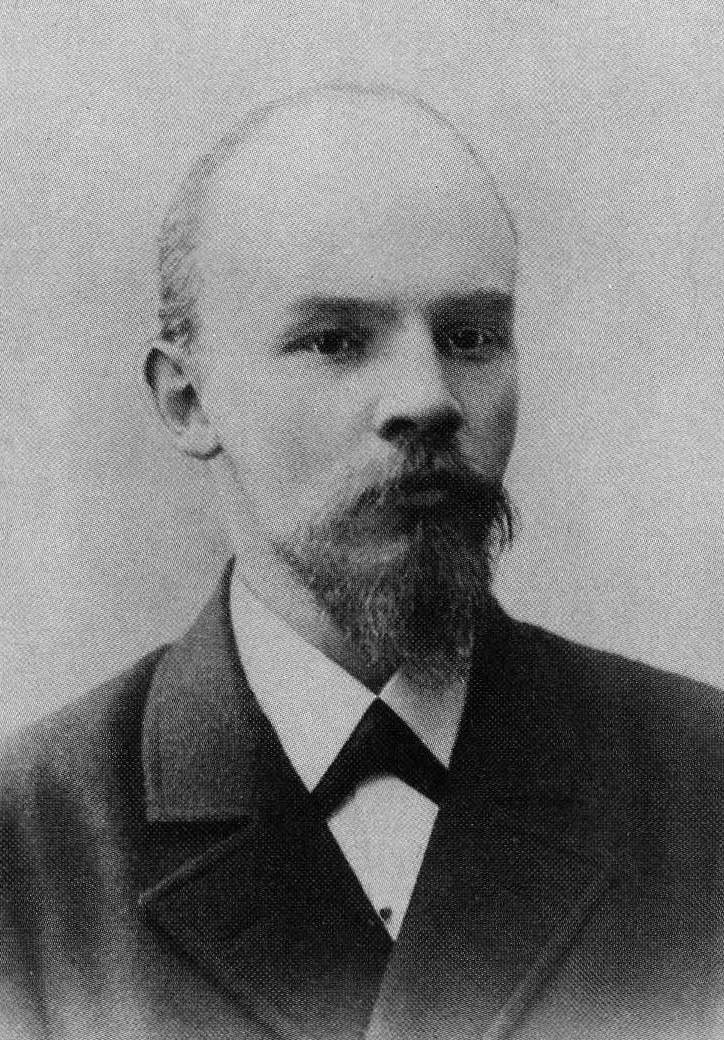
Lenin had thus declared that the orthodox Marxist position was that the coming of industrial capitalism to Russia was a progressive beacon in history that was neither possible, nor desirable to resist. Ironically Marx himself disagreed with Lenin and the rest of the Russian Marxists who also held such a position. Marx had actually worked with the very narodnik economists whom Lenin had castigated in his book. Marx himself was not a narodnik (as a communist he was not an adherent of agrarian radical liberalism), however he agreed with their analysis of Russia and that it was possible and desirable to use the mir to resist capitalist development.
Marx and the narodniks paid closer attention to the actual function of the connections between urban industrial development, western finance, and Russian agriculture. Rather than simply assuming, as Lenin did, that these connections must be accompanied by inevitable industrialization of the countryside, they noticed that they were actually sucking the countryside dry, explaining Russia's status as Europe's 'sick man' from a political-economic point of view. Indeed western financial capitalists were investing in Russian industry which in turn was allowing Russia to industrialize urban areas and build infrastructure with the capability to deliver grain from the countryside to the world market which in turn would finance more industrialization. However the whole process was predicated on the control of peasant labor to ensure the production and delivery of grain for the world market.
This need for controlling peasant labor entrenched the manorialist and autocratic social structure of the empire. What incentive would Russian decision makers have to displace the very peasant production and modes of social control over it that were guaranteeing their biggest industrial achievements as a nation? Marx also concluded that since the mir provided an already existing mechanism for social control of wealth within peasant culture that in combination with revolutionary upsurge abroad and the revolutionary transformation of the countryside itself the mir could act as a springboard past capitalist industrialization towards socialism. Lenin was never made aware of the fact that Marx's view was opposite of his.
At the end of the 19th century Russian Marxism would convene its own social democratic party; the Russian Social Democratic Labor Party (RSDLP). It was in the context of strategic debates within the RSDLP that Lenin wrote one of his major works in What is to be Done? This pamphlet is often mistakenly characterized as advocating control of the social democratic movement by a conspiratorial cabal of revolutionaries, but this is simply not true. He was instead arguing for applying the social democratic model of building a socialist party within the underground political scene in the lead up to the overthrow of the autocracy. Just like the German Social Democratic Party (SPD) Lenin maintained that the RSDLP should develop its own underground publications and practical leaders and organizers to bring scientific socialism (the word that classical Marxists used to refer to their doctrine following Marx's collaborator Friedrich Engels) to the working masses.
In the pamphlet Lenin, in criticizing a view he referred to as economism (supposedly the view that the political struggle should be replaced by daily working class struggles for better compensation and working conditions, although Lenin lumped many opponents in with this view that did not share it), Lenin argued that the workers would not be able to achieve the right sort of revolutionary consciousness on their own. While this is often interpreted as if Lenin was arguing that workers would have to be totally directed from above by a cabal of Marxist revolutionaries, this was not his point. Rather Lenin was making the traditional classical Marxist argument for the leading role of the socialist political party (a doctrine often referred to as vanguardism).
According to the classical Marxist revolutionary strategy it was those with a proper understanding of Marxist theory that understood the programmatic requirements of socialism. As such the masses, without an initiation in Marxist theory, would have to be trained in that theory and brought into a unified political organization which is directed strategically by those with the highest expertise in Marxism. Thus it is this socialist political party that would have to lead the workers to state power and thus lead the 'workers' state'. Lenin draws on the leading figure of classical Marxism of the time, Karl Kautsky, in order to support his argument because Kautsky himself endorsed it. This organizational centralism was a basic tenant of classical Marxism.
The alternative approach was articulated by political Anarchism according to which revolutionary consciousness comes not out of tutelage by experts, but out of the collective and collaborative experiences of the working masses themselves. As such it was not the socialist political party that was to take power through the state. Rather the working masses collectively assert their control over society in opposition to the ruling class and its counterrevolutionary forces. This approach to the strategy of revolutionary socialism (the ultimate goal of the overthrow of capitalism and class society in favor of the creation of a voluntarily organized human community without class divisions) is organizationally decentralist.
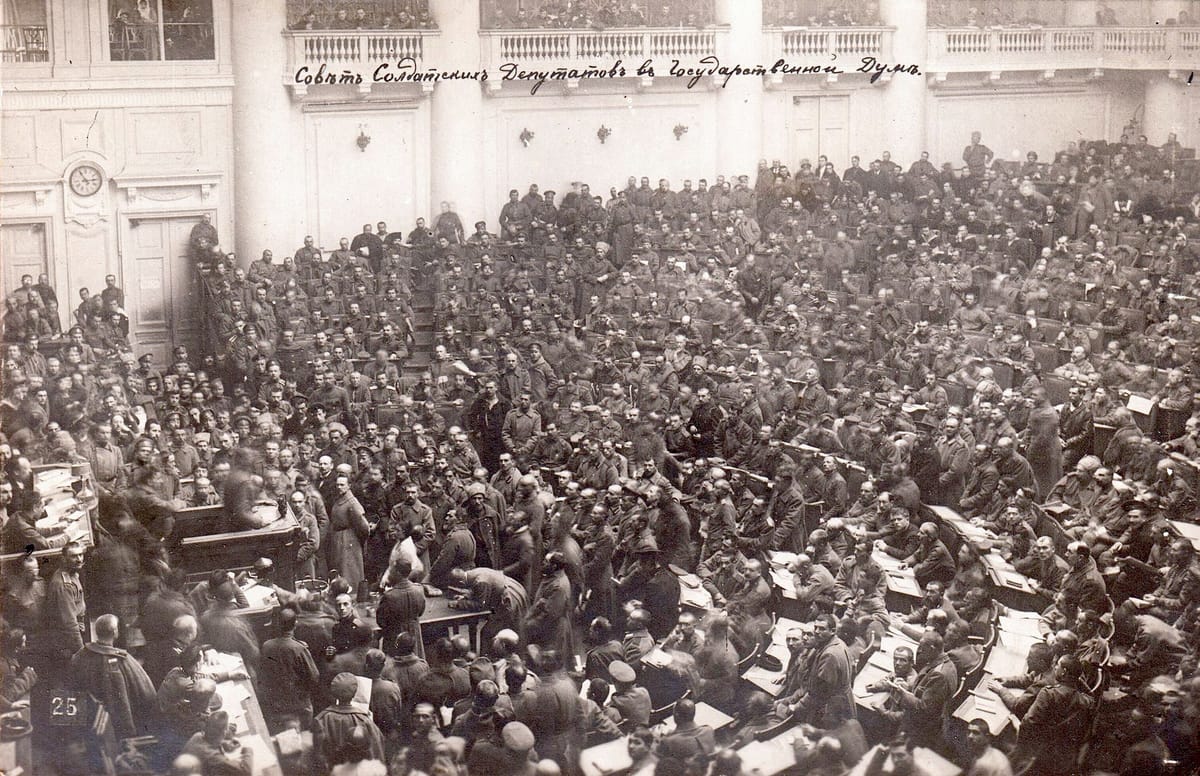
In 1905 the first modern Russian Revolution took place. Russia, despite ideologically projecting national military might, was defeated by a relatively new world power in Japan producing a grave national humiliation. This humiliation concentrated anger at the social issues presented by decaying Tsarism in a way that pushed the population in both urban and rural settings to rise up. In Petrograd mass demonstrations produced a new kind of social structure controlled by the workers; the soviet, Russian for council.
In the countryside peasants rose up against landlords and weren't fully suppressed until 1907. Tsar Nicholas The Second was forced to make token concessions, in particular the creation of an elected advisory body to the Tsarist government called the duma. However, Nicholas, like his father and grandfather, refused any move toward representative government, steadfastly maintaining the autocracy. In the end the 1905 revolution was crushed by the power of the state, but it created the antecedents for the revolutionary developments that would end Tsarism in 1917 including uprising in the countryside and the workers' soviet.
Meanwhile the second congress of the RSDLP in 1902 had produced a split between the minority (Mensheviks) and the majority (Bolsheviks). While historical legend has often painted the split as the result of Lenin trying to brow beat the rest of the party to accept his dictatorial conspiracy of revolutionaries, this was actually not the case. The split was occasioned by relatively narrow bureaucratic issues such as who should occupy what posts in regard to the party and its publication Iskra, Russian for 'spark'. The most substantial point of difference was the debate between Martov and Lenin over whether only trained worker activists should make up the party membership (Lenin), or whether the party should be a mass party open to the general working class.
No central issues of the political strategy of classical Marxism were at stake in the split. Lev Davidovich Bronstein (nom de guerre Leon Trotsky) was at this time a Menshevik who took it upon himself to nock down the straw man hyper-centralist position that was being attributed to Lenin with Polish social democratic Marxist Rosa Luxemburg joining the critique in a document that was later retitled by others as Leninism or Marxism (the original title was the much less scintillating Organizational Questions of The Russian Social Democracy). In reality Lenin's position was not any more centralist than the classical Marxist position both Trotsky and Luxemburg themselves subscribed to. In any case the Mensheviks and Bolsheviks would never come back together making the unified RSDLP dead in the water not long after it's late 1800s creation.
Fast forwarding to 1917 a precarious alliance system between European nations led to the breakout of the first world war. For socialists who did not support the war (the major socialists parties ended up supporting the war because of their connection to the bureaucratic machinery of European nation-states) the mass slaughter and destruction provoked by the war constituted international fratricide involving a working class that had been swindled by bourgeois governments into believing that the war was in their interests. The war pulled in Tsarist Russia which once again was bested badly on the battlefield by opposing powers, in particular Germany. Russia's participation in overseas excursions once again concentrated the population's grievances into a cauldron of anger ready to burst.
It was even worse in this case because not only was their great nation suffering humiliating defeat, but ordinary Russians were being flung into the meat grinder by the droves and vast amounts of social resources were redirected from the impoverished population to the war effort. In February (going by the Julian Calendar) 1917 urban risings once again roiled the capital city and peasants rose up in the countryside. This time, when Russian soldiers were ordered to fire on their countrymen they instead turned their guns against their commanding officers. The autocracy began to crumble and Nicholas The Second was advised to abandon the throne with he and his family ultimately fleeing to be later killed by Bolshevik agents.
The Duma officials then created a new government to stand in as the legal ruling body for the collapsed Tsarist autocracy. However, the effective power over the country became the Petrograd Soviet, the center of the revival of the workers' soviets from 1905 in the capital. The peasants would revive the revolution in the countryside with a partial revolutionizing of the mir commune against its patriarchal leadership by the younger generation. The urban workers, in addition to the soviets, also formed factory committees. These were organizations of workers at the point of production through which workers exercised pressure over factory management in their interests and even seized control of factories themselves.
In April Lenin came back from exile and proclaimed his April Theses according to which the Bolsheviks needed to pass from the minimum program to the maximum program and effect a socialist revolution through the soviets. Despite affirming the organs of working class self-organization Lenin had not broken from his classical Marxist centralism. His vision required that the Bolsheviks as a party would take power with the mandate of the soviets and establish the workers' state. However Lenin's thought had gone through significant changes as a result of WW1 when the social democratic parties, to Lenin's horror, had voted for war credits, and his master Karl Kautsky had failed to resolutely oppose this exercise in what Lenin referred to as opportunism.
Lenin was led toward the writings of Marx and Engels on the Paris Commune observing that their idea of the dictatorship of the proletariat included the dissolving of the hierarchical and bureaucratic functions of the state into organs of working class control over society. In his work The State and Revolution Lenin analyzed the state as contradictory to human freedom and an organ by which one class represses another. Thereby the function of the proletarian dictatorship would be to erode the functions of the state and replace them with participatory organizational functions embracing the working masses. He summed this up with the slogan every cook will govern.
However, Lenin still did not give up centralism. In the same document Lenin equated socialism with state control of industry and the paying of workers' wages by the state, misinterpreting Marx's distinction between lower and higher phases of communism, and referring to the former as 'socialism' in which the proletarian state would take on the functions of administrating wage labor and a still class divided society. Also in S&R Lenin explicitly put forward the idea of democratic centralism in which the proletariat was to have its voice through the party, but the party was to maintain tight ideological discipline. This was more, or less just an explicit formulation of the doctrine of the socialist party classical Marxism was always committed to.
The provisional government was more, or less a sham from the beginning. Instead of pulling out of the war its second head of state, Kerensky, engaged in ill-thought out French Revolution inspired attempts at offensives which only ended in defeat. There was additionally no question of redistribution of land to the peasants, or the convening of a constituent assembly of actually elected officials which the government was eventually supposed to do. The effects of these blunders resulted in an attempted coup by general Kornilov which was put on ice by revolutionary workers themselves and urban riots in July which then led to further repression of the Bolsheviks by the government. In October the provisional government's failures would catch up with it.
Many commentators including socialists opposed to Bolshevism have seen the October revolution as a Bolshevik coup. This isn't a very accurate description of the event as it turns out. The seizure of power from the provisional government was effected by working class supporters of the Bolsheviks in the capital called red guards and was ultimately approved (with Bolshevik pressure) by the congress of soviets which had come to embrace soviets throughout the country, including the addition of soldiers' and peasants' soviets to workers' soviets. In addition the Bolsheviks did in fact redistribute land to the peasants (although large estates came under the control of the state).
However, ultimately it was the Bolsheviks that took power, not the Petrograd Soviet, in keeping with their centralism. Lenin appointed a slate of officials called commissars to staff the bureaucracy of the new state and the soviets almost immediately became subordinated to Bolshevik dictates. The constituent assembly was called, but was ultimately closed by the Bolsheviks after the most recent incarnation of the populist movement, the social revolutionaries, won the vote. Again, this action is often portrayed as a repressive one by the Bolsheviks, including by anti-Bolshevik socialists. However, at this point the liberal constitutional project had gone defunct in Russia in the many blunders of the provisional government. Further, if it was the Petrograd Soviet that seized power from the provisional government, rather than the Bolsheviks, the result would not have been liberal representative government, but worker and peasant control of Russia and all of its social wealth including the land and the factories, what Marx and Engels would have called proletarian dictatorship. To boot, the Bolsheviks appointed an Anarchist to oversee the closing of the assembly and many SRs became commissars in Lenin's government.
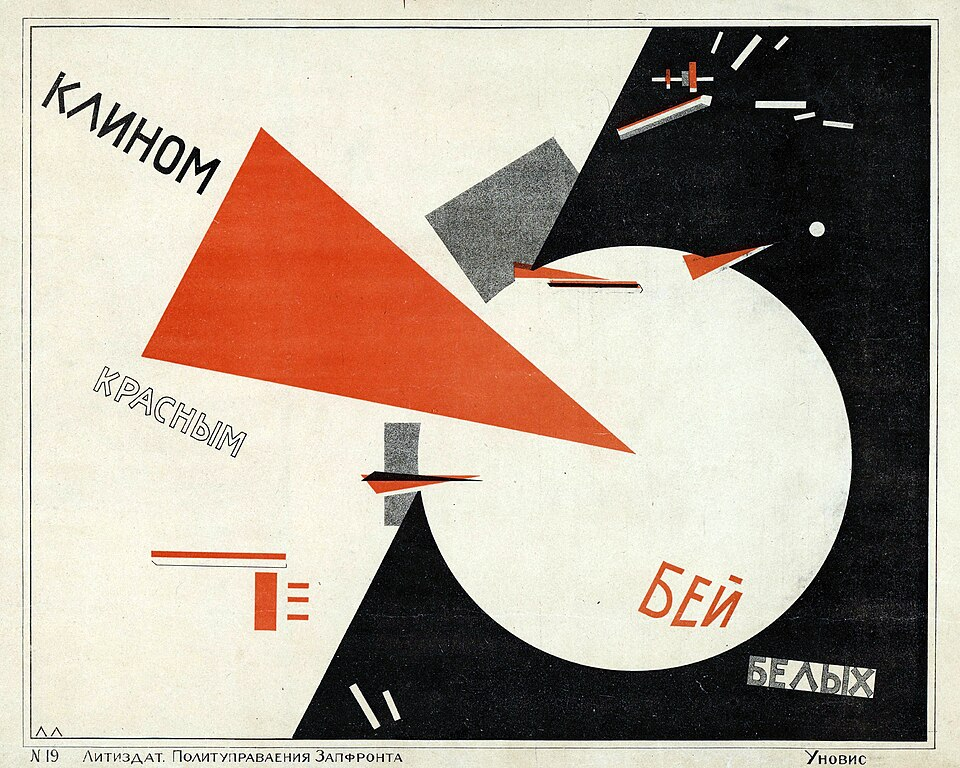
What does need to be highlighted is the way the new Bolshevik state rapidly transformed into an autocracy over the workers and peasants. October essentially immediately kicked off a civil war between the Bolsheviks, former Tsarist generals called the whites, invading powers such as France, Britain, and the United States attempting to strangle communism (Japan also got involved because of territorial ambitions), and various 'green armies' of peasants resisting both the whites and Bolsheviks. In order to fight the war the Bolsheviks brought back the secret police, under Tsarism called the Okhrana, as a repressive mechanism. The Bolshevik secret police was named the Tcheka (in later Soviet times it was renamed to the NKVD then KGB, and in post-communist Russia is called the FSB) and headed up by Felix Dzerzhinsky.
In accordance with classical Marxist ideas of the socialist state production was early completely nationalized (put under state ownership) while the war led to the severe inflation of the money supply. Since the Bolsheviks did not and at this point could not transform the broader relations of production the war only intensified the need for the exploitation of the countryside to feed the cities. Bolshevik forces raided the countryside imposing (and often exceeding) quotas for the requisition of grain from the peasants. Workers who were lucky enough not to be caught up in various massacres committed by both red and white forces were plunged into misery, often being forced to steal and scavenge for items to sell on the black market. Broad rationing was introduced for the entire population, which some Bolsheviks interpreted as being the first step to creating a communist society.
Trotsky, who had long since been converted to Bolshevism and became a leading Bolshevik within the soviet movement, created a regular hierarchical military to replace decentralized and voluntarily mobilized worker/soldier militias. The Bolsheviks for a time allowed the factory committees to manage industrial production, but because there was no overarching federal structure of working class organization which bound them together, they often ended up simply competing on the market and hording resources. With the need for industrial discipline imposed by the war the Bolsheviks ended worker control and instituted one man management of the factories. Tsarist officials and managers were often brought back to oversee the factories and the military under the ideological supervision of the Bolsheviks.
The war-economy combined with the Bolshevik party autocracy has come to be referred to as war communism. However, it involved no actual transformation of the relations of production that constituted Russian society other than the bringing of all industry under the control of the state. The same model of economic exploitation of the countryside + political autocracy remained, augmented by hyperinflation and civil war. Ultimately, however, the Bolshevik classical Marxist project in Russia hinged on the development of further working class uprisings in solidarity with the Russian Revolution abroad.
The conditions of war-torn Europe did in fact produce movements for worker control in the west, but these movements were ultimately suppressed as a result of a trend toward far-right politics and autocratic rule on the continent. Meanwhile the Bolsheviks were confronted with the immediate threat of a powerful German state that was in a position to impose punishing territorial concessions in exchange for a separate peace. Unlike the provisional government, the Bolsheviks were conscious of the need to pull out of WWI, but concluding a separate peace with Germany would have meant a particularly unsavory concession to an imperialist power. A faction called the left communists, including Nikolai Bukharin who would become a leading Bolshevik figure in the immediate history of the new regime, argued for a generalized guerilla revolutionary war against.
Trotsky attempted to thread the needle by appealing to the German working class to rise up during negotiations which predictably fell on deaf ears. Ultimately Lenin's position, that peace with Germany was the price that needed to be paid for ending the war, won out and the (still rather hard to swallow) Treaty of Brest-Litovsk was adopted in 1918. It is true that the Bolsheviks could have tried to fight Germany, but Lenin was correct that in the absence of a broader revolution in western countries, this would have meant adding the defeat of Germany to the already daunting task of winning the civil war, and crucially would have meant prolonging Russia's hated involvement in the world war. In the end Lenin's position was the most practical given the defeat of western revolutionary movements and the Bolsheviks' priority of preserving their own power at any cost.
By 1922 the Bolsheviks had won the civil war. They had concluded political and trade agreements with the invading western powers and because of a combination of territorial and political advantages had bested the whites. The Bolsheviks in holding on to the capital had the privilege of being able to fight the whites from the center with the latter having to fight out of the periphery. Further the whites had nothing to offer the masses. Ideologically they proffered an unrefined militaristic (and often antisemitic) nationalism intent on rolling back all the gains of the revolution, including the restoration of landlords in the territories they controlled. The masses thus came to view the Bolsheviks as the lesser evil to the whites.
In 1921, with the civil war wrapping up, workers in Petrograd, suffering under war-communism, carried out a strike which was then repressed by Bolshevik leader Zinoviev. In solidarity with the strikers sailors at the Kronstadt naval base mutinied against the Bolsheviks and demanded the end of war communism and the the restoration of soviet power along with free elections to the soviets. Despite the fact that the Bolsheviks held the sailors in high regard because of their revolutionary zeal in both 1905 and 1917 the former were totally unsympathetic to the sailors' cause. In order to justify a violent crackdown the Bolsheviks proffered the narrative that the sailors had became a mass of peasant rabble that had made deals with the whites and western powers in order to overthrow the Bolshevik state.
As historian Paul Avrich points out there was nothing, but the weakest circumstantial evidence to support this narrative. Nevertheless the uprising was crushed and with it the last gasps of worker-peasant control. At the same time the Bolsheviks held their tenth party congress at which factions within the party were banned. This effected a purge of party factions such as the workers' opposition which were agitating for worker participation in administration.
With the civil war over the Bolsheviks were now pressured to end war communism. If they did not the masses, particularly the peasants, would have likely simply carried them away. Thus taking advantage of the sapping of the masses revolutionary energy the Bolsheviks introduced the New Economic Policy (NEP) including the abolition of grain requisition, allowing peasants to market their grain for private commercial purposes, and further allowing for the limited existence of private enterprise. The party dictatorship remained.
This gave the Bolsheviks the necessary reprieve to stabilize their new state which in turn led to its managerial bureaucratization. Lenin in particular complained about this bureaucratization given the distinction between it and actual working class control of administrative functions. However, at the same time Lenin was also moving in the other direction. He began to explicitly claim that state directed capitalism was the basis for Russia's socialist transition.
Lenin even at one point declared that one person dictatorship was not incompatible with proletarian dictatorship. In general the Bolsheviks began flirting with Fordist and Taylorist scientific management methods from the west in which capitalists would use techno-scientific means to break down the labor process into simple and mindless tasks in order to more efficiently squeeze workers for productivity. Trotsky and Lenin debated the role that unions had protecting the workers under the workers' very own state. Trotsky demanded their total subordination as rubber stamp agencies for the state (what the soviets had by this point been reduced to). Lenin, who's position was pretty much always the deciding one including this case, insisted that the workers' state could not leave the workers without any mechanisms for representing their interests, but like Trotsky denied that the unions should be ultimately autonomous from state power.
A debate between Stalin and Lenin on the national question occasioned the creation of the Union of Soviet Socialist Republics. The national question was particularly important to the revolution and the Bolsheviks given that the Tsarist Empire tightly subordinated its national minorities (from Ashkenazi Jews to non-Russian Eastern European nationalities and Central Asians) to Russian rule and culture. As a Georgian national minority and commissar for nationalities Joseph Djugashvili (nom de guerre Stalin) strangely proposed that the non-Russian territories acquired via the civil war (which ended with the Bolsheviks having retained most of the empire's land) should be fully integrated as administrative units within the Russian state itself. He gave this policy the Orwellian name "autonomisation".
This proposal was likely the result of the fact that Stalin's perspective on the national question dictated that small nationalities stuck in their own parochial ways should be subsumed by larger more dynamic national cultures. Lenin saw this as a violation of the principle of the right of nations to self-determination. In his Imperialism: The Highest Stage of Capitalism he argued succinctly that the cause of WWI was the development of industrial and financial oligopolies that pushed capitalist nations to conquer other cultures and lands producing a scramble for colonies. Thereby one of the cracks in capitalist-imperialism to be exploited in order to achieve socialism was the national oppression of these peoples by the imperialist system. Thus socialists needed to affirm the struggle of national minorities and oppressed nations against national oppression.
Lenin saw Stalin's view as 'great-Russian chauvinism' that disregarded the objective need for national liberation. Instead Lenin proposed that the non-Russian peoples and territories should be granted their own republics whose union with each other and the Russian republic was strictly voluntary. Stalin bent the knee to Lenin easily leading to the creation of the USSR. However, especially with Lenin's death and Stalin's rise to power Stalin basically achieved his policy with the right of republics to leave the union only existing on paper.
On the whole the defeat of the revolution in other parts of Europe presented a huge problem for the Bolsheviks. The presupposition of their entire framework was that the revolution had to be immediately international in order to succeed because of the international political power of capitalism. Now the Bolsheviks had to face the fact of isolation on the international scene confronting the capitalist world. The NEP presented the further problem of the pernicious growth of the private sector. A new crop of agricultural capitalists dubbed "NEPmen" emerged and for a time industrial and agricultural prices began diverging sharply in an episode known as the scissors crisis (because the diverging lines on a graph visually resembled a pair of scissors).
Bolshevik theory became dedicated to solving these problems from a Marxist perspective. Before he died Lenin outlined a plan for the development of industry and agriculture along socialist lines via the formation of peasant cooperatives which were to be financially integrated with the development of state controlled industry. After his death a debate ensued between the so called left and right oppositions. The former, represented by Trotsky, Zinoviev, and Kamenev advocated the use of state power to force peasants to produce for state directed industrial development. The latter represented by Bukharin and initially Stalin advocated 'socialism at a snails pace' in which the NEP would be extended to provide peasants incentives over time to join state controlled cooperatives which would then finance industrialization.
Left oppositionist Yevgeni Preobrazshensky proposed 'primitive socialist accumulation'. Primitive accumulation is the name given by Marx to the process by which the direct producers are tricked and coerced out of the wealth they produce ultimately leading to the establishment of capitalist class relations. Preobrazshensky proposed that the socialist state should coercively extract the wealth produced by the peasants to feed industry. In reality none of this had much to do with socialism, quite the opposite. The goal for both right and left oppositions was the same as every other Russian government since industrialization began under Tsarism.
That is the Bolsheviks needed to find a way to use their political autocracy to extract the produce of the peasantry so that it could be sold on the world market and the proceeds used to finance industrial development. What this ultimately meant is that Russia occupied the same place in the international division of labor that it did before the revolution after it had essentially concluded. It was still a predominantly agricultural autocracy which had to exploit the peasant masses for the world market in order to finance industrial construction. The main difference was that rather than being subordinated to this pattern of production by a mix of private industrial and western finance capital, the workers and peasants were now being squeezed for these purposes by a sprawling state bureaucracy which controlled 'the commanding heights' of the economy.
The upshot is that Russia's place within the capitalist world-economy had been preserved, rather than transcended for socialism, or subject to a new political order on the way to socialism. Russia's place in world capitalism would only be significantly altered when Stalin came to power and imposed his 'revolution from above'. Even then, as we will see in other articles, Russia was not extricated from world capitalism, but moved up the competitive ranks of its axial division of labor. The Russian Revolution represents for Anarchism a near perfect proof of concept.
According to Anarchists if the masses of people self-organize they can use their collective strength to repossess social life and social wealth from the ruling class and transform society along the lines of voluntary association and mutual development of individuals. This is precisely what the Russian workers and peasants did when they rose up against Tsarism and later the provisional government. From February to October 1917 Russia was under the effective control of self-organized workers and peasants associations from the revolutionized mir commune and the workers', peasants', and soldiers' soviets to the factory committees. As such Russian Anarchism was a large part of the revolution including the participation of Anarchist Communists and Anarcho-Syndicalists until they were driven underground by the Bolshevik autocracy.
Unfortunately the Anarchist movement was sucked in by the Bolsheviks' Anarchist sounding slogans such as 'all power to the soviets'. Lenin's work in particular managed to convince them that the Bolshevik idea of proletarian dictatorship was consistent with their goals. They found out that this was not the case too late, with emigree Russian Anarchists Emma Goldman and Alexander Berkman only breaking completely with Bolshevism after the suppression of Kronstadt. Subsequent Anarchist and 'left-communist' criticism of the results of Bolshevism inside and outside of Russia independently converged on the notion that the Bolsheviks, rather than creating a proletarian dictatorship, had created a form of state-capitalism in which the state had taken on the functions of capital accumulation in addition to resubordinating the workers and peasants.
For Anarchists whenever a group like the Bolsheviks appoints itself the representative of the laboring masses and takes state power on its behalf that group will transform into a new ruling class over the laboring masses all the while claiming to speak for them and in their interests. This is exactly what happened after the Bolsheviks seized control of the country. The organs of worker/peasant self-organization were either absorbed as rubber stamps of a new autocratic state bureaucracy staffed by the Bolshevik party, or simply eliminated all together. Through war communism, the suppression of Petrograd workers and Kronstadt sailors, and the NEP (in addition to the waning of prospects for international revolution) the Bolsheviks had under state direction reunited Russia with the capitalist world-system via economic connections to the world market and diplomatic relations with capitalist-imperialist powers. The revolution had turned in on itself. The Russian Revolution thus stands as a monument to the viability of Anarchism and the danger of centralist approaches to social revolution.
Sources
Russia In Revolution, Smith
The Russian Revolution, Smith
The Russian Revolution, Fitzpatrick
Origins of the Russian Revolution, Wood
The Bolshevik Party in Conflict, Kowalski
There is No Communism in Russia, Goldman
Western Marxism and the Soviet Union, van der Linden
Bolshevism, Maximoff
Lenin, Lih
Lenin Rediscovered, Lih
History of the Soviet Union, Kenez
The Development of Capitalism in Russia in the Works of Marx, Danielson, Voronstov, and Lenin, White
Marxism and Socialist Revolution, Eley
Revolution and Counterrevolution in Europe 1917-1923, Newman
Lenin and Bolshevism, Lih
1919, Fayet
The Economic Content of Socialism in Lenin, Chattopadhyay
The Political Thought of Joseph Stalin, van Ree
Kronstadt, Avrich
The Bolshevik Revolution and Workers' Control in Russian Industry, Avrich