Anarcho-Syndicalism in Bangladesh: Present Context & Challenges

1. Shift of Power and the Reconstruction Strategy of the Bourgeois State Apparatus
The political shift in Bangladesh's state power on August 5, 2024, was not a revolution in the interest of the working class; rather, it was an unprecedented internal rearrangement of power within the bourgeois state structure. Following the fall of the Awami League—the secular bourgeois political force that ruled for over a decade and a half—the ousted party now faces an extremely hostile social and political reality. Despite institutional repression and being severely cornered at the grassroots level, this secular bourgeois group is attempting to reorganize itself by leveraging its long-standing bureaucratic experience, robust financial networks, and the cooperation of lumpen capitalists. Their recent activities and psychological resistance in various regions of the country prove that no faction of the bourgeois class easily relinquishes its power and right to plunder capital.
The current BNP-Jamaat government that came to power after this political shift—which is essentially an opportunistic coalition of technocrats serving the interests of US imperialist and neo-liberal financial institutions, the military bureaucracy, and bourgeois reformists—has plunged the working class into a state of profound confusion. The so-called "democratic" and religious-nationalist forces (the BNP-Jamaat alliance), who themselves were accused in the past of corruption, lumpen capitalism, and the suppression of workers, are today posturing as "anti-fascist."
In reality, the primary terror of all these bourgeois factions (whether it be the secular Awami League or the right-wing BNP-Jamaat and their extremist allies) remains the same: the spontaneous political rise and independent consciousness of the working class. Driven by this fear, they deploy the violent instruments of the state apparatus (Police, Army, RAB, BGB) and keep the proletariat divided through artificial ideological conflicts to sustain their class exploitation. From an anarcho-syndicalist perspective, we must understand that the state is not a neutral institution; it is always an instrument for protecting the interests of the ruling class. Therefore, replacing one bourgeois party with another is fundamentally antithetical to the liberation of the working class.
2. Historical Legacy: The Trap of "Razakarocracy" vs. Secular Capitalism
To understand the evolution of Bangladesh's socio-political history, it is essential to analyze the dynamics of its class struggle. The primary driving force behind the anti-colonial liberation struggles of 1952, 1969, and 1971 was the exploited working and peasant class of this country. However, after independence, a new domestic lumpen-bourgeois class emerged by hijacking that revolutionary consciousness of the proletariat. The religious-fascist and reactionary ideology (locally known as "Razakar-tontro" or Razakarocracy), which should have been socially eradicated after its defeat in 1971, instead took deep root in rural and urban life under the patronage of the state and capitalism.
For a long time, the previous ruling party maintained a balance of power at the grassroots level by using this "Razakarocracy" or religious extremism as a bogeyman. In doing so, they cultivated a lumpen "Kishore Gang" (juvenile gang) culture, which is actually a distorted byproduct of capitalism. These lumpen forces established terrorist control over workers' neighborhoods, slums, and workplaces, thereby choking the voice of the ordinary worker.
The events of August 5 exposed this structural bankruptcy of the bourgeois leadership. When the top leadership fled with their accumulated capital, the field-level ordinary workers and marginalized masses became mere cannon fodder for bourgeois politics. This historical lesson teaches the proletariat that relying on any specific "savior" or bourgeois party ultimately pushes the working class toward an even greater catastrophe.
3. Relevance of Anarcho-Syndicalism and Strategic Opportunities
The current profound political instability and vacuum in Bangladesh have created an unprecedented historical opportunity (Strategic Window) for the anarcho-syndicalist movement. As the civil-war-like polarization among the bourgeois parties becomes starker, and the state fails to resolve the crises of its own making, the utility of a radical alternative philosophy outside the conventional governance system becomes evident.
Whether the Awami League returns to the center of state power in the near future or the current right-wing forces consolidate their position—in both scenarios, the structural violence of the bourgeois state will not cease. Only the targets of oppression and the polarization will shift. To escape this endless cycle of exploitation, the working class must stop tailing bourgeois parties.
Strategic Roadmap and the Secular Front
During this transitional period, our strategy must be multifaceted:
- Class-conscious Secular Front: It is urgent at this moment to build a progressive and secular front against religious extremism, fundamentalism, and intolerance. However, this front will not be a bourgeois liberal platform; its foundation must be economic equality and the unity of the exploited class.
- Ideological Proliferation at the Grassroots: Breaking the illusion of reformism, we must spread the core principles of anarcho-syndicalism—Workers' Autonomy, Decentralization, and Direct Action—among the workers.
- Building Alternatives to Corporate Unions: As an alternative to the existing compliant, yellow, and management-pocketed trade unions, independent syndicates or workers' councils must be formed in every factory. These councils will not merely fight for wage increases but will aim for total control over production.
4. Current Crisis of the Bangladesh Anarcho-Syndicalist Movement and the Need for Protective Networks
Despite its theoretical integrity, the history of the anarcho-syndicalist movement in Bangladesh (such as the efforts of the Bangladesh Anarcho-Syndicalist Federation or BASF) is currently going through a period of severe organizational stagnation and strategic crisis. Advancing this philosophy in a deeply conservative, religiously polarized society plagued by state and social terror is undoubtedly a monumental challenge. Many comrades are currently growing pessimistic about the effectiveness of this movement. Their despair is not baseless; rather, it is rooted in the ruthless material reality of the capitalist system.
Today, capitalism has distorted human psychology to such an extent that workers are forced to prioritize immediate survival over long-term liberation. For a worker subjected to the exploitation of Surplus Value, spending time on political theory outside of a life consumed by grueling overtime for extra income is an extreme luxury. Added to this is the culture of joint terror perpetrated by the state and religious fundamentalist groups.
In Bangladesh, joining a revolutionary movement means facing extreme economic and physical catastrophe. The working class here has no savings or surplus capital. Consequently, if a worker's home is destroyed or if they are terminated from their job due to movement activities, there is no mechanism for rehabilitation. Furthermore, due to the country's privatized and commercialized healthcare system, a worker injured by state or fascist thugs often ends up crippled and living a living-death due to a lack of proper medical care. This extreme uncertainty and lack of security cause the proletariat to psychologically withdraw from the battlefield of resistance.
Key Realization: We must admit that it is impossible to retain hungry and insecure workers on the streets merely with empty theoretical jargon. Until the movement can build a Mutual Aid Network, an emergency medical fund, and a legal defense shield within itself, the scope of the anarcho-syndicalist movement will remain constrained.
5. Economic Condition of the Contemporary Proletariat: Bankruptcy of Unions and the State
Bangladesh's current GDP growth and the neo-liberal "epic of development" stand primarily on the cheap labor of the ready-made garment (RMG) industry, the construction sector, migrant workers, and agriculture. However, the lion's share of this economic surplus flows directly into the pockets of multinational corporations and domestic lumpen capitalists.
In the face of unbridled inflation and skyrocketing commodity prices in the current market, the minimum wage of workers is a cruel joke. Working conditions are highly hazardous and unsafe. Even after massive state-corporate massacres like Rana Plaza or Tazreen Fashions, occupational health and safety remain virtually non-existent in the informal sectors. Every day, numerous workers lose their lives at workplaces; while termed "accidents" in bourgeois parlance, these are in reality institutional murders.
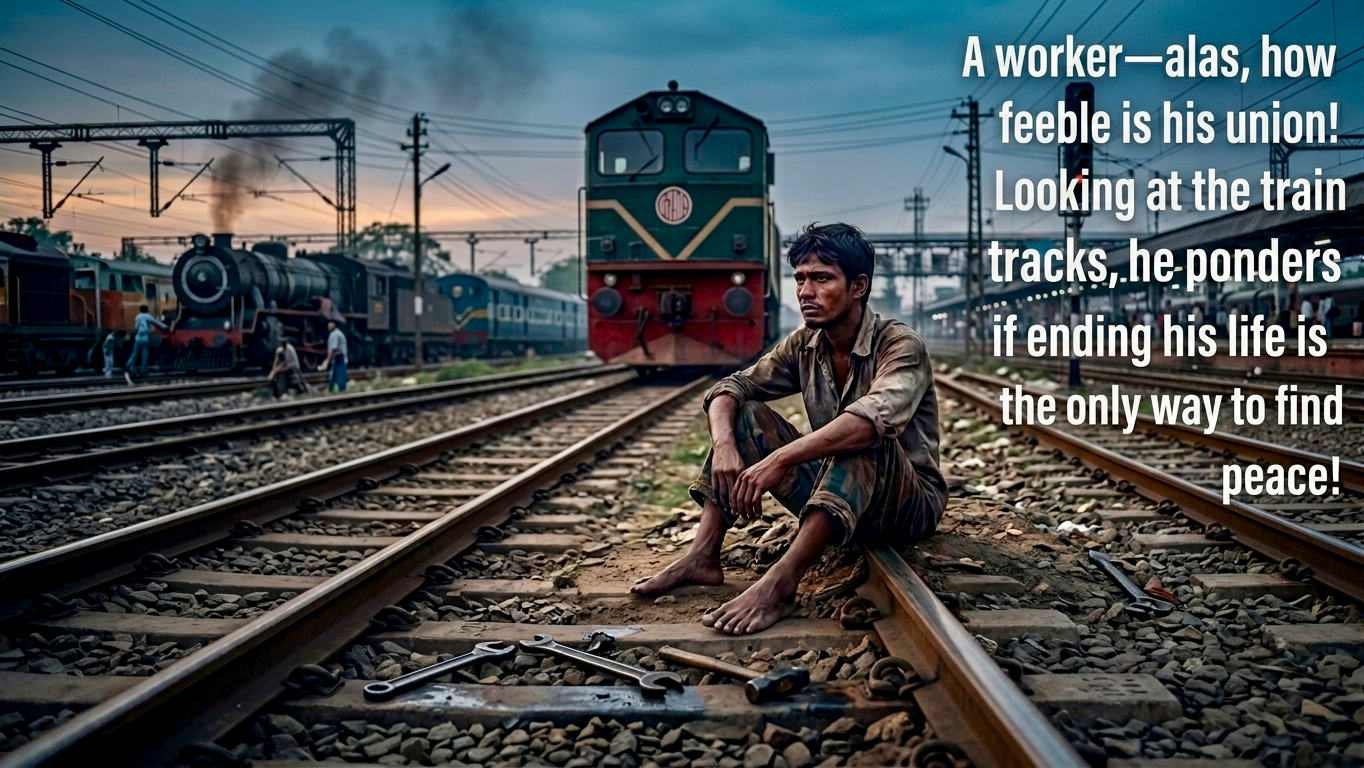
The root cause of this crisis lies in yellow journalism, corporate media, and, above all, a subservient and weak trade union system. Most major trade unions in Bangladesh are either politically tied wings of some bourgeois party or bought-and-paid-for slaves of the owners (Yellow Unions). When workers engage in direct action to demand arrears or living wages, these very union leaders collaborate with the state and police to repress the workers and throw them into jail under false charges. Due to the absence of an independent, class-conscious, and revolutionary syndicate, the vast proletarian force of Bangladesh stands completely disenfranchised and unprotected today.
6. Fall of Usurious Civilization and the Rise of Proletarian Internationalism
The social decay and moral bankruptcy we observe today are actually signs of the ultimate distortion of capitalism, or what can be called "Mohajoni Shovvota" (Usurious/Mercenary Civilization). In the feudal era, despite the suppression of exploitation, some pseudo-humanitarian social responsibilities remained. But modern capitalist society has reduced all human emotions, art, literature, culture, and relationships into mere commodities (Commodification of Human Relations).
Money is now the sole yardstick for nobility, capability, and character. The healthcare system has turned into a profit factory instead of a place of healing; the legal system has become a protective shield for the wealthy. The core mantras of this system are "Time is Money" and "Business is Business." This extreme individualism destroys the spirit of empathy and Solidarity within human beings. People are forced to worship this system because this bourgeois society yields no human dignity to the propertyless.
Yet, within this darkness, the light of liberation is visible according to the laws of history. In contrast to this global crisis of capitalism, a resurgence of working-class autonomy and the consciousness of a stateless society is occurring worldwide. The core tenet of anarcho-syndicalism is: the one who labors shall be the driving force behind the means of production and societal decision-making. There will be no place in society for those who lead parasitic lives by exploiting surplus value based on the labor of others.
The capitalists and their intellectual lackeys propagate this free socialist concept as "anti-individual freedom" or "unrealistic." However, they actually fear losing their freedom to exploit. Wherever mountains of private property and monopolization of wealth exist, social evils like theft, mugging, coercion, and state fascism are inevitable. The true liberation of humanity is possible only by shattering this bourgeois arrogance and the legal frameworks of private property.
Conclusion: A Call to the International Proletariat
The geopolitical and socio-economic equations of Bangladesh will not change merely through a transfer of power or a revision of the bourgeois constitution. Whether the reins of governance remain in the hands of Yunus's neo-liberal clique, the Awami League, the BNP-Jamaat, or right-wing fascism—the fate of the worker will not change.
We do not view this current transitional period in Bangladesh merely as a local crisis; rather, it is an inseparable part of global capitalism. Therefore, we call upon the comrades of the international anarcho-syndicalist movement—integrate the direct struggle of this marginalized and fighting proletariat of Bangladesh as a part of your International Solidarity. To defeat the nexus of local capitalists and global capital that exploits the workers of this country, we must coordinate our struggle at the international level.
The struggle is long, but the fall of the usurious civilization and the victory of the workers' syndicate are equally inevitable.
Workers of all countries, unite!