Fanny Kaplan: The Socialist Revolutionary Who Challenged Lenin’s Coup Against 1917 Revolution

Fanny Kaplan: The Socialist Revolutionary Who Challenged Lenin’s Coup Against 1917 Revolution
The 28-year-old half-blind woman appeared in a crowd of people near the Michelson arms factory in southern Moscow on August 30, 1918, took a “.32-caliber Browning pistol” and shot at Vladimir Lenin, the chief dictator of the Bolshevik regime, three times. Lenin was wounded by two bullets in his left shoulder and neck and although he narrowly escaped death, the shooting became a trigger that provoked a nationwide reaction and the Bolshevik regime proclaimed the Red Terror. Kaplan was executed for assassinating Lenin four days later without trial in a Kremlin courtyard and her body was cremated in an iron barrel in order to prevent the creation of her grave or monument. Here, it is important to note that Fanny Kaplan’s execution for the assassination of Lenin does not mean the attempt was successful. This serves as a clear example of how authoritarian regimes operate: an execution for an assassination attempt does not guarantee that the attempt resulted in death.
Contrary to what one might think about the case, the shooting at Lenin by Kaplan was anything but unpremeditated action. Based on her radicalization and commitment to the democratic agrarian ideas of the Socialist Revolutionary Party and her dissatisfaction with the Bolshevik autocracy that undermined popular democracy, Kaplan considered Lenin not as the liberator of the working people, but as a dictator who betrayed the Revolution.
Early Life, Revolutionary Beginnings, and the Siberian Katorga
Feiga Haimovna Roytblat (sometimes also Feyga Chaimovna Roitblat or Roitman), whose name is known in history as Fanny Kaplan, was born on February 10, 1890, in the Volhynia Governorate of the Russian Empire (nowadays it is Ukraine). She was raised in a family of schoolteachers. In 1905, Kaplan became a participant of revolutionary fever which spread over Russia. She joined an anarchist secret organization and started to use the pseudonym "Dora".
December 22, 1906 turned out to be a disaster for Kaplan who found herself in the room of a hotel in Kiev (Kyiv) putting together or storing homemade bombs in order to carry out an assassination of the governor-general together with her revolutionary boyfriend Viktor Garsky. One of those bombs exploded prematurely and killed a chambermaid of the hotel. As Garsky ran away, Kaplan was seriously injured and got damaged with explosions in her head, hands, face, ears, and eyes.
Sixteen-year-old Kaplan was arrested immediately after the explosion and tried in the military court for armed assault. She was sentenced to death; however, since she was underage, it was changed to lifelong imprisonment with hard labor in the katorga – tsarist Russian penal system in Siberia. She was imprisoned in Maltsev and Akatuy prisons of Nerchinsk katorga for 11 years. Being in prison, Kaplan faced corporal punishments which included caning on bare back as well as terrible headache and permanent temporary blindness. Being in prison, she learned Braille writing and committed suicide at least once. The blindness according to the prison doctors was hysterical or because of the injuries of the explosion. After electrical therapy and treatment in the hospital of Chita, she managed to see something again.
After the Russian February Revolution of 1917, which overthrew Tsar Nicholas II, the amnesty given to political prisoners led to her release after eleven years of incarceration. In Kharkiv, she underwent eye operations, which helped restore mobility in her eyesight. During 1917, she managed to get a job in the municipal government in Simferopol, located in Crimea. But when the Bolsheviks captured Simferopol in January 1918, Kaplan was deprived of her job and moved to Moscow by March 1918.
Kaplan’s Understanding of Socialism and the SR Ideology
During her katorga years in Siberia, Kaplan moved on from her earlier anarchism and joined the Socialist Revolutionary Party (SRs). The Socialist Revolutionaries were one of the main currents of Russian socialism that embodied the traditions of 19th-century populism.
Kaplan’s notion of socialism was characterized by several main ideas differentiating it from Marxist-Leninist socialism:
● Agrarian and Popular Basis: As opposed to the Bolsheviks whose focus was limited to urban industrial workers, the Socialist Revolutionaries considered the enormous peasantry of Russia to be the true basis of Russian socialism. They promoted the social redistribution of land to peasant communes and insisted that socialism had to evolve out of the working masses.
● Democratic Socialism and Pluralism: The ideology of the Socialist Revolutionaries was based on the French Revolutionary ideas of “liberty, fraternity and equality”. They stood for a democratic socialist republic wherein freedoms of speech, assembly, press and universal suffrage would be guaranteed along with economic reforms.
● Moral Commitment and Personal Action: The SRs maintained a powerful tradition of moral absolutism and sacrifice. The examples of role models such as Vera Zasulich, Sofia Perovskaia, Vera Figner and Maria Spiridonova made them consider the political violence not as the means of tyranny, but as morally justified resistance to oppressive rulers.
For Kaplan, socialism was closely connected with popular democracy and the dignity of people. In her opinion, socialism was impossible without the government corresponding to the actual will of the whole population, not the dictate of a political group backed by armed power.
Why Kaplan Considered Lenin a Betrayer of the Revolution
Kaplan's final and irrevocable break with the Bolshevik leaders took place in January 1918 because of the forced dissolution of the Constituent Assembly.
In the aftermath of the revolutions of 1917, a democratic national election was held in Russia with the aim of electing a Constituent Assembly which would formulate a constitution for the country. The Socialist Revolutionary Party emerged as victors in the elections gaining the highest number of votes in the whole country. However, when the Constituent Assembly met in Petrograd in January 1918, it did not submit to be the mere tool for implementation of Lenin's program. As a result, the next day of meeting, Lenin and the Bolsheviks conducted a coup against the Socialist Revolutionary Party who gained the highest number of votes in the Constituent Assembly across the whole country by forcibly dispersing the Constituent Assembly with the use of armed guards.
For Kaplan and other Socialist Revolutionaries, this forced dissolution of the Constituent Assembly meant an outrageous treason and a coup against the Revolution. As Kaplan perceived, Lenin proved himself a man without any care about democracy, worker, and peasants' self-governance and about the socialist idea in general. Creating a one-party Bolshevik dictatorship Lenin deprived the Russian people of their voting rights and destroyed all the achievements of the 1917 Revolution.
In her interrogations by the secret police, Kaplan clearly stated her motives. According to her, she was supporting the Constituent Assembly while seeing Lenin as a traitor who was undermining the worldwide socialist revolution.
The Assassination Attempt: August 30, 1918
By the summer of 1918, tensions in Russian politics became very high. In the morning of August 30, 1918, the chairperson of the Cheka in Petrograd, Moisei Uritsky, was murdered by a young radical. Nonetheless, senior members of the Bolshevik party continued their planned public appearances in Moscow that evening without providing additional security.
Lenin gave a speech that evening to a large audience of factory workers in the Michelson arms factory located in the south of Moscow, discussing the issue of the dictatorship of the proletariat. After the meeting ended and Lenin was leaving for his car, Kaplan approached Lenin in the yard of the factory. Hearing his name being called, Lenin turned around, and then Kaplan shot three times at him from a .32-caliber Browning pistol.
● The first bullet went through Lenin's coat.
● The second bullet hit his left shoulder.
● The third bullet entered the left side of his neck, damaging one of his lungs and lodging near the collarbone.
Lenin fell down into the car, which rushed him to the Kremlin quarters of Lenin, who refused to go to the hospital for the reason of waiting for another attack from assassins. The doctors came to the conclusion that the bullet, which damaged his neck, did not kill him because he turned his head at the moment of shooting.
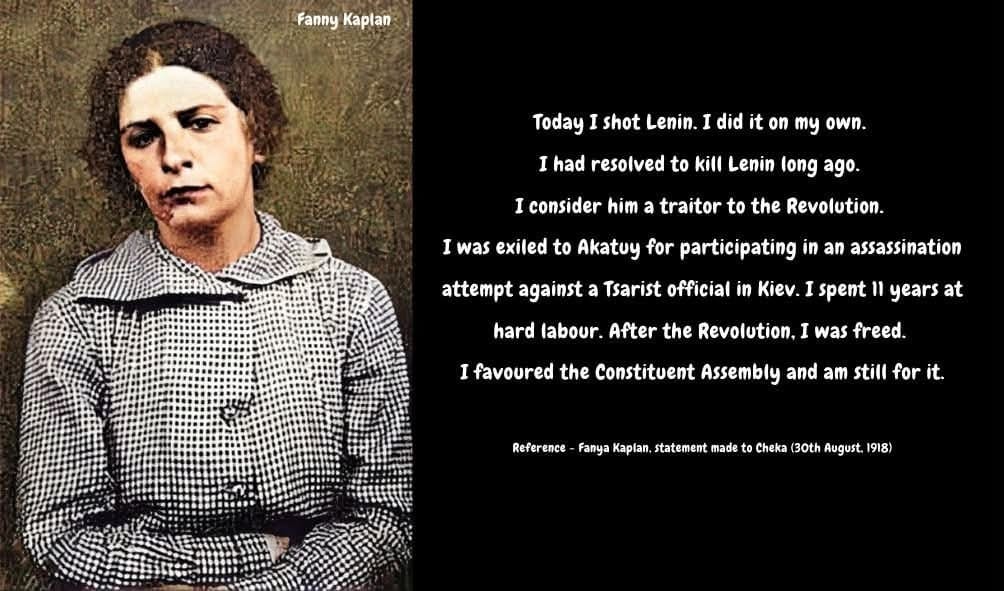
Kaplan did not run away. She was arrested at a tram stop near the scene of murder within several minutes and was immediately transported to the Lubyanka prison for interrogation by the Cheka. In six interrogations, she was always stubborn and did not give any information about the co-conspirators and the source of the gun. Her confession was recorded:
"My name is Fanya Kaplan. Today I shot Lenin. I did it on my own. I will not say from whom I obtained my revolver. I will give no details. I had resolved to kill Lenin long ago. I consider him a traitor to the Revolution. I was exiled to Akatuy for participating in an assassination attempt against a Tsarist official in Kiev. I spent 11 years at hard labour. After the Revolution, I was freed. I favoured the Constituent Assembly and am still for it."
Execution, Aftermath, and Historical Legacy
It is necessary to note that the leadership of the Bolsheviks did not expect a judicial trial of Kaplan. So, on September 3, 1918, the chair of the All-Russian Central Executive Committee Yakov Sverdlov ordered Kaplan's immediate execution.
Accordingly, Kaplan was led to the courtyard of the Kremlin used as a garage where she was executed personally by Pavel Malkov, the commandant of the Kremlin. He executed the order to kill Kaplan by firing a bullet into her back. While the Latvian guards were turning on trucks' engines to mask the shot sound, Malkov and a few people threw the body into the iron fuel barrel and burned it in the Alexander Garden next to the Kremlin. No marked grave and no remains were left.
Two days after Kaplan's execution, on September 5, 1918, the decree about the Red Terror was issued by the Bolshevik government. The attempt on Lenin's life and the murder of Uritsky were used as justification for a harsh campaign of mass arrest, hostage taking, and summary executions of class enemies.
Although Lenin survived, the bullets caused serious harm to his health. It was too dangerous to remove the bullet from his neck and he had to live all the rest of his life with the metal splinters in the body. Many scientists, both historians and physicians, believe that the serious physical shock because of the shooting led to the series of strokes that killed Lenin in January 1924.
Modern review of the case pointed to different forensic and visual inconsistencies, eyewitness contradictions and the fact that the bullet removed from the body of Lenin in 1922 was not compatible with Kaplan's Browning pistol. Additionally, there has been long discussion about the possibility of accurate pistol aim in view of her poor sight. But in 2026, the article in Acta Ophthalmologica proved that her visual functions allowed to shoot accurately from direct range at 10 feet in dim light.
Eventually, Fanny Kaplan is one of the most controversial characters of the Russian revolution. In her perception and in the minds of the SR members, her attempt on Lenin was the supreme expression of revolutionary sacrifice – an attempt to get rid of a tyrant, restore democratic sovereignty and punish the betrayer of socialism.
References
Findsen, Jenny R. "Women and Violence in Revolutionary Russia, 1860–1925." Master's thesis, Central Washington University, 2021. https://digitalcommons.cwu.edu/etd/1549.
Gilbert, Paul. "The Assassination Attempt on Lenin's Life by Fanny Kaplan." Nicholas II: Emperor. Tsar. Saint (blog), August 30, 2025. https://tsarnicholas.org/2025/08/30/the-assassination-attempt-on-lenins-life-by-fanny-kaplan/.
Schwartz, Stephen G., Christopher T. Leffler, Peter M. Allen, and Andrzej Grzybowski. "Fania (Fanny) Kaplan and the Attempted Assassination of Vladimir Lenin: Ophthalmologic Considerations." Acta Ophthalmologica 104, no. 6 (2026): 705–708. https://doi.org/10.1111/aos.70073.
"Fanny Kaplan: The Woman Who Tried to Assassinate Lenin." Utterly Interesting, August 30, 2024. Updated October 6. https://www.utterlyinteresting.com/.