Fuentes and the Executioner: The rising legitimist in the age of populism

Long before Nazism became the definitive symbol of antisemitism, despotism, and xenophobia, an earlier generation of far-right ideologues was already constructing conspiracy theories and promoting the expulsion and extermination of minority populations. Today, with the rise of democratic right-wing populism and the normalization of illiberal conservative ideas, an odd ripple effect has appeared in political culture. Rather than fascism regaining traction—something it could not achieve then and still cannot now—other species of illiberal conservatism have found a peculiar niche in the contemporary landscape.
In the United States, one figure embodies this strange revival: Nick Fuentes. While he has repeatedly praised Hitler and at times described himself as a Nazi, Fuentes is not, in any coherent ideological sense, a fascist. His political mazeway draws instead from other far-right traditions, often presented through a mix of provocative irony and straight sincerity. His admiration for figures like Franco, Stalin, and Napoleon reveals less an interest in their specific doctrines than in their shared authoritarian posture. In much of the material, he just engages in lame attempts at shock humor, yet beneath such displays of cheap bait to enrage his enemies, there does exist material where he expresses a coherent and genuine longing for a type of re-enchantment of the world by rigid hierarchy and clerical authority.
Fuentes’s conception of Hitler as a “misunderstood conservative” reflects this mix of bait and sincerity in his work: he sees the dictator not as the architect of global catastrophe, but as a defender of national integrity. This reading overlooks how Nazism would have crushed any theology or politics resembling Fuentes’s own. The “Hitler was actually a misunderstood conservative who was made a world villain by fake Allied propaganda to undermine conservative values” myth is its own larger topic concerning how Holocaust revisionism can manifest itself in all sorts of peculiar ways in non-fascist far-right spaces. His praise of Stalin and Napoleon is rooted in their naked exercise of power. At the same time, his admiration for Franco is more substantive, given the latter’s imposition of Catholicism as a state-enforced religion. Still, it is doubtful Franco would have reciprocated that admiration; Fuentes’s calls for the Vatican to wield diarchic and ultimately greater power than the state far exceed what Franco himself permitted.
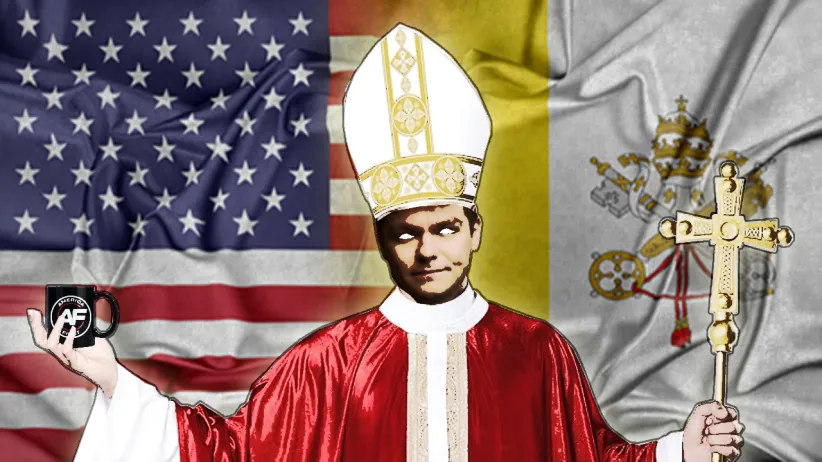
Before he broke off his support for Trump due to the 2024 campaign and the second administration's continued support for Israel, Fuentes even proposed a bizarre utopian scheme. In this scheme, Trump’s initial 2016 election was to somehow transform into a larger project over time that would see him crowned as a Catholic monarch, ruling a Vatican-backed America—a fantasy revealing both his integralist (diarchic rule of church and state to reorder the government towards a path of spiritual common good) impulses to mass depoliticize the populace and his detachment from liberal constitutionalism due to personal alienation from it to seek an alternative system to rediscover social belonging. Fuentes's support for Palestine is premised on removing "Jewish dominance in the US" and retreating the US towards an isolationist foreign policy. His opposition to the Israeli genocide of Palestinians is ultimately in service of a grand and horrifying vision for a large-scale domestic attack and removal of minorities. The recent rise in anti-Zionism since the October 6th attacks and Israel's brutal response of collective punishment has boosted the platform of antisemitic personalities like Fuentes; however, thankfully, most of the growing anti-Israel sentiment has managed to separate itself from antisemitism.
Funnily enough, Fuentes's newfound popularity and audience have actually become something of a curse more than a blessing for him, as he's become noticeably more irritated and annoyed being surrounded by more like-minded individuals. He seems to drift towards the company of certain political adversaries as a way to stimulate himself from the drudgery of listening to his audience agree with him. While in this period of modern decadence, which he defines as caused by ethnic, religious, and sexual minorities, he still manages to recognize, in a sort of grand political irony, that he can have more creative freedoms in a plural and secularized society than he would be afforded in a world dominated by his own ideas. Since in this "fallen world" he can walk away from like-minded people and hang out with catboys, while in a world dominated by his ideas, he wouldn't be allowed such pleasures. Any deeper psychological analysis, however, is for others to engage in.
Fuentes represents a curious reemergence of legitimism—the oldest species of illiberal conservatism—into the twenty-first century. This lineage of classical far-right thought first appeared in the early nineteenth century with thinkers such as Joseph de Maistre and Louis de Bonald. De Maistre called for a universal Catholic order where all nations paid religious service to the pope but were given some autonomy in their temporal governance; Bonald, by contrast, envisioned Catholic supremacy within the Christian world while largely leaving non-Christian societies untouched, thinking it to be too costly. The movement was initially known as ultra-royalism (or simply ultras) in post-revolutionary France, dedicated to restoring the Bourbon monarchy. Over time, legitimism came to designate, in its narrowest sense, the claim of the Bourbon dynasty’s senior branch to the throne. Yet, in its broader and more generically ideological form, legitimism signified the mythic and organic idealization of the medieval order—a vision of a society whose restoration could heal the alienation and decadence unleashed by the Enlightenment and its revolutions. No matter how religious any form of legitimism is, it has to rely heavily and ironically on the secularized conditions of the Enlightenment to come to its intensely reflexive and instrumental ideas about religion and its function in human society as a good for historical continuity rather than exclusively a good for religious observance.
Legitimism is counter-revolutionary, though not in the sense its opponents meant. It did not seek merely to reverse history or “reset the clock.” Rather, it aimed to revive the values, hierarchies, and spiritual cohesion of the medieval world in a self-conscious, modernized, and, as time progressed, more radically transformative way. This results in a medieval modernization that requires a reimagined and cohesive Middle Ages, enhanced by the integration of modern materials and ideas. Often incorporating the early modern European system of the ancien regime, but often criticizing its absolutist monarchies and their trend of administrative centralization, and the overall move away from feudal Europe as the beginning of the end. The precise use of "counter-revolutionary" here will mean an extensive attempt to invert modernity by restoring a sacred, depoliticized, and earlier temporality to then progress on from, a typical display of cosmological time travel in modernism. Legitimism’s counter-revolution promotes rule by multi-minoritarianism, typically represented by three layers of rigid social hierarchy: nobility, clergy, and peasantry, contrasting with elitism, which is characterized by the dominance of singularized elite hegemonized values and beliefs. Legitimism is the closest to a pure “reactionary” ideology, but instead of literally going back, they instead do something worse: move the tyrannies of the past forward.
In this respect, legitimists were often more radical than the authoritarian conservatives of the early twentieth century, who eventually eclipsed them. Whereas the elitist ultra-statism of authoritarian conservatism, which proclaimed “new states” outside the liberal order but opposed to radical dynamism, sometimes literally using the phrase “new state” in some way, for the existing national community to serve under, sought to modernize conservatism under the guidance of a dictator or an elite governing body. There, the usage of religion and monarchy was that of subservient instruments, even when the leaders themselves were monarchs, to create a new illiberal statist community run by existing elites and structures, never aspiring to resurrect the medieval ethos. Whereas legitimists wanted to remake society altogether, to resurrect the medieval spirit itself through modern means. Even when later legitimists like Charles Maurras, an agnostic who incorporated positivist ideals and treated Catholicism as instrumental and opposed theocracy, still espoused restoring medieval and anicen regime ideals onto France, an incredibly traditionalist vision that would've gone well beyond what the Vichy regime's leaders were willing to go. Maurras also represented a more intensive nationalist turn for Legitimists dubbed "integral nationalism."
It can even be argued that legitimism, like any generic concept, eventually transcended its original European context and found expression in the non-European world. The Middle Ages—though marked by diverse economic worlds—nonetheless shared a recognizable constellation of values: complex, immobilized social hierarchies; providential forms of authority; guild-based economic organization; and varying degrees of local self-governance, often accommodating tribal or customary authorities within regional frameworks. As modernity reconceptualized the medieval period as a unified ethos, this mythicized vision of the Middle Ages was reinterpreted not just in Europe but in other parts of the world. In the Islamic world, it contributed to what might be termed Islamic legitimism, culminating in regimes such as Khomeini’s Iran, the Taliban’s Afghanistan, and Saudi Arabia. In recent years, however, the Saudi monarchy has gradually distanced itself from its legitimist foundations, moving toward a form of authoritarian liberalism, a species of liberal conservatism that requires its own article, akin to that found in Kuwait and the United Arab Emirates.
Fuentes’s oddness, then, can be understood as a product of the heightened conditions of late modernity and internet culture. The collapse of the liberal geoculture—the global framework of liberal norms that once governed political legitimacy—has created a strange vacuum. The strangeness of which is only exacerbated by the economic conditions of further decline following the end of neoliberalism in the Great Recession. In that void, extremism is paradoxically more visible yet less potent. While space has opened for extreme ideologies to reenter public discourse, it still hasn’t resulted in governance, as this space is largely monopolized by populists rather than by extremists. As a result, ideologies like socialism and fascism feel simultaneously nearer to collapse and further from influence: their apocalyptic tone resonates, but their political agency is still withered. Populists, particularly of the illiberal conservative kind, have absorbed the energy of extremism without inheriting its revolutionary capacity.
To clarify this analysis, we should form a basic taxonomy of the political right. Broadly, the right can be divided into three primary spheres: the center-right, the radical right, and the extreme right, with the term "far-right" encompassing the latter two. The far-right will be our main focus here.
The center-right, or systemic right, corresponds to ideological species within liberal conservatism, which is committed to preserving the systemic order, constitutional liberalism, and social orders built on upholding gradual reform. This can materialize in many governmental positions, such as coalitions with centrist liberalism inside a plural government; subordinate, where the liberal conservative force holds less or little power compared to centrist liberalism in government; dominant, where a liberal conservative force holds significant power over centrist liberalism in plural governance; or autocratic, where the liberal conservative force holds exclusive power in governance. The autocratic position produces liberal social orders that lack democratic procedures outright or effectively through a hegemonized party.
The radical right, or alter-systemic right, corresponds to ideological species within illiberal conservatism and the whole of the libertarian ideological genera, which seeks alter-systemic solutions—either by efforts to build societies outside the liberal order with theories of illiberalizing constitutions or outright seeking post-constitutionalism to overturn liberalism's perceived cultural or moral dominance locally, or even going as far as theorizing about creating a radical right geoculture (either dominated by a single illiberal conservative vision or allowing a coexistence of multiple) to replace liberalism's perceived global dominance, yet without effectively dismantling the capitalist world-system.
Illiberal conservative schemes focused on restoring social continuities and tradition to control and curate an "imperfect humanity" from destroying itself. Libertarian schemes focus on an alternative form of horizontal sovereignty, which places all individual persons as equally and separately sovereign from each other, which produces a kind of hyper-interstatism where every human, usually adult, is equal to their own polity and anatomically on par with nation-states or empire-states in previous polity forms in the interstate system.
Legitimism’s position on our conception of the radical right is solidified by the fact that many of its most transformative forms advocate for the capitalist world-system to have a religious hegemony in it, with either an official church authority enforcing certain rules onto part or the whole interstate, as seen with Catholic varieties, or this authority represented by a large religious state, as seen with Islamic varieties.
This taxonomy of the radical right is influenced by Cas Mudde and Stanley G. Payne but breaks from them in notable ways by tying the ideological spectrum to chrono-ethnological and world systems analysis. I.E., the temporal trajectory of agentic imagination and its consequential relationship in relation to the capitalist world-system. Mudde, for instance, conceptualizes the radical right as "illiberal but democratic" and the extreme right as "illiberal and antidemocratic." Payne used authoritarian conservatism as a far broader term in his tripartite typology for right-wing authoritarian nationalism to refer to those wanting less socio-structural change from the radical right, who were considered their own separate category, who were for more drastic changes to society.
The extreme right, or post-systemic right, corresponds to the ideological genera of fascism and jihadism, which operate on a post-systemic level, aiming not only to abolish the liberal order but also to transcend and destroy the capitalist world-system altogether through violent revolution and a social order built on total dynamism. Fascism’s ultranational rebirth, however self-describedly “capitalist,” requires the subordination and destruction of interstate norms and functionality to the ultranation’s greatness and creativity. Jihadism is seen as the furthest right within the extreme right because its global paradise of martyrs requires all its members on an individual level to be self-sacrificing in its replenishment. Jihadism’s globalism, while more open and seemingly “inclusive”, is far more intimately and outwardly inegalitarian as it requires the whole of humanity to be brutally regenerated on a far more individual level.
Within this framework, the far-right spectrum—moving from the more moderate to the most extreme—can be outlined as follows, with only the ideologies that concern us here within the spectrum: democratic right-wing populism → authoritarian conservatism → legitimism (which all make up species within illiberal conservatism) → libertarianism → fascism → Jihadism. Note that other unnamed illiberal conservative species exist, and libertarianism, fascism, and jihadism host their own complicated histories of speciation and subgenera, such as what Being calls cultural and racial fascism, but this is left out for simplicity's and focus's sake.
Among these, democratic right-wing populism represents the most moderate form of the far-right. It seeks to “save” constitutional democracy by redefining its laws, rights, and legitimacy as belonging exclusively to the ethnos—the spiritually and ethnically hegemonic national community imagined as the rightful core of the nation. Libertarianism, by contrast, occupies the furthest edge of the radical right because it rejects any form of social cohesion not derived from voluntary private contracts. This vision leaves the individual in a condition of absolute autonomy yet profound social isolation, producing a form of inegalitarianism even more radical than illiberal conservatism, which at least preserves “social freedoms” within institutional or communal hierarchies. Jihadism is represented as its own ideological genus, separate from a simple form of Islamism, and put on the furthest right due to its rejection of nationalism and existing Islamic communities that it views to be inherently corrupted, and demands that all members sacrifice themselves to replenish the utopia of global martyrs.
For those paying attention, Fuentes—despite his “America First” rhetoric and apparent attachment to nativism that might initially mark him as a right-populist—is, in fact, ideologically at odds with right-populism. His variation of legitimist belief envisions a society in which the “native people” would be depoliticized, as a majority would be placed into permanent lower-class services under reimagined, transplanted European medieval hierarchies of aristocratic, hierocratic, papal, and monarchical authority. His white nationalism, though seemingly inconsistent with legitimism, is not foreign to it: by the mid-nineteenth century, some legitimist theorists such as Arthur de Gobineau had reinterpreted racial prejudice as a natural extension of their call for a stratified, multi-layered social order—by arguing that excessive race mixing deteriorated medieval values and led the way to destroying “natural class divisions” via the equalization of power by democracy and capitalism. Gobineau also regarded whites as the most superior and stated that “all civilizations derive from the white race, that none can exist without its help, and that a society is great and brilliant only so far as it preserves the blood of the noble group that created it, provided that this group itself belongs to the most illustrious branch of our species,” in his infamous An Essay on the Inequality of the Human Races, which has become a major work of early white supremacist literature. Legitimism was generally overtly hostile to capitalism’s excesses in that they regarded the bourgeoisie as gluttons who disregarded traditional social differences for the social equalization of commercialism, unlike the proper upper class of aristocracy in their minds, which, according to them, knew how to provide a higher purpose for the lower classes other than work and consumption. This created an aristocratic class consciousness for legitimists to employ in their analysis of society's ills.
Time and time again, even Fuentes’s racism always falls short of the kind found in Nazism’s ultranationalism, although this isn’t to say it's “less bad”; rather, it's ideologically different but still capable of doing plenty of harm. When pressed on whether he would prefer a multiracial fellowship recognizing the sovereignty of Christ or a community of atheist white men, he consistently chooses the former. He even said his Catholic beliefs and politics came first before white nationalism and “white genocide.” A source of consistent friction within Fuentes has always been the simple fact that Jesus Christ taught universal and equal subordination of all mankind under the power of God; notions of white superiority over the “lesser races” mean nothing and, in fact, are inconsistent with this teaching of human equality before God’s superiority. His antisemitism is far more consistent and arguably much stronger, given that Jewish people have been deemed by bigoted Christians for centuries to be “responsible for Jesus’s death,” and the supersessionist doctrine in particular, which argues that the Christian church has succeeded the Jewish people as the new rightful inhabitants of God’s covenant.
In taking this all in, Fuentes isn’t even a populist. Racist and evil authoritarian? Obviously. But his specific politics are those of a Catholic legitimist with a flair for theatrics and digital spectacle seeking to co-opt the energies of Trumpist populism for distinctly non-populist ends. His own Groypers movement even had something of an internal fissure a while ago between the Protestant paleoconservatives (the previous American right-populist movement before Trump) within it and the legitimist Catholics.
Anarchists should view their opposition to the political right as a multifront conflict against heterogeneous forces of inegalitarian malleability. Conservatism alone is a beast with many faces, a lot of them older than fascism, and should be fought head-on with clear recognition of their nuanced differences and theoretical approaches so as to better hit back at targets with a clearer focus. We can’t simply rally our banners as Antifa but also as Anticon. Opposing the non-fascist populist right, legitimists, and so on, more directly. The rise of right populists doesn't mean a rise in fascism, but it still does mean a rise in tyranny that must be resisted.
Sources and further reading:
- Arthur de Gobineau — An Essay on the Inequality of the Human Races
- Roger Griffin — Fascism: Key Concepts in Political Theory
- Roger Griffin — Interregnum or endgame? The radical right in the ‘post-fascist’ era
- Steven Kale — Gobineu, racism, and legitimism: A royalist heretic in nineteenth-century France
- Cas Mudde and Cristóbal Rovira Kaltwasser - Populism: A Very Short Introduction
- NCTV — Global Jihadism: Analysis of the Phenomenon and Reflections on Radicalisation
- Stanley G. Payne — A History of Fascism, 1914-1945
- Kevin Vallier — All the Kingdoms of the World: On Radical Religious Alternatives to Liberalism
- Immanuel Wallerstein — World-systems Analysis: An Introduction
- Post-Comprehension — Life, Liberty, and the pursuit of Likeness (https://medium.com/@postcomprehension/life-liberty-and-the-pursuit-of-likeness-6a2b1b9ebcda)