McPolitics: The Compass That Ate Ideology

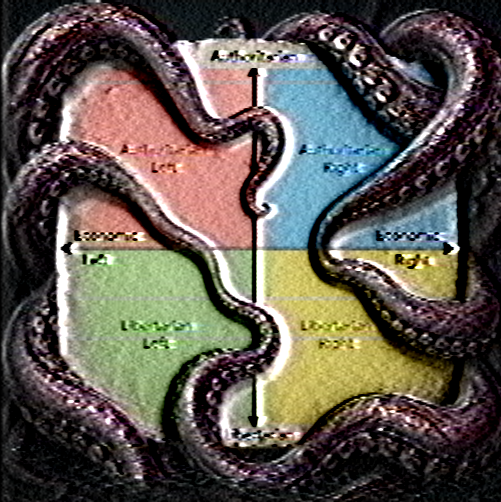
One of the most successful noosurgical instruments of early internet culture, the Political Compass was created in 2001 by New Zealand journalist and amateur noosurgeon Wayne Brittenden. It draws from the work of Wilhelm Reich, Hans Eysenck, and Theodor Adorno, according to the website’s own description. Because, of course, this thing is inspired by a psychoanalyst, personality psychologist, and social theorist. It became massively popular during the 2010s alongside meme culture and social media, eventually becoming so normalized online that many people now assume (to comedic horror) it is a longstanding academic framework within political science rather than a relatively recent internet artifact. Its influence has been significant not because it maps political ideology particularly well, but because it reformats political consciousness into something simplified, consumable, and behaviorally manageable.
Although this process of turning political ideology into simplistic behavioral policy training predated the political compass by over half a century, the compass merely hyper-intensified those earlier developments, which we will briefly review and refer to as ideological reversity and ideological decoupling.
Ideological reversity occurs when surface policy positions replace the deeper worldview they originally emerged from, resulting in ideological labels being used to refer to specific policy sets. For example, liberalism goes from a specific worldview about the rule of sameness and enlightened contractualism to being used to refer to economic deregulation or social progressivism. Leading one to use the term in combination with others, most infamously, in the format of “I am socially X-ideology and economically Y-ideology.”
Ideological decoupling is the process through which political ideologies are atomized into measurable administrative modules for specialized data collection. Those policy-set labels taken from broken-down political ideologies are then used here to quantify independently or comparatively how “liberal” or “conservative” a person, institution, or place supposedly is. For example, one might measure how “liberal” an economy is by its openness to private and multinational commercial interests. This trains people not to ask about or investigate deeper political worldviews, but instead whether someone supports specific administrative policies which are already circulating among incumbent politicians, parties, and electoral campaigns.
The Political Compass standardizes this decomposition in both virtual and meat space through an online questionnaire. Given that the line between those who are wired and unwired is continually blurred. It does this by transforming political self-identification into a fast, quantified, and increasingly aestheticized process, all easily accessible in an online questionnaire format. Because, of course, this would be delivered via questionnaire, given that technocrats love nothing more than a good piece of paperwork for you to fill out in the name of data analysis. The website upon which this infernal thing exists even openly declares: “Our essential point is that Left and Right, although far from obsolete, are essentially a measure of economics.” There could scarcely be a better slogan for moderate technocracy and its methods of decomposing politics than the idea of it as merely a measurable arrangement of economic preferences.
Now, how does this magical techno-wizardry work? The mechanism is as follows: respondents answer 62 multiple-choice questions using a four-point scale—strongly agree, agree, disagree, strongly disagree. Each response is assigned a weighted value, typically +1, +0.5, −0.5, or −1, depending on both direction and whether the item is categorized as economic or social. These values are then aggregated across two orthogonal axes: economic (left–right) and social (libertarian–authoritarian), ultimately generating a numerical ideological coordinate within a two-dimensional grid.
Each axis is conventionally bounded at ±10, though real outputs usually fall within fractional intermediate values. For example, a result might read: economic −5.25, social +0.67. These coordinates are then plotted onto a four-quadrant grid: on the top are authoritarian left, authoritarian right, and on the bottom are libertarian left and libertarian right. The use of “authoritarian” and “libertarian” here, packaged primarily as indicators of top or bottom management and inclusive or exclusive culture in policy creation, separates both concepts from anything historically and taxonomically useful. The four-quadrant format itself has spawned countless internet memes, extending well beyond politics.
This structure is not merely descriptive but implicitly normalizing. It conditions political thought toward treating ideologies as decomposable vectors rather than internally coherent worldviews.
For example, the statement,
“I want universal healthcare, but only for my ethnic group,”
is implicitly decomposed into separable scoring components rather than treated as a unified ideological formation. Leading one’s political imagination to see the above statement as an isolated mathematical equation rather than as part of a wider political philosophical position requiring further exposition. Under the system’s logic, it resolves into something structurally equivalent to:
[universal healthcare → -1 econ] + [ethnic exclusivity → +1 auth] = [top-left -1]
These components are then summed along orthogonal axes, yielding a composite coordinate approximately situated in the authoritarian-left region of the grid.
The user is thus positioned as both the instrument and the instrumentalist of analysis (essentially nudging the user into a voluntary form of self-instrumentalization), encouraged to externalize political belief as standardized inputs and then accept an externally generated ideological identity in return. This produces a feedback structure in which self-description is routed through predefined metric categories, encouraging individuals to reimagine political commitments as calculable trade-offs rather than holistic positions.
By compelling users to map themselves along predefined axes, the compass becomes subtly internalized at a deep psychological level, gradually reshaping not only self-perception but also the very schema through which politics is understood. This makes the compass intuitively accessible for widespread use. It's apparent that the user-reported “accuracy” is caused and reinforced by a mild confirmation loop: the more one adapts to its categories, the more coherent the resulting placement appears. You got that “accurate position” because it was leading you there to find it.
There isn’t anything wrong with trying to map out or simplify political ideology, but the Political Compass doesn’t merely do that. Rather, it reformats political consciousness into a system optimized for fast-food ordering. Politics becomes less a matter of grand worldview formulation and more a process of McDonaldized self-curation through quantified preferences and behavioral metrics. McDonaldization describes the increasing dominance of efficiency, calculability, predictability, and control through quantification within modern institutions. The compass offers a rapid, standardized, and highly shareable method of processing political identity. Rather than requiring in-depth engagement with political theory and activism, the compass compresses ideology into a fast-consumable interface.
Initially, identification with an ideological ism, which emerged prominently in the early 19th century, was shaped by a complex interaction between subjective (internalizing social production) and objective (externalizing social production) forces, which came to signify associations with written political traditions, collective organizations, and individual activism. Ideological affiliation wasn’t achieved through highly calculable, predictable selections of controllable policy positions but rather signified attachment to larger structures of meaning that arose from unpredictable, chaotic places of existential worry. Not to imply this meant every previous and current non-technocratic political self-identity is necessarily always done through grandiosely accurate and rigorously exercised application. But it did/does arise from an earnest mess of homeless meaning and method. Which, when left unmonitored, pose a potential threat to moderate technocratic plans.
The larger background to this transformation of political ism as a programmatic sign to a policy sign was, to simplify, a long journey we will divide into three eras. The first era, from the late 17th century to World War II, felt far more precarious and fragile in certain ideological ways to people in what was the emerging liberal international order, which didn’t fully exist until the post-1945 world. The ambiguity was who would settle the question of what would create permanent earthly solidity in the face of modernity’s flux?
Once this question was “answered” by the end of the Second World War, the emerging liberal international order increasingly presented moderate technocratic management as the final solution to ideological instability. Again, management, not ideology! Because, according to the ideology of moderate technocracy, there was no more need for belief in any ideology, including itself, and so people need not actively believe, fight, and name themselves moderate technocrats or participate in any grander historical struggle. Because what moderate technocracy demanded from people wasn’t programmatic activity but policy activity. To participate, while heavily guided and proceduralized, in taking data collection activities, which include voting. And so a quick, long journey of development began to turn political self-identification into policy preference.
From 1945 to 1991, a new ambiguity emerged: why was there alienation within this supposed solidity? Flux was still there, and yet the ethos told its people that their only response to this existential problem was drive-through elections and take-out mobilizations. Resulting in all sorts of explosive events of terrorist action from enemies of the liberal international order attempting to end the plastic flux to the supporters attempting to reassert it through state-sponsored violence overseas.
The last era, from 1991 to the present, has seen the whole infrastructure of the liberal international order dying off and thrown into a freefall in the last decade alone, but its language and thinking still desperately cling to minds. Presumably, one would think we would see a return to the political ism as a programmatic sign, but really, there is no such guarantee. The same goes for presuming the policy sign will continue strongly. The use of the word decomposition throughout isn’t simply allegorical, as the composition of moderate technocratic brain surgery is atrophied by compressing, cannibalizing, and recycling it further into a more blatantly and crudely displayed interface. Meaning the policy sign is grossly necrotizing before our eyes as people take inspiration from the political compass by making their own similar political questionnaires.
What are anarchists to do in this age? Well, for starters, don’t reverse and decouple anarchism into another word for policy! There are no anarchist policies to test and tease out in front of focus groups, electoral stages, and political offices. No, someone putting up their cart after grocery shopping isn’t “anarchistic”; it surely doesn’t make you an anarchist either, as if we can somehow measure how anarchist someone is by what behavioral niceties they do. Anarchism isn’t another vague methodology through which we can test out psychological nudging on a population, like scientists experimenting on lab rats. We must avoid technocratic trappings and learn to fully embrace the free part of free association by expressing ourselves as a grandiose cosmic project that will accept no substitutes. People aren’t mere instruments to procedural means; they’re universes in themselves! They, the muddied workers, the twilight prostitutes, and the carnival freaks, will make conscious the instruments of ideas and labor with their minds and hands, marching in unison against the limits of the unconscious.
Citations and further reading:
- Political Compass website - https://politicalcompass.org/
- The first McPolitics Essay - https://medium.com/@postcomprehension/mcpolitics-moderate-technocracy-with-fries-8814866e3eb1