Control on a plate (MBG and the Illusion of State Care)
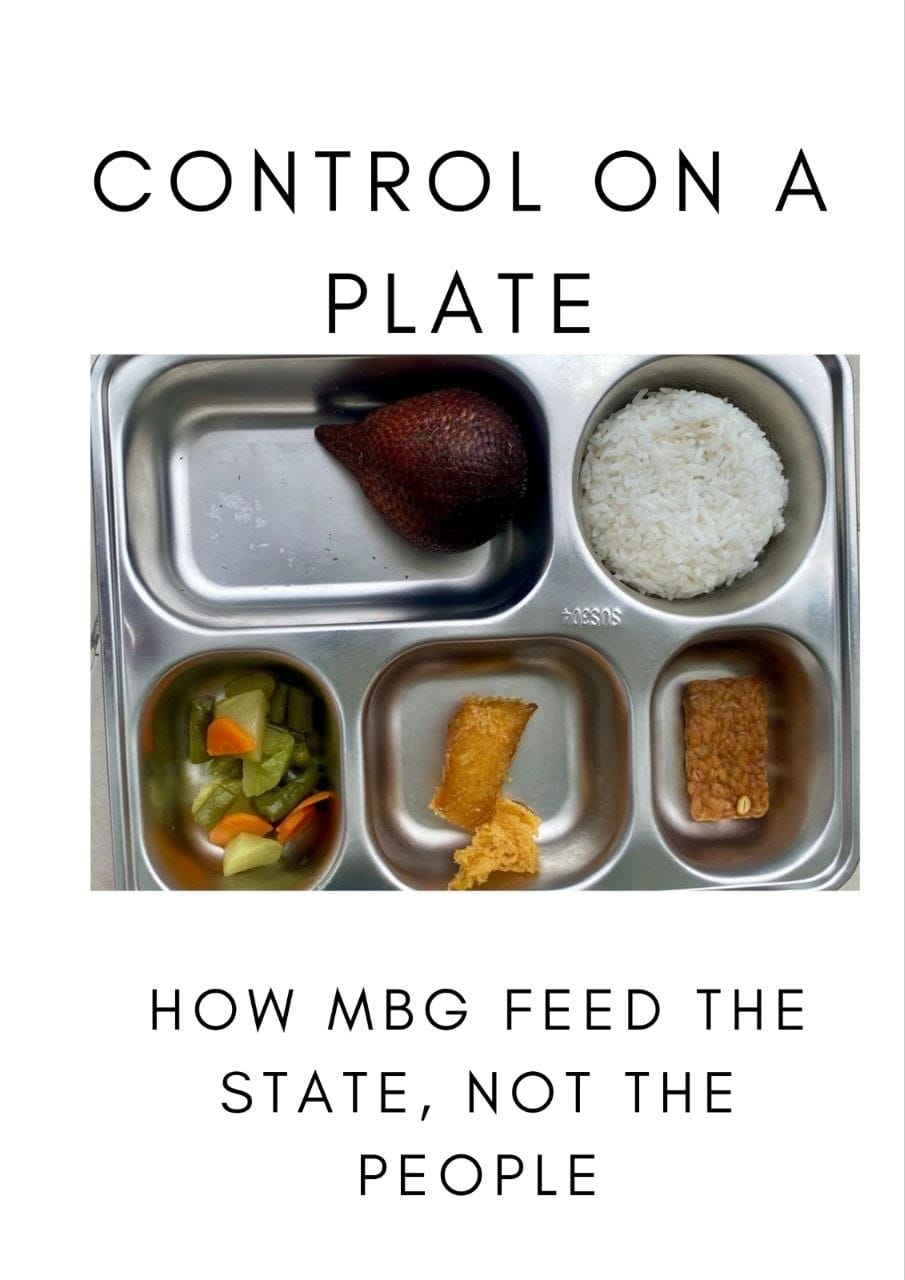
The state feeds. But never without consequences. Indonesia’s Free Nutritious Meals Program (MBG) arrives with promises that are difficult to reject : addressing stunting, improving children’s nutrition, and proving that the state is truly present in people’s lives. In its official narrative, MBG is framed as a symbol of progress, a sign that the state does not merely govern, but also cares. Yet beneath this language of welfare lies a question rarely asked “why is the state so determined to maintain this program, even as criticism grows, problems persist, and its impacts begin to endanger those it claims to protect?”. This question matters, because it reveals that MBG is not simply a social policy. It is part of a broader logic of power.
From the outset MBG has been plagued with structural problems. Inadequate infrastructure, chaotic distribution, and questionable food quality all point to a program built on weak foundations. Yet instead of being halted or seriously re-evaluated, MBG continues to expand. This is the contradiction, failed policies are usually corrected or abandoned. MBG is not. The explanation cannot be found in the language of welfare. It must be sought in the network of interests operating behind it. MBG opens up a vast economic space. Food procurement, logistics distribution, and the management of Nutrition Fulfillment Service Units (SPPG) create a new ecosystem involving investors, contractors, bureaucrats, and even state security forces. This is not merely a program about feeding people. It is a mechanism for channeling large flows of capital through organized networks. In this context, it becomes clear why the program is so difficult to stop. What is at stake is not just policy, but the circulation of profit and the distribution of power.
One of the most revealing aspects of MBG is the profit potential embedded within the SPPG system. Under current schemes, a single kitchen can generate around six million rupiah per day. Over a year, this becomes a significant sum. At the national level, it becomes an industry. At this point, MBG ceases to be a social program. It becomes a business. And like all businesses under capitalism, profit is not evenly distributed. It concentrates. A small group of actors captures substantial benefits, while the majority remain passive recipients. Ironically, a program presented as a solution to inequality risks reproducing it.
The involvement of state security forces further clarifies this trajectory. The participation of the military and police in MBG is often justified as a logistical necessity. In reality, it signals something deeper, the expansion of armed institutions into the economic and social sphere. But the problem goes beyond distribution. In practice, security forces are not only involved as implementers. They are increasingly positioned as managers and even owners of SPPG units. This means they do not merely oversee the program, they directly profit from it. At this point, the boundary between power and business collapses entirely.
Institutions that are supposed to remain neutral are transformed into economic actors. They do not just secure the system, they become embedded within its circuits of profit. With daily incentives reaching millions of rupiah per kitchen, this involvement is not marginal, it is systemic. The implication is clear that MBG does not only extend state control over everyday life. It also strengthens the economic power of state security apparatuses themselves. When the same institutions act as implementers, regulators and beneficiaries accountability becomes nearly impossible. What remains is a closed loop of power reproducing itself.
The contradictions of MBG also appear clearly in its funding. The government frames the program as the fulfillment of a basic right. Yet at the same time, other sectors such as education and healthcare, also fundamental rights are deprioritized. This reveals a clear political choice prioritizing programs that are highly visible and easily instrumentalized for political gain over long-term investments whose benefits are less immediate. Food becomes a symbol. Education and healthcare become budget lines. This contradiction exposes that MBG is not simply about welfare. It is about image and control.
Perhaps the most alarming aspect is its direct impact on children, the very group it claims to protect. Mass food poisoning is no longer an isolated incident. It has become a pattern. Thousands of students have reportedly suffered from food related illnesses across different regions. This is not merely a technical failure, it indicates a system unable to guarantee the most basic requirement ; safety. Under normal circumstances, a program that endangers children’s health would be suspended. MBG continues. The decision to persist, despite clear risks, suggests that other priorities outweigh safety. Here, the logic of power becomes unmistakable.
MBG operates in two directions at once. On one hand, it appears as assistance. On the other, it produces dependency. When basic needs such as food are mediated by the state, the relationship between state and society becomes increasingly asymmetrical. The state becomes the central distributor. People become recipients. Over time, this erodes the capacity of communities to organize themselves. Yet alternative systems already exist like local food networks, school canteens, and community based solidarity initiatives. These systems are often more flexible, more responsive, and more grounded in real needs. But they are not chosen. Not because they are ineffective, but because they do not align with the logic of control.
From a broader perspective, MBG reveals how modern states operate not only through law and coercion, but through the management of everyday life. The state regulates not only what is prohibited, but also what is consumed, how it is distributed, and who is entitled to receive it. Within this framework, welfare is not merely an objective. It is an instrument. An instrument to build legitimacy. An instrument to distribute resources selectively. An instrument to reproduce structures of power.
The notion of “free” in MBG ultimately becomes misleading. Nothing in such a system is truly free. Costs always exist, even if they are not immediately visible. They may take the form of diverted budgets, health risks borne by recipients, or the erosion of social autonomy. In all these forms, one thing becomes clear that welfare administered from above always comes with consequences.
To view MBG simply as a policy in need of improvement is to accept the premise that the state is the primary solution. But a deeper look reveals that the problem lies not in implementation, but in the underlying logic itself. As long as welfare is managed by the state, it will remain entangled with power. As long as the distribution of basic needs depends on bureaucracy, it will always open space for interests beyond welfare itself. The question, then, must change. Not : how can MBG be improved? But : do we want to remain dependent on such a system?
Perhaps it is time to consider another possibility. That communities are capable of organizing themselves. That solidarity does not need to be mediated by the state. That basic needs can be met without centralized structures of control. This is not a utopian idea. It already exists in various forms, though often ignored. And perhaps that is precisely the threat. Because systems that are truly autonomous do not require the state to survive.
In the end, MBG is not just about food. It is a mirror. A mirror reflecting how power operates : by giving, while binding. By helping, while controlling. And as long as we continue to see the state as the sole provider of welfare, we will continue to accept what it offers including its consequences.
As long as we believe in the state as savior, we will keep being fed.
And kept under control.