Football: The Quiet Path of Anarchism in Indonesia

Anarchism in Indonesia is often imagined as something that must always be visible: black flags, loud slogans, and open confrontation with the police. This image is convenient for the state and the media, as it makes labeling, criminalization, and simplification much easier. What is rarely discussed is the reality that most anarchist practices in Indonesia actually operate without a name, without public declaration, and without explicit ideological claims. They move quietly.
Anarchism does not always appear as a proclaimed political identity, but rather as the way ordinary people organize their lives, depend on one another, and reject unnecessary control. In the Indonesian context (where formal political space is narrow, organizations are easily repressed, and ideological language often feels alien) anarchism has instead found its path through popular culture. One of those paths is football.
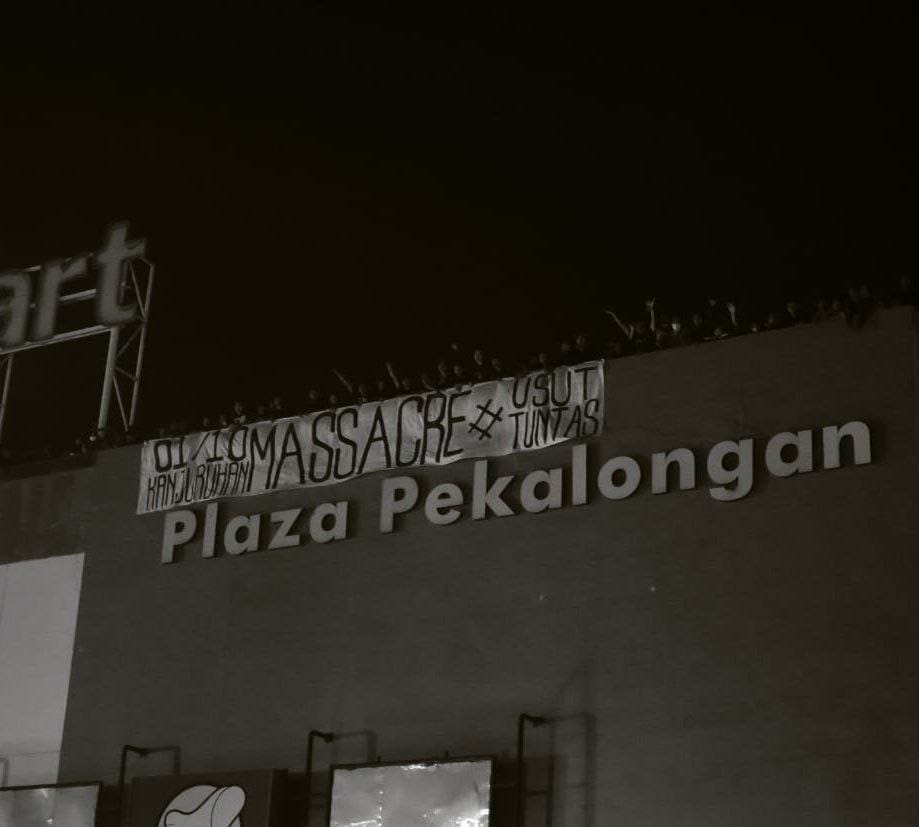
The presence of anarchism in Indonesian football did not emerge from a single moment or a formal organization. It grew gradually as supporters began to realize that stadiums were not merely places to watch matches, but social spaces constantly monitored and controlled. Police repression, collective criminalization, arbitrary bans, and open violence against supporters became the first political experiences for many people, often long before they ever encountered the word politics itself.
Since the early 2000s, especially in cities with strong supporter cultures, autonomous practices began to emerge: sponsor free watch parties, terrace collectives without formal structures, the circulation of zines, murals, and spontaneous acts of solidarity when comrades were arrested or harmed by the police. These practices did not always call themselves anarchist, but they carried clear values: anti authoritarianism, collectivity, and autonomy. This awareness did not grow from theory books, but from repeated encounters with power. From here, football became one of the first spaces where many people (particularly working class youth) came into contact with anarchist practices without passing through the gate of formal ideology.
Football is the most massive form of popular culture in Indonesia, deeply rooted in the working class. Stadiums, neighborhood fields, and roadside watch parties are not elite spaces. They are filled with workers, informal laborers, poor students, the unemployed, and urban youth living under economic uncertainty. Football does not demand cultural capital, formal education, or ideological permission. In an increasingly individualistic and fragmented society, football offers something increasingly rare: a collective experience lived directly. Bodies are present together. Emotions are felt together. Risks are shared together. Within this experience, solidarity does not need to be taught, it grows on its own. This is the starting point. Not theory, not doctrine, but lived experience.
What is often referred to as an “anarchist football scene” is not an organization, not a supporter faction, and not a structure that can be formally registered. It is better understood as a fluid and dispersed ecosystem of practices. It lives through autonomous, sponsor free watch parties; terrace collectives without permanent hierarchies; non commercial grassroots leagues; solidarity tournaments; the production of zines, murals, chants; and football-based mutual aid practices. Some people within this scene call themselves anarchists. Others do not. But that is not the main point. What matters is the way relationships are practiced: horizontally, collectively, and relatively autonomous from both the state and capital. There are no lifelong leaders. No rigid structures. What exists instead is trust, habit, and a shared willingness to look after one another. Here, anarchism appears not as a declared ideology, but as a social practice that is lived.
Unlike conventional political education, which is often elitist and verbal, football teaches politics through experience. On the terraces, people learn to trust strangers. They learn to share resources without coercion. They learn to organize themselves without formal commands. They learn to protect one another from repression. These values lie at the core of anarchism. But here, they do not arrive as lectures, they emerge as habits. Chants are easier to remember than manifestos. Terrace visuals leave deeper impressions than pamphlets. Collective experience is far more powerful than abstract arguments. Many people practice anarchism without ever uttering the word anarchy. And precisely because of that, these practices endure.
The state understands this potential. That is why the relationship between the state and football in Indonesia has always been marked by suspicion. The police treat stadiums as spaces that must be controlled militaristically. Fences, barricades, intimidation, and tear gas have become normal parts of the football experience. The issue is not simply match security. The state fears autonomous crowds, masses that gather without formal leadership, without electoral agendas, and without being easily directed. Such crowds are difficult to predict and even harder to control. The anarchist football scene becomes a threat not because it is always openly radical, but because it cannot be fully co opted. It cannot be tamed through sponsorships, permits, or elite dialogue.
Football capitalism attempts to manage this potential in another way: commodification. Clubs become political and business instruments. Supporters become markets. Collective identities are reduced to merchandise and social media content. Social relations are transformed into relations of consumption. Yet this effort always leaks. In the gaps of commodification, practices of solidarity continue to appear: free watch parties, fundraising without branding, non commercial tournaments, and informal aid networks. These small practices may not look heroic, but precisely because of that, they are difficult to destroy.
Anarchism does not live on the main stage. It lives in the cracks. Of course, the anarchist football scene is not a sacred space. It is full of contradictions: toxic masculinity, sexism, narrow nationalism, exclusivity, and internal conflict. All of this is real and often painful. There is no point in romanticizing the terraces as purely emancipatory spaces. But these contradictions are not reasons to dismiss its potential. On the contrary, this is where anarchism actually exists: in messy terrain, full of conflict, never finished. Anarchism does not grow in sterile spaces, but amid the tensions of everyday life. The question is not whether football is perfect, but whether the solidarity born within it can be expanded, deepened, and carried into other spaces.
Football is not the final goal of anarchism. It is a gateway. Through football, people learn collectivity before learning the term for it. They learn mutual dependence before understanding its theory. These experiences can then spill over into workplaces, neighborhoods, and other social spaces. In the Indonesian context (where political organizations are easily destroyed and ideological language is often viewed with suspicion) cultural approaches become an important means of survival. The quiet path does not mean a passive path. It is a patient, grounded, and deeply rooted one.
The arrests of Bogi and Hanif, both known as supporter activists and anarchists, for social media posts calling for mass action last August, along with the arrest of Fahril in the same context, reveal one important fact: the state recognizes that political consciousness exists among supporters. Not as a “mindless crowd,” but as subjects capable of thinking, moving, and organizing themselves. This repression proves that football is not an apolitical space. Precisely because it has become a medium for consciousness and solidarity, it is monitored, controlled, and criminalized. This quiet path of anarchism may not always be visible, but it is real enough to be feared.
Anarchism in Indonesia does not always arrive with black flags or shouted slogans. Often, it comes in subtle forms: terrace songs, shared logistics, protecting comrades from police violence, and solidarity without expectation of reward. Football is one of those quiet paths. As long as people continue to gather, share, and refuse total control, anarchism will continue to find its way, sometimes in the most unexpected places.
And in Indonesia today, one of those paths is called football.
Free all political prisoners!Until everyone is free.