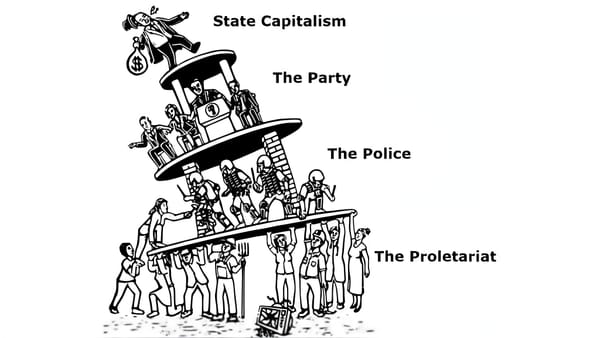
The Necessity of Anarchist Transhumanism: A Promethean Manifesto

Marx's philosophy of history aims to interpret historical change as the result of the interplay of conscious human decision, technological innovation, and the social relations that facilitate the development of technological infrastructure in human societies. He explicitly argues that this materialist dialectic points to a historical trajectory which, although not historically inevitable and thus dependent on the contingent choices of human beings, moves toward a society in which the development of the forces of social production and thus production and accumulation of social wealth is consciously, autonomously, and collectively directed towards the needs and development of all human individuals. It is for this reason that heterodox Marxists have stressed a humanist interpretation of Marx's philosophy as against the 'productive forces determinism' of Marxist orthodoxy as well as the 'overdetermination' of structural Marxism; both of which try to argue that Marx's philosophy of history lacks any special place for history as directed by autonomous human subjects advocated by traditional humanist philosophy. Anarchists historically accepted this kind of materialist dialectic in emphasizing the determination of historical change by free cooperation among human beings and human struggles against domination in relation to the technological development of social wealth and the possibility of all humanity sharing in the benefits of that wealth in voluntary relations of mutual benefit among individuals.
Thus, the kind of socialism advocated by humanist forms of Marxism as well as Anarchism presupposes a promethean view of technology and human history. That is, a political anthropology which sees history as a struggle among human beings for universal human emancipation, dependent on the contingent choices of human individuals as well as the technological development of human societies, where this technological development contains within itself the possibility of a truly free society provided that social relations are restructured along non-exploitative, non-dominating lines. This Prometheanism is to be distinguished from other purported forms of Prometheanism. Statist forms of Marxism historically held that the development of the productive forces by rational state planning would automatically lead to a free socialist commonwealth.
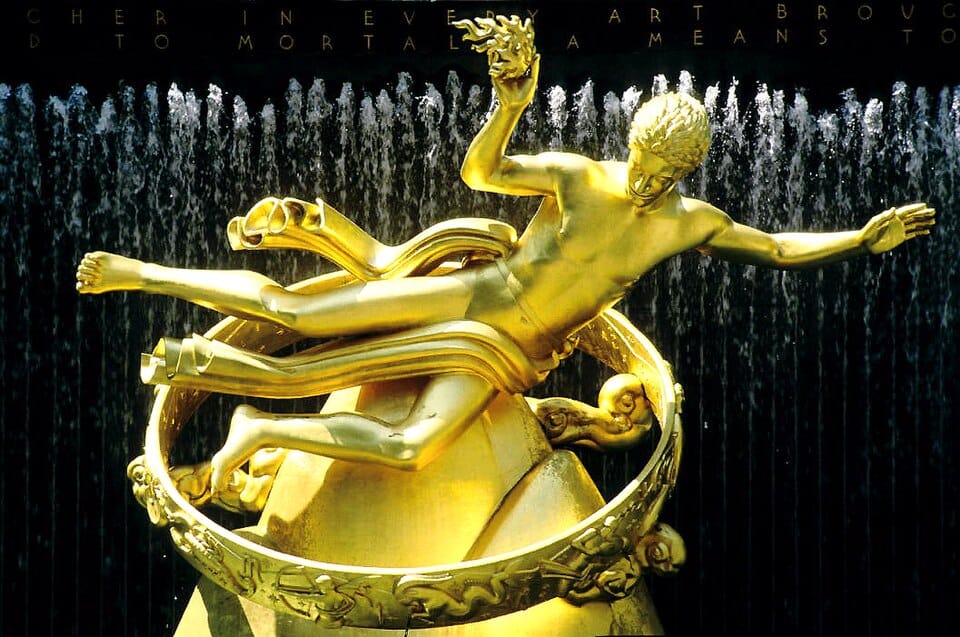
Furthermore, in debates among 20th century Anarcho-Syndicalists advocates of industrial decentralization in free producers' communes debated advocates of the takeover of centralized industry and scientific management techniques pioneered by industrialists and their use in the self-managed activity of producers in the new society. These views are both Promethean in that they advocate technological means of human emancipation, given that Prometheus was the Greek god who was tortured for stealing fire from the other gods and gifting it to humanity. None the less they clash with each other. In the case of statist Marxism, the status of a state-controlled command economy as one in which state planners, rather than workers, or producers themselves direct social labor, requires a class distinction between workers and planners such that the former is forced to go to work for the latter. In the case of the Anarchist advocates of industrial centralization and scientific management self-management would be contradicted by the subordination of labor to centralized structures of labor control. In both cases the liberating power of technology would be suppressed in practice for the development of oppressive forms of technology which concentrate benefits among those with ultimate power.
In the mid 20th century, a Promethean ideological and philosophical movement known as transhumanism developed advocating an addendum to traditional humanistic ideas of human reason, autonomy, and liberation. Transhumanism stated that this vision of human liberation and subjectivity is dependent on the development of advanced technologies to surpass the biological and natural limitations of human subjects. Like humanism in general transhumanism was for most of its existence caught up in mainstream political discourse which failed to question the class relations and structures of social domination characteristic of modern industrial society under capitalism and the state. This is seen in the fact that the first person to coin the term transhumanism was Aldus Huxley's brother Adrien who was an advocate of eugenics; a movement popular among scientific elites in the 19th and 20th centuries which advocated culling the human population so that only the purest human forms would survive and was thus deeply connected to racism, classism, and ableism.
More recently developments in information technology have led to a Silicon Valley based transhumanism in which IT capitalists such as Elon Musk and Peter Thiel have used transhumanism as a justification for the acceleration of what Marx calls the organic composition of capital; the ratio of automated labor to living labor from workers themselves, as well as further developments in technologies used by corporations and the state for surveillance purposes. In Silicon Valley since the 90s a bourgeois form of Prometheanism has been conjured up as a fictional vision of a digitalized world created by tech capitalism in which all individuals can achieve autonomy, while the actual monopolization of IT for the exploitation of labor, wealth inequality, and surveillance by corporate and state structures of the capitalist world-system is ignored. Embroiled in this controversy is the issue of new AI technologies which in addition to having huge environmental costs (the hardware requires huge amounts of energy and water) are also worsening issues of racial and gender discrimination and have since the IT revolution in the 90s been rapidly accelerating technological unemployment.
As such many on the anti-capitalist left have dismissed transhumanism as an ideological cover for the horrors of digital capitalism. This perspective is myopic. It's obvious that the bourgeois transhumanism defended by Silicon Valley lacks the ability to achieve real human freedom and acts as a form of ideology clouding people's judgement about the reality of bourgeois social relations, one (but not the only) function of ideology as a social phenomenon identified by Marx. However, this is the case for bourgeois versions of all thin-centered ideologies which the anti-capitalist left broadly accepts. A thin-centered ideology is simply an ideology simplistic enough in its basic components to be attached to more grandiose host ideologies.
Feminism is a thin-centered ideology which has been historically dominated by bourgeois social movements such as progressivism, but which has been developed in Marxist and Anarchist versions as to take the ideology beyond these limitations. The same goes for transhumanism. As such Anarcho-Transhumanism was recently developed to combine transhumanism with an Anarchist framework able to liberate the technological transformation of the human form and natural reality from capital and the state. There is thus no reason for Anarchists and humanist Marxists to resist a socialist version of transhumanism. In fact, addressing the transition from industrial society to digital society requires a transhumanist orientation, at least if one is committed to the control of technological development in favor of the autonomy and self-determination of human individuals.
The transhumanist view should not be confused with the view that all forms of technology are morally neutral, or good. In particular Anarcho-Transhumanism does not see technologies designed for subjecting workers to more arduous labor, which require destruction of the ecological capacities that support sentient life, or which are designed for militaristic purposes (e.g. nuclear weapons) as technologies which are compatible with human freedom. Technologies must be specifically designed to facilitate the development of human freedom, or at least not be deleterious to it, in order to get the AnTrans seal of approval. However, the vision of socialism advocated by AnTrans is the opposite of technologically austere.
In such a society the free production and accumulation of social wealth in view of the needs of all human individuals means the use of technology to project consciousness into nature and thus the cosmos itself, making the world as comfortable for sentient life as possible. As such AnTrans is a sentientist worldview. Sentientism is the combination of a naturalistic epistemology (a view of knowledge and justification that elevates science and autonomous reason over revelation, tradition, and authority) and sentiocentrism (the view that the center of ethical value is the capacity for experience). Sentientism contrasts with more austere views sometimes accepted by the anti-capitalist left such as eco-socialism, eco-Anarchism, and ecology more generally.
These views prioritize the preservation of connections making up the physical ecosystem over the extension of sentient life within that ecosystem. As such eco-socialists frequently try in vain to prove that Marx was not a Promethean whereas eco-Anarchism is dominated by views like that of ecologist Murray Bookchin which conflate Anarchism with face-to-face republican democracy in which citizens are obligated by the polity to respect ecological structures. While sentientists concur with ecologists that the ecological crisis in which capitalist production is actively degrading the life-supporting capacities of the ecology is one of the most important problems facing humanity and thus demands resolution, sentientists hold this position not on the basis that existing ecological structures are intrinsically valuable and deserving of protection (many of them are hellish from the standpoint of sentient wild animals without the technological, or social capacities to escape predation and starvation and continue to be so for human beings as a result of our technological limitations as seen in natural disasters and disease for example). As such AnTrans is in conflict with ecologist approaches to the ecological crisis such as degrowth which preach the reduction of social production and wealth accumulation in order to halt the environmental crisis. Instead AnTrans advocates the expansion of production and accumulation in a way that replaces technological infrastructure incompatible with the continued existence and health of sentient life with those which nurture it.
If one thinks about it AnTrans is obligatory from the standpoint of living up to humanistic and socialist values. Socialism requires the use of productive technology for the free development of producers in voluntary association. Humanism requires the employment of scientific rationality to extend human autonomy beyond its current social and natural limitations. Private property and the state, in ensuring the class rule of capitalists over workers, block the universal realization of these values. The same is true of non-Anarchist ideologies which by definition value other objectives over the full self-determination of human individuals.
Sources:
https://www.anthroencyclopedia.com/entry/transhumanism
https://theconversation.com/super-intelligence-and-eternal-life-transhumanisms-faithful-follow-it-blindly-into-a-future-for-the-elite-78538
Rise and Fall of the Neoliberal Order, Gerstle
Neoliberalism, B. Steger and K. Roy
https://blueshifted.net/faq/
https://www.youtube.com/watch?v=E71Dzm0MYnY&t=34s&pp=ygUVYW5hcmNobyB0cmFuc2h1bWFuaXNt
https://redandblackanarchists.com.au/green-confusion-the-metaphysical-and-political-failures-of-ecology/
https://theconversation.com/groks-antisemitic-rant-shows-how-generative-ai-can-be-weaponized-257880
https://news.mit.edu/2025/explained-generative-ai-environmental-impact-0117
https://theconversation.com/distrust-in-ai-is-on-the-rise-but-along-with-healthy-scepticism-comes-the-risk-of-harm-260189
Democracy, Zack
https://plato.stanford.edu/entries/feminist-philosophy/
https://link.springer.com/article/10.1007/s13347-022-00507-5
Anarchism, Honeywell
Marx After Marxism, Rockmore
Understanding Marxism, Boucher
Marx's Concept of Man, Fromm
Marxism and Freedom, Dunayevskaya
https://sentientism.info/what-is-sentientism/an-overview