Limitations of Reformism and the Imperative of Class Struggle

It has already been explained in dozens of texts that the history of human civilization is essentially the history of class struggle. Ever since the breakdown of primitive communist society, the existence of two opposing classes—the exploiters and the exploited—has become inevitable. Although the form of this exploitative system has changed in the modern capitalist setup, its core character has not altered in the slightest. In anti-exploitation struggles and during discussions among various freedom-seeking organizations of different trends, certain theoretical and organizational aspects repeatedly emerge—such as the struggle for increasing wages, the removal of capitalist waste, and the struggle for prevailing voting systems and the restoration of democracy—which paint a precise picture of the modern capitalist system. Therefore, the question of the working people liberating themselves from this complex and multi-dimensional web of capitalist exploitation should be discussed above all else.
The Struggle for Wage Increases and the Psychology of Wage Slavery
In the capitalist system, wages remain at the center of the working class's daily struggle for survival. The wage a worker receives by selling their labor power is what they must use to ensure food, clothing, shelter, and the sustenance of their family. Consequently, driven by the need to improve their living standards, workers regularly agitate and, in certain cases, succeed in securing wage increases. But the question is: can this struggle for wage increases provide permanent liberation for the working people?
When analyzed theoretically, it appears that this struggle for progressively higher wages actually teaches workers to reconcile with, or make bearable, a form of "wage slavery". A massive foundation of anti-capitalist literature rests on the idea that capitalists do not pay workers the full value of their labor; rather, they give a portion of what workers produce as wages and pocket the rest as "surplus value" or profit. When workers manage to raise wages through intense agitation, capitalists do not sit idly by. They immediately begin seeking ways to offset the financial loss caused by those increased wages.
Therefore, after conceding to workers' demands for higher wages, capitalists play a very tactical role. They do not allow their profits to take a hit because of the increased wages. Instead, they raise the prices of manufactured goods. By increasing the prices of daily necessities, rice, lentils, oil, transportation costs, and other services in the market, they take that extra money right back out of the workers' pockets.
Under various pretexts—such as rising raw material prices in the international market, inflation, dollar shortages, or increased production costs—the capitalist class indulges in a festival of price hikes. As a result, even if workers' wages nominally increase, crushed under the millstone of inflation, their real purchasing power (Real Wages) ends up lower than before. This cyclical struggle for wage increases is essentially a maze where workers keep running but never reach the destination. Standing in this reality, viewing the struggle for wage increases as an anti-capitalist struggle is a grave fallacy.
Patchwork Reform vs. Radical Change
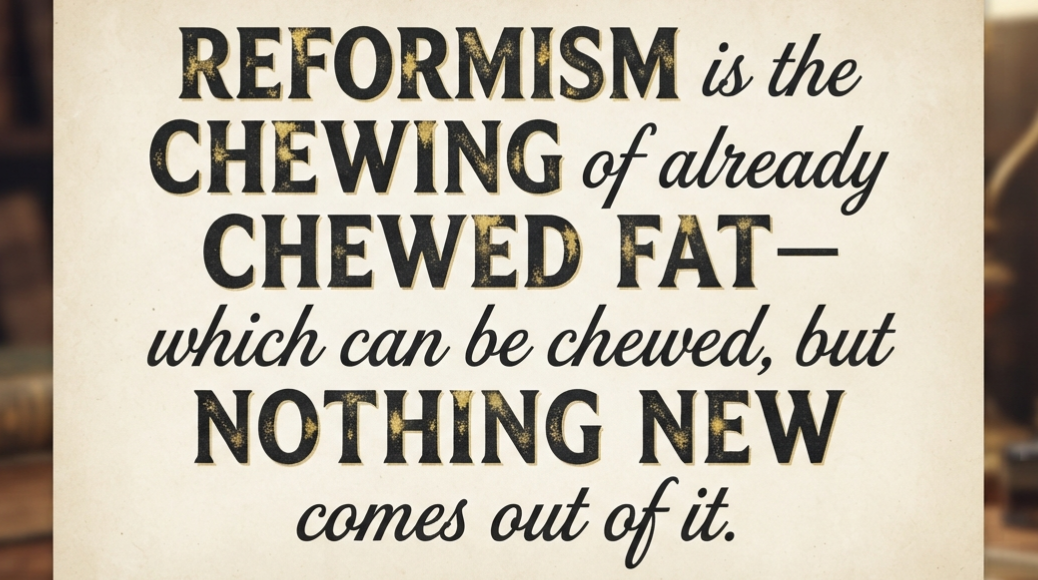
Witnessing the inherent crises and anomalies of the capitalist system, many people express temporary anger, lament, or demand patchwork reforms from within the existing system. No matter how much hatred and disgust are expressed toward the existing disorder, on the whole, it cannot cast any permanent impact on uplifting the fate of the working people.
Trying to fix certain flaws through fragmented means or by passing laws within the state framework is like applying ointment to a rotting body. Such reformist demands or fragmented protests not only confuse working people but also waste their valuable energy and time. The political energy or power of workers that ought to be spent on a structural revolution or radical change gets exhausted while trying to secure patchwork demands. Therefore, abandoning the illusion of fragmented reform and opening the path of radical transformation or systemic change leaves the working people with no other alternative.
The Alternative
To counter the joint attacks of the capitalist state apparatus and the capitalist class, sporadic or short-lived movements will not suffice. What is needed is a coordinated and sustained protest. Scattered strikes or temporary demonstrations cannot shake the foundations of capitalists because they possess the state police force, legal protection, and an endless supply of capital.
The working people must understand that their struggle is not merely against the owner of a specific factory, but against the entire capitalist mode of production. To make this struggle successful, fragmented and isolated movements must be transformed into a centralized and cohesive political current. Only through a sustained and class-conscious struggle is it possible to challenge the monopoly of the capitalists.
Capitalist Waste Removal vs. Class Struggle
Capitalism means nothing but profit-making, and in the process of this profit-making, various kinds of rubbish, crises, and social pathologies are constantly generated in society and nature. Unemployment, inflation, environmental destruction, corruption, cultural degradation, and multidimensional social crises are the structural waste of capital.
Often, so-called civil society or reformists engage themselves in the task of cleaning up this waste. They are busy cleaning only the surface dirt while leaving the core structure of capital intact. But as long as the factory named capitalism remains operational, waste will continue to be produced from it. Therefore, instead of being engrossed in the constant task of removing capitalist-created waste, the primary duty of anti-capitalists is to bring the "utility of class struggle" to the forefront. In the struggle for social transformation, class struggle is the only weapon that can uproot this exploitative structure. Seeking solutions to problems through charity or relief work while masking the core site of worker-owner conflict is meaningless.
Class Consciousness vs. The Bourgeois Illusion of Restoring Democracy
In bourgeois democracy, the "voting system" or electoral politics is propagated as the sole key to liberation. It is propagated that all problems can be solved through the votes of the majority. But scientific honesty is never achieved by relying on the prevailing voting system or legal framework.
Scientific truth is found by shaking the pages of history. The matter becomes crystal clear through the example of Galileo. When Galileo proved that the earth revolves around the sun, the majority of the people of that society, the Church, and the prevailing legal system did not accept it. By the judgment of the majority of those times, Galileo was marginalized and a minority. If the vote of the majority or the prevailing legal process were the yardstick of truth, Galileo's scientific truth would have been proven false, and the unscientific doctrine of the Church would have survived as truth.
The capitalist class controls people's consciousness through its propaganda machinery and economic power in such a way that the majority of people often end up voting in favor of their own exploiters. This proves that the support of the majority or the politics of regular voting does not always point the way to objective truth or liberation. Hence, the politics of restoring democracy or the politics of voting is irrelevant in the context of class struggle.
The political struggles witnessed in current times under the names of "rescuing democracy" or "protecting voting rights" conceal deep class interests behind them. If workers or toiling people plunge into the movement to restore conventional bourgeois democracy without acquiring class consciousness, it is essentially nothing more than a struggle to promote sluggish intellect.
Bourgeois democracy is a system which, although seeming open to all, keeps its key in the hands of the capitalists. In this system, only power changes hands, but the form of exploitation does not change. If the working class becomes mere instruments in the power struggles of bourgeois political parties without being conscious of their own class interests, historical role, and the politics of social transformation, it is merely an expression of their ignorance and stagnant intellect.
Therefore, the path to the true liberation of working people from the millstone of capitalist exploitation is radical change and the correct application of class struggle. While relative struggles for wage increases or patchwork reformism can give workers temporary relief, they cannot provide permanent liberation. Toiling people must determine their path to liberation only in the light of a scientific outlook and deep class consciousness. Only when the working class tears apart the illusion of the prevailing voting system and bourgeois democracy and organizes itself as the vanguard of its own liberation, will it be possible to establish an exploitation-free, egalitarian society.