The Return of the Barracks State
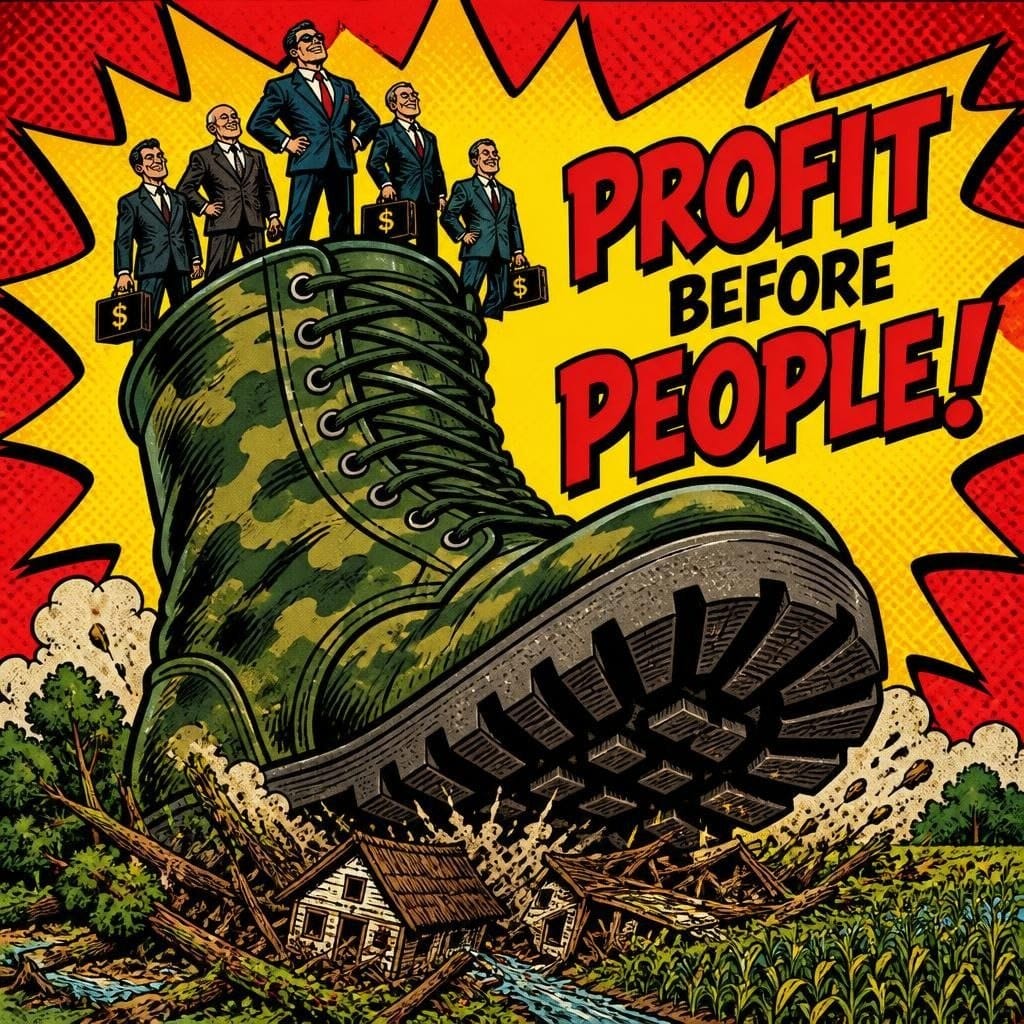
Watchdoc’s investigative documentary Pesta Babi (Pig Feast) explicitly and undeniably dismantles the deeply rooted blood ties between military institutions, the state apparatus, and the circulation of capital in Papua. In this heart wrenching film, it is made perfectly clear how the expansion of New Autonomous Regions (DOB) in Papua (often sugarcoated with sweet narratives of accelerated development and welfare) is always closely paralleled by the establishment of new regional and local military commands (Kodam, Kodim, and Koramil) sprouting across the territory.
Instead of functioning purely for national defense against the genuine threat of foreign invasion, the construction of these new military barracks shares a geographical and spatial correlation that is perfectly identical to the maps of mining concessions, massive palm oil plantations, and Food Estate project areas. It is here that we see the true face of state expansion: it does not arrive bearing notebooks or community health centers; it arrives bearing gun barrels to fence off the circulation of capital from the fury of citizens whose living spaces have been stolen.
Agro Militarism: Food and Energy Estates and the Dispossession of Living Space
The horrifying reality reflected in Papua is the most precise entry point for viewing the true terror of the returning "barracks state." It does not exist in a political vacuum, rather, it fuses organically with the interests of the corporate oligarchy. These mega projects, which necessitate land starvation, are concrete manifestations of military invasion into the realm of production to serve greedy capital accumulation. We must not forget that before taking the presidential seat, Prabowo Subianto was the chief architect and commander of the Food Estate project under the massive umbrella of the Ministry of Defense. This colossal undertaking slyly piggybacked on narratives of the post pandemic global food crisis and geopolitical conflicts to legitimize the clearing of millions of hectares of land, stretching from the virgin forests of Papua and the peatlands of Kalimantan to the landscapes of Sumatra.
But what actually happens on the ground when these projects are executed? Customary forests that serve as buffers for the global ecosystem are ruthlessly clear cut, biodiversity is decimated, and the food sovereignty of local residents is violently ripped from their own hands. In South Papua, the Merauke Integrated Food and Energy Estate (MIFEE) project (which is continuously replicated, reincarnated, and repackaged under new names to avoid stigma) stands as a colossal monument to the crimes of agro militarism. The state unilaterally hijacked the living space of the indigenous Malind people, an entity that for thousands of years proved capable of sustaining themselves autonomously from the wealth of the sago forests and swamps. That living space was then privatized and handed over on a silver platter to a consortium of corporate giants.
What, then, is the role of the military amidst this ecological and humanitarian tragedy? The military is not deployed to the swamps to shovel mud or plant superior seeds like genuine farmers. Take, for example, the large scale cassava planting project in Kalimantan under the Food Estate framework. Relying on top down mobilization, military personnel were drafted into land clearing and the execution of a project promised as a food security solution. The results fell drastically short of expectations. Various obstacles (from unsuitable soil characteristics and weak planning to an approach that entirely ignored local knowledge) caused the project to fail its hyped up targets. This failure proves that martial discipline and coercive capacity are no substitute for agrarian knowledge, community participation, and careful ecological management. When social issues are treated as military operations, the outcome is rarely resilience, it is the squandering of resources and the repetition of failure.
They are deployed in camouflage uniforms, carrying long barreled rifles, and riding in tactical vehicles purely to secure what the state labels "National Strategic Projects" (PSN). Who are they securing these projects from? From the local citizens and indigenous communities fighting to defend their ancestral lands. The concept of "food security" has been systematically hijacked to mean "national defense", a linguistic manipulation that automatically grants absolute legitimacy to state repression against the peasantry and indigenous peoples. Those who refuse to surrender their land are instantly branded as "rebels," "anti development," or "separatist groups."
Under the grip of the agro militarist regime, the land and the earth are no longer viewed as living spaces or as a mother nursing life, but merely as a logistical operations map to be conquered. Upon this map, corporations are rolled out a red carpet to plunder resources, while military institutions act as officially uniformed security guards funded by taxpayers. To prop up an extraction and social control machine of this massive scale, militarism absolutely requires physical infrastructure that grips the very veins of the countryside. This is where we witness the true horror of the resurrection and expansion of the Territorial Command (Koter), an obsolete structural relic of the New Order dictatorship that hierarchically positions military units to parallel and shadow the civilian government structure, all the way from provincial capitals down to the alleyways of rural villages.
Grassroots Economic Co-optation: Red and White Cooperatives and the Logic of MBG
The invasion of barracks logic into the civilian sphere does not stop at large scale land grabbing in the outer islands. It creeps much deeper, infiltrating the economic heartbeat of citizens at the lowest levels through manipulative, populist initiatives like the "Red and White Village Cooperative" (Koperasi Desa Merah Putih) program. Historically, politically, and sociologically, the concept of the cooperative was originally initiated by the lower classes as a form of resistance and horizontal solidarity. It is a vessel of mutual aid among the working class, artisans, and peasants to organize themselves independently and survive the onslaught of capitalist monopolies and loan sharks. Yet, beneath the dark shadow of the barracks state, this emancipatory concept of cooperativism is ruthlessly hijacked and its meaning twisted beyond recognition.
The Red and White Village Cooperative program explicitly requires (or proactively involves) the intervention of military territorial apparatuses. Everyone from the village level non commissioned officers (Babinsa) to district level officers are appointed to sit as "advisors," "supervisors," or "drivers" of the citizens' economy. Behind this patriotic narrative hides an absurd structural tragedy. To smooth the way for this bureaucratic mega project, the military opened the floodgates for massive new recruitment across various regions. Thousands of village youth signed up, dreaming of heroism, class mobility, and the noble promise of defending the country. The reality is the exact opposite, these new recruits are ultimately reduced to cheap construction labor. Ordered under a command system, they mix cement, lay bricks, and physically build the Red and White Village Cooperative facilities. Soldiers, who should theoretically be trained to face external defense threats, are transformed into manual laborers for civilian projects controlled by the military elite. This is exploitation within the body of the institution itself, all to build the infrastructure of state control in the countryside.
The military's direct involvement in the daily affairs of the village economy (from the trade of harvests and the distribution of subsidized fertilizer and seeds to citizens' savings and loans) is not a form of "selfless service." From an anti authoritarian perspective, this is an attempt at total conquest of rural economic spaces. Cooperatives are repurposed into a new style of intelligence posts and instruments of social control. Crucial access to capital, markets for selling produce, and basic agricultural needs are now absolutely controlled by those who wear uniforms and carry guns. Imagine the impact on the citizens, if a farmer or rural laborer is critical of the state's repressive policies, or dares to speak out against surrendering their land to environmentally destructive corporations, they can easily be isolated, blocked, and ostracized from economic access in their own village. This is militarism’s most effective method for slowly suffocating citizens without having to fire a single bullet. They tie the stomachs and pockets of the peasantry to the chain of command, ensuring that economic dependence perfectly transforms into unconditional political obedience. The cooperative is no longer a tool of emancipation, it is the extended arm of a disciplinary regime that murders self reliance.
Furthermore, this militaristic cooptation seamlessly connects to another civilian invasion operation, the Free Nutritious Meals (MBG) program. On the surface, MBG is a highly populist campaign promise that is difficult for public common sense to reject. What kind of tyrant would dare oppose the noble effort of feeding malnourished children? No one. But for anarchists accustomed to dissecting power structures, the way a program is implemented always speaks much louder and more honestly about the true nature of power than its formal objectives.
In practice, the implementation of MBG reeks of the barracks and is deeply integrated with the rural cooptation structure. The military is deployed to build and manage hundreds of "public kitchens." TNI territorial battalions are directly involved in the logistical supply chains and food distribution (which will inevitably intersect with the monopoly of the Red and White Village Cooperatives). Even the top leadership of the National Nutrition Agency has been handed over to retired generals. The critical question is : to simply solve the issues of malnutrition and starvation, do we truly need a rigid, armed military command approach? The answer, of course, is no, unless the actual goal of this program is not just to feed, but to condition national scale social control.
Social programs under state control are never neutral. The philosopher Michel Foucault, in his sharp historical analysis of governmentality and biopolitics, reminds us how the modern state uses the instrument of "welfare" as the most sophisticated means to discipline the population. Feeding children in schools morphs into a biopolitical instrument to penetrate the most private spaces of citizens' families, subjugating them and creating an illusion of absolute dependence on a "Father State" that acts as though it is incredibly benevolent. When matters of the stomach are managed through a military chain of command, the message is glaringly intimidating, citizens are merely passive objects in a giant logistical operation steered from the center. There is no room whatsoever for community solidarity initiatives, independent peasant unions, or genuine citizens' cooperatives to manage their own food self sufficiency autonomously. The collective agency of the people is slowly killed, suffocating behind the uniform of welfare. Citizens are only expected to sit quietly in class, open their mouths wide, and thank the camouflage uniforms spoon feeding them.
The Broken Promise of Civilian Supremacy
To fully understand why militarism has been able to force its way back into every pore of our lives (from the jungles of Papua and rural commerce to the school desks of children) we must look back at the history of the 1998 Reformasi honestly and with profound bitterness. The fall of General Suharto's dictatorship in May 1998 was the monumental peak of the people's resistance. Millions of Indonesians, students, workers, and the urban poor took to the streets, sacrificing blood and lives, demanding the end of the authoritarian regime and the abolition of the military's Dual Function (Dwifungsi ABRI). Reformasi promised one thing that seemed simple but was fundamentally crucial, the military must return to its barracks, and politics must be returned to the hands of civilians.
On paper, the structural achievements of Reformasi looked incredibly impressive. Dwifungsi was officially and legally abolished. The police force was strictly separated from the military. The military/police faction in the parliament (which for three decades of the New Order acted as the military's political shield and rubber stamp) was finally dissolved. Active soldiers were constitutionally strictly prohibited from holding political and civilian administrative offices. The hope underlying these drastic changes was clear and noble, the military must operate purely under the control of a democratic civilian authority, citizen participation must replace the deadly command regime, and armed apparatuses must restrict themselves back to their narrow function as the state's external defense tool.
However, like many bourgeois democratic transitions worldwide that refuse to dismantle the roots of class oppression and refuse to destroy capitalism, Indonesia’s Reformasi left behind highly structural and fatal unfinished business. Reformasi never truly uprooted military power in the economic sector. Only its form and camouflage changed. If during the New Order era militarism was nakedly present through legally institutionalized Dwifungsi, post Reformasi militarism transformed like a chameleon. It became a settled consciousness, a pragmatic political habit, and most crucially, the military repositioned itself as the gatekeeper of highly profitable extractive capitalist operations. The generals may no longer sit for free in the comfortable seats of parliament without an election, but they shed their uniforms to transform into coal mining commissioners, political party elites, and the ranks of the new oligarchy controlling the livelihoods of the masses. The "development" language of the New Order merely mutated into more market friendly phrases like "maintaining the investment climate," but the repressive approach to silencing citizens' resistance was maintained entirely. This is the invisible legacy of the New Order: a structure of repression that makes militarism always feel natural and necessary because it is tasked with protecting the elites' circulation of capital.
Militarism is More Than the Presence of Soldiers
Looking at this reality, what we are witnessing in Indonesia today is not merely the return of a government regime coincidentally led by a former general. Nor is it simply the "return of the New Order" in the exact same shape, form, and cosmetics. This is a phenomenon that is much deeper, more systemic, more persistent, and more pervasive: it is the strengthening of militarism as a hegemonic political culture in civilian life and resource management. Before analyzing this further, it is crucial to distinguish between two things often conflated by the general public, the military as a state institution, and militarism as a living ideology.
In almost all modern nation states, the military is the state's coercive organ formally tasked with territorial defense. From the perspective of non anarchist society, the existence of this institution is often considered a sociological inevitability. But from the perspective of anarchists, this institution has always been an instrument of organized violence holding a monopoly on repression and death. Far deeper and more dangerous than its physical institution, militarism is something else entirely, it is the software, the spirit that moves it.
Militarism is a rigid ideology that believes with all its heart that every kind of social problem, economic turmoil, ecological crisis, and even disease outbreaks can essentially be solved through command mechanisms, tight control, and the threat of a rifle. In the militarist mindset, obedience and uniformity are valued and prioritized far above citizen participation, diversity of opinion, and deliberation. Stability (which in the state's dictionary is often nothing more than a euphemism for "security for oligarchic capital accumulation") is treated as the highest, unquestionable value, even if achieving that stability requires the state to sacrifice civil liberties, human rights, and social justice. Hierarchy in militarism is not viewed merely as a functional division of labor, but is dogmatically trusted as a reflection of the absolute, natural order of society.
As Hannah Arendt philosophically warned in her immortal work, Eichmann in Jerusalem, the greatest, deepest, and most terrifying problem of obedience is not merely the figure of the ruling tyrant, but the broad masses who accept the logic of command without daring to ask a single question. The radical American historian Howard Zinn, in A People's History of the United States, also brilliantly demonstrated that militarism thrives not just because it possesses superior weaponry or deadly killing technology, but because of its highly manipulative ability to engineer collective consciousness. Militarism systematically brainwashes the working class and society so they genuinely believe that state style order is the most urgent need, far superseding their own fundamental rights to justice, freedom, and autonomy. It lives in the language of state bureaucracy that demands "targets" and "cleansing." In Indonesia today, militarism infiltrates through populist narratives that naively assume a president with a military background is automatically "decisive," "authoritative," and "solution oriented." This is the poison that slowly but surely dulls and kills critical reasoning in our public spaces.
The Prabowo Era: From the Representation of Militarism to the Normalization of Authoritarianism
The government under the control of Prabowo Subianto brings all these fascist manifestations to a completely new boiling point. This is not solely because the reins of power are now held by a retired general whose name is forever shadowed by a dark history of past human rights violations, but rather how that military background is no longer merely represented as a symbol of leadership, but has been nakedly normalized as the primary method of statecraft. Twenty six years after Reformasi, we are forced to witness the systematic infiltration occurring inside the cabinet.
The placement of active and retired military figures in highly strategic civilian posts is done demonstratively and without shame. Sugiono sits as Minister of Foreign Affairs, Sjafrie Sjamsoeddin takes over the Ministry of Defense, Major Teddy Indra Wijaya is appointed as Cabinet Secretary (sparking massive legal polemics regarding his active status in the military and his rapid promotion to lieutenant colonel), Djamari Chaniago and other high ranking officials now dominate civilian institutions of the caliber of the National Nutrition Agency. To liberal political observers, this might simply be viewed as a "reward," a political compromise, or post election patronage. However, from a critical anarchist perspective, this is a deadly consolidation of the coercive apparatus sinking its claws directly into the heart of civilian administration. The sole purpose is to ensure that the wheels of government and society run and move exactly like a military battalion that knows no dissent.
Even more horrifying, look at the public narratives produced and reproduced every day by the machine of power. Through all its propaganda instruments, the state never tires of repeating mantras about the importance of "national discipline," "firm leadership," "blind patriotism," and "one command." At the same time, civilian democracy (which fundamentally requires deliberation, open debate, negotiation, and the constitutional right to disagree) is negatively framed as something "slow," "talkative," "noisy," and "hindering the nation's progress." Wrapped in this deceptive narrative, militarism is packaged and marketed as the panacea for all the complexities and sluggishness of bourgeois democratic bureaucracy. The crisis of inequality, which was actually created by the greed of the state capitalist system itself, is then answered with the obsolete recipe of new style fascism: iron fisted leadership.
Resisting the Barracks State, Organizing Our Anger
Twenty six years ago, the thunderous demand to return the military to its barracks echoed bravely in streets burning with tear gas and the people's anger. Today, with a cabinet lineup once again colored by the faces of military officers, with a legal system orchestrated like a combat operation command, with projects stealing indigenous lands heavily guarded by police rifles, and with the promise of welfare delivered through the barrel of a gun, we know exactly where we stand. Reformasi is not merely unfinished or stalling; it has been completely betrayed and hijacked by the illicit alliance between military power and oligarchic capital.
The main problem we face today is not just shallow math about counting how many retired officers sit in the government. Their presence is merely a symptom of a much more chronic and deadly disease. The core problem is the tragedy of when barracks logic is fully accepted and normalized by the broader society as the only solution to the nation's multidimensional crises. The tragedy occurs when bloody agrarian conflicts in Papua, Kalimantan, or Sumatra are responded to by the state with the establishment of new Kodim and Koramil bases, rather than the restitution of stolen customary rights. The tragedy occurs when the fulfillment of the people's welfare is reduced to merely a centralized logistical project (like distributing rations on a battlefield) instead of handing true control over the means of production to the working class and the peasantry.
As free individuals, anarchists, and anti authoritarian groups, we understand with absolute conviction that the entity called the state was never, and will never be, designed with mechanisms to liberate the people. A state controlled by the logic of militarism will ultimately have only one primary, absolute function that is to protect the process of property accumulation and the wealth of the ruling class, and to point its guns at anyone who dares stand in its way.
Resisting the return of the barracks state will never be enough if we merely whine and beg for a "professional military subordinate to civilian politicians" (because we all know civilian politicians serve and are funded by the exact same oligarchic masters). This resistance demands our radical commitment to building a counter order. An organic order born purely from the womb of solidarity among workers, the unity of indigenous peoples whose rights have been stripped, and independent economic organizing without oppressive hierarchies. That order is born from mutual aid, not from the coercion of command and the threat of an officer's bayonet. We must consciously refuse to bow our heads. We must refuse to be treated merely as passive objects of the state's "resilience" experiments that profit the elite. True reform and human liberation can never be achieved inside luxurious parliamentary buildings, it must be continuously reclaimed on the dusty streets, inside the factories where surplus value is sucked dry, and upon the bulldozed customary lands, every single time the state's combat boots try to trample on our dignity and our freedom.