The USSR: An Anarchist View

In my article on the Russian Revolution I explained the process by which the first communist state in world history came into existence. In 1922 this state became known as the Soviet Union. Those who embrace the official ideology that ultimately took root within it think of it as a really existing socialist society as do most anti-communists who see in the Soviet Union all the evils of communism demonstrated for all to see. According to the Bolshevik Marxists that created the state it was a 'workers' state', a concept in post-Marx Marxism which referred to the commandeering of state power by the socialist, or communist party to control society in the interests of the working class during their class struggle with the bourgeoisie.
The supposed workers' state was presented with the problem that in seeking state power the Bolsheviks had to, in the words of Wallerstein, Hopkins, and Arrighi; constrain the class struggle. This took the form of subordinating (the workers', peasants', and soldiers' soviets) and eliminating (the factory committees and worker/soldier militias) the self-organized revolutionary organizations of the working masses and replacing them with the machinery of the Bolshevik party autocracy (the Tcheka, supervised former Tsarist officials and managers, and the Red Army). The effect was ultimately to put the Bolsheviks in the position of presiding over the same, capitalist, political-economy that the Tsars presided over. This political-economy consisted in a political autocracy dependent on extracting agricultural product from the countryside in order to finance industrial development via the world market.
The Bolsheviks had to concede to market liberalization, particularly for the peasants, in order to prevent the collapse of the regime, in the form of the New Economic Policy. However, because the political-economy was still dependent on the exploitation of the countryside, this concession was rapidly posing an obstacle to further industrialization. The left opposition demanded that the NEP be ended and state coercion used to effect the extraction of agricultural product from the countryside. The right opposition sought to ride out the NEP to economic prosperity that would incentivize the peasants to voluntarily give up their product to the state.
The Bolshevik who would resolve the issue was Joseph Stalin who had accumulated numerous party posts in the meantime including general secretary. In 1924 Stalin gave a series of public speeches that were published as Foundations of Leninism. In these lectures he outlined the basics of a new approach to Marxism. The Marxism of the Bolsheviks was classical Marxism. Classical Marxism claims that the precondition for a successful social revolution is an immediate international upsurge of the working class in solidarity with the newly formed workers' state. This was the orthodoxy of the parties of the second international workingmen's association until WWI led them to forsake their internationalist principles.
The fact that the Bolsheviks had become an isolated power within a capitalist world in the wake of the defeat of wider working class uprisings in the west forced them to try to figure out what to do in the absence of the immediate international upsurge. While the left and right oppositions tried to solve this issue by deciding how the countryside would be exploited, Stalin alone started to rethink the premises of classical Marxism in relation to this obvious subversion of its expectations. He did this by developing a different form of Marxism which preserved the need for the workers' state, but did away with the need for immediate international revolution. Instead of seeing national frontiers as an obstacle to revolution to be immediately negated, in his lectures Stalin proposed that the national community, in conjunction with the state, be viewed as a potential transitory mechanism for the revolution to utilize.
According to what Stalin would name Marxism-Leninism (explicitly rejecting the attachment of his own name to the doctrine in the form of "Stalinism") national communities are a material social reality created by the uneven development of the capitalist mode of production across cultural boundaries. As such the nation should be seen as an embedded feature of the economico-cultural development of human communities under capitalism, rather than a culturally arbitrary division of the working class according to the imperatives of the capitalist economy alone. The ideological core of Marxism-Leninism thus became the claim that in building the workers' state the social revolution should reshape the national community into one mobilized for the economic and military development that would allow it to outcompete the capitalist nations at which point the class struggle would be completed and the need for both the nation and the state would disappear in a communist world culture. In classical Marxism the international socialist movement aimed at dissolving national frontiers via the immediate solidarity of the world working class without national distinctions. In Marxism-Leninism the international communist movement was to coordinate the creation of revolutionary socialist nations that come together in solidarity against the capitalist nations.
While the Bolsheviks were scrambling to make classical Marxism work under conditions of national isolation Stalin had created a new version of centralist Marxism (Marxism that aims to commander the political as a separate sphere for the organization of society in favor of a transition to socialism) that straightforwardly applied to conditions of national isolation. The workers' state, in Marxism-Leninism, did not depend on an immediate world revolution, instead it was to concentrate on building up national economic, and military might and mobilizing the population for the revolutionary ideology. This put Stalin in the position to defeat both the right and left oppositions to secure this vision for the Soviet Union. Initially he made alliance with the right against the left.
While the left was preaching a radical break with the NEP in affirming the NEP he could present himself to the conflict weary Soviet public as fighting for stability and practical management of society. Once he defeated the left he then changed his position rapidly in view of the need to solve the problem of the peasantry as an obstacle to the requisite exploitation of the countryside. With his new found authority and support from the population, state officials, and activists he then effected a rapid break from the NEP referred to as his revolution from above. The revolution from above took place from 1928 to the early 30s.
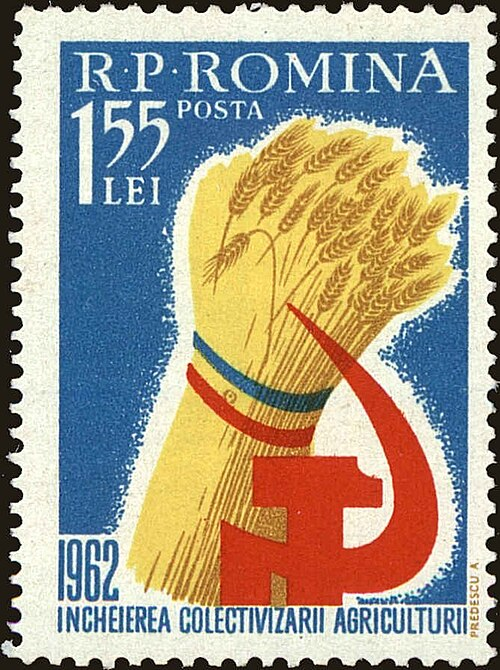
The state once again took full control of the economy, rather than just its commanding heights, and set five year plans for economic development that included agriculture and industry. Peasants were herded into collective farms where the state could extract grain targets unincumbered. Workers were subject to tight industrial discipline under state authority in service of the fulfillment of industrial targets. A general uprising of middle and poor peasants in the countryside in response was ruthlessly repressed under the farcical justification that restive peasants were 'kulaks' (rich peasants). This break-neck state directed capital accumulation produced a famine in the early 1930s that killed 4-6 million people.
That episode is often focused on as a unique horror of Soviet history and indeed Soviet authorities' response to the famines including trapping starving national minorities such as Kazakhs and Ukrainians in famine ravaged regions at the very least bordered on genocidal. However, this episode is not out of step with Russia's economic history. The squeezing of the countryside for the world market by industry in Tsarist times also produced catastrophic famine. Indeed the whole point of the revolution from above was to break the power of the peasantry in order to sell its product on the world market and thereby finance further industrialization.
Workers had things not much better. In addition to crowded and poorly provisioned urban housing workers were subject to being sent off to labor camps in case of missing work, or being late. The creation of labor camps was an early repressive mechanism utilized by the Bolsheviks, but under Stalin they grew into a sprawling system of detention facilities and penal colonies which provided the economy with forced, unpaid labor, known as the gulag from the acronym for the camp administration. While initial centrally directed economic plans were hectic with firms competing to fulfill targets and targets being overfulfilled the revolution from above solved the problem faced by Russian political-economy.
They enabled the state to purchase means of production on the world market (during the great depression no less) and thereby finance rapid industrialization which in turn over time proletarianized the Russian population so that it would no longer be dominated by peasant agriculture. This enabled the Soviet Union to grow into a world super power second only to the United States and to no longer rely on the exploitation of the peasantry to stay afloat. However, this was not accomplished by a transformation in the fundamental relations of production. These were still characterized, as in Tsarist times, by realizing a continuous cycle of investment for return in connection with the world market.
The difference was that Stalin's revolution from above broke the power of the peasantry to the point where further industrial capital accumulation and a subsequent Soviet industrial revolution became possible. This paralleled industrial revolutions and proletarianization in the west and in a fraction of the time. It is for this reason that many Anarchists and non-ML Marxists regard the Soviet Union as state-capitalist. The Soviet Union was still propped up by relations of production in which production was carried out according to investments in industry and agriculture which then brought about returns that could be reinvested. This is the basic process of capital accumulation with the distinction that in Soviet times the state directed the entire process, rather than private entrepreneurs.
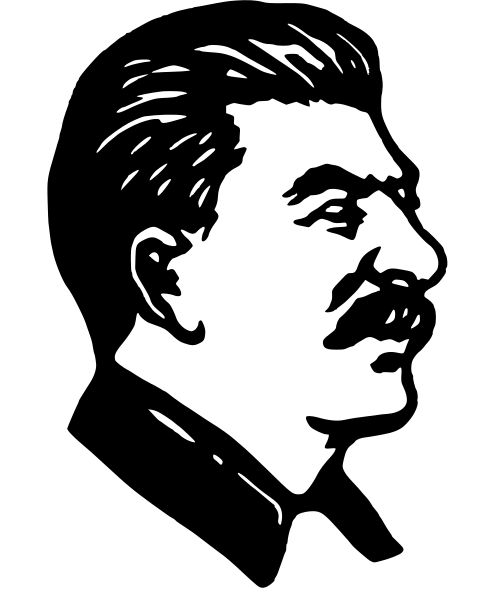
Stalin solidified his political-economic gains by carrying out a massive purge of the party and state bureaucracy that involved extracted confessions under torture and duress, executions (including of Zinoviev, Kamenev, the assignation of Trotsky in exile, and Bukharin), and gulag sentences. The purge essentially eliminated any vocal critic of Stalin and created a personal autocracy around him in place of a collective party autocracy which was only restored after his death. Historians and commentators often put this episode down Stalin's cynical power seeking and opportunism. More attentive scholarly literature has shown this to not be likely.
In directing the purges Stalin was often acting on the basis of information delivered by paranoid sources that took any indication of anti-Soviet dealings on the part of domestic, or foreign forces as serious threats to the state's internal security. He thereby made numerous paranoid decrees for punishments and extractions of confessions, often just ignoring the possibility, and what we know to be historical fact, that he and his secret police were simply whipping themselves up into a frenzy while ignoring the salient evidence. The class function of the purges was to remove once and for all any opposition to the man of steel's heavy fisted approach to state-capitalism, ultimately enshrining it as the basis of Soviet political-economy until the Soviet Union's collapse and even after Stalin's legacy was significantly revised by his successor Khrushchev.
Soviet state-capitalism was so strong that it was able to weether a tortuous assault by the genocidal Nazi war machine. The Soviet Union, at this time having exclusive leadership of the international communist movement, failed to mount any effective opposition to the rise of fascism and far-right politics in Europe between World Wars, especially the rise of the Nazis. Having come to see the threat the Nazis posed the USSR sought a united front with the western powers which the latter blew off, not appreciating the threat posed by the fascists and being enamored with anti-communist sentiment. Stalin, keen to play both sides off against each other, thereby made a pact with the Nazis known as Molotov-Ribbentrop which entailed non aggression and the exchange of material support between the powers.
Soviet state-capitalism thus produced another historical curiosity; the alliance of a far-left dictatorship with that of the far-right. This strange compromise was born out of exigencies of state power on the world stage. The Nazis needed to buy time to carry out their mission of fully conquering Europe, whereas the Soviets needed to play divide and conquer between their new (Nazi Germany) and old (France, Britain, the US) enemies. The Nazi-Soviet pact is perhaps the best example of realpolitik there ever was, ironically exemplified by two nations who stood for revolutionary confrontation with the whole world.
The Soviets were initially the party being played the fool. While they supplied Nazi Germany with valuable material support during the holocaust, the Nazis failed to realized their material promises to the USSR. The two engaged in a joint project of carving up Poland between each other, allowing the Nazis to carry out the holocaust there, and when the Nazis finally decided to invade, Stalin was caught completely off guard, despite the availability of evidence for what was ultimately going to happen. The Nazis thereby unleashed a punishing assault on the USSR laying waste to civilians and putting the mighty power on the back foot. The siege of Leningrad was especially horrific.
In response the Soviet Union mounted a huge campaign of military and civilian sacrifice with the advantage of having relocated industry before the fighting and ultimately of finally joining forces with the Allies against the Axis. Nevertheless, the Soviet Union by far put the most manpower and resources into fighting the Germans, loosing catastrophic amounts of lives, and ultimately bringing the war machine to its knees. Thereby the Soviet Union came into, or back into control of Eastern Germany, Ukraine, the Baltic countries, Hungary, Poland, Czechoslovakia, Romania, and Bulgaria. During the pact communist parties around the world were instructed to oppose WW2 and avoid confrontations with fascism, but once the Nazis invaded the policy was flipped and communist parties, particularly in Western Europe, were brought into antifascist popular fronts with bourgeois parties with a mandate not to seek the overthrow of bourgeois democracy until much latter down the road.
The ideological mobilization of the population for the war effort was not based on the fraternal union of the world working class resisting the scourge of ultranationalism and racism, but a 'great patriotic war' in which the defense of mother Russia and by extension other Slavic nations as subordinates to be led pushed out any notion of class struggle, or world revolution. This totalitarian nationalism even shied away from the overt denunciation of antisemitism. The Nazis were a threat not because they were racial-nationalists, at least that's not the primary reason even if Soviet ideology was anti-racialist by definition, but they were a threat because they had attacked the motherland. While the sacrifices of the Russian people to defeat the Nazis must be admired, the ideological tenure under which those sacrifices were made highlights the degree to which the Soviet project had accommodated itself to world capitalism.

While Khrushchev criticized Stalin's excesses, primarily the purges and personal autocracy, he made sure to continue to exalt Stalin for the political-economy the the latter had created, because anything else would have put Soviet state-capitalism, thereby the interests of the high level state bureaucracy, into question. When Khrushchev did begin to alter Soviet political-economy by decentralizing the ministries responsible for the economic plan he was simply removed from power. After Khrushchev the Soviet Union became increasingly corrupt, particularly under Brezhnev who had familial and inner circle connections to the illegal economy. In these years the Soviet economic dynamism making possible an industrial revolution during the great depression and the rebuilding of the nation after the destruction wrought by the Nazi invasion began running out and growth started stagnating.
Shortages of quality consumer products, which had always been an issue, became even worse. Political repression had reached an ebb by this time largely thanks to Khrushchev's liberalizations (he abolished the Gulag and relaced it with paid labor in prison camps) and the bureaucratic inertia of the system resulting in the elite more and more going through the motions of managing the system instead of concentrating on ideological mobilization. Yet despite Brezhnev's tenure promising "real, existing socialism" in which the central plan was suppose to provide increasing yields in terms of standard of living and thereby make up for the lack of ideological exhortation from the centers of power, citizens of the Soviet Union had to endure a standard of living which was slightly worsening while being tantalized with images of western consumerism and lacking any freedom of political expression.
Class struggle was by no means over after the Stalin period. Any good historian of class struggle knows that the subordinate classes can at best be mostly subdued for a period of time, but as long as antagonistic class interests persist, the class struggle will continue in one form, or another. This is what happened almost immediately after the Stalin period reflecting the precarious position the party-bureaucratic ruling class had fallen into with the death of the man of steel, the ideological reframing of his legacy, and the beginnings of the stagnation of the post-Stalin Soviet economy.
In 1953, the very year Stalin died, there was an uprising of Gulag prisoners in Vorkuta and a general working class uprising in East Germany. Three years later in 1956 there was wide scale working class uprising in Hungary in which workers once again formed their own self-organized associations which then had to be put down by Soviet tanks. In 1968, the year of a world revolution involving workers and students, there was an intellectual spring in Czechoslovakia in which ideas of the decentralization of the command economy and democratic elections as means of revitalizing 'socialism' became popular. Here too tanks were sent in to prevent the calls for reform from really augmenting Soviet political-economy, or the Czech place in it.
In the 1980s in the Polish Soviet republic was rattled by mass working class demonstrations against austerity measures imposed by the authorities. For a time the formation of a political movement called Solidarity put the establishment on the back foot and forced it to concede, putting Soviet authority within the country to the test. Eventually, however, the movement was suppressed by the authorities and Solidarity banned as a political organization. None the less the Solidarity movement in Poland marked the beginning of the end for the USSR.
The ideas of the Prague Spring in particular influenced the last Soviet leader; Mikhail Gorbachev. He believed that those ideas could revitalize Soviet 'socialism' and thereby allow the USSR to escape its long-running state of decay. He took advantage of the population's exhaustion with the barely propped up social order to implement two main lines of reform. Glasnost; meaning political opening, brought in political liberalization that allowed the population to freely express its political views for the first time in generations.
Perestroika introduced market liberalization that aimed at leaning out the bloated central plan. Initially an effort was made to bring in worker cooperatives alongside the state sector, but this initiated no meaningful results. Gorbachev also moved to significantly normalize political relations with the west and end the ill-conceived Soviet invasion of Afghanistan as well as bring about free elections. His vision was to remake the state socialist model according to leaner state planning and genuine electoral political democracy that tolerated some degree of political competition.
Gorbachev's reforms were by and large too late and to piecemeal to really counteract the decay of Soviet political-economy. However, the bureaucratic ruling class certainly had conservative elements who were frightened by the coarse of events. Hardliners within the communist party attempted a coup against him in 1991, but this coup failed on a complete lack of support from the population, or any broader constituency within the regime. What the reforms did do is start a process that Gorbachev was unable to contain.
Eventually the Soviet leader was faced with the prospect of letting the non-Russian republics leave the Soviet Union, or bringing in the tanks to quash resistance yet again. Ultimately Gorbachev choose to give them the option to leave. Gorbachev wanted to revitalize the Soviet project, not destroy it. However his belief in the ideals of the Prague Spring meant that he would rather see a voluntary dissolution of the USSR then hold it together by force any longer. In 1991 the Soviet Union collapsed with essentially no bloodshed.
Protestors tore down the wall separating East and West Berlin ultimately leading to the reunification of Germany under a liberal democratic political ethos. The Soviet Republics became their own independent nation-states in addition to abandoning communism. In notable cases the erstwhile ruling communist party was outright banned. Boris Yeltsin, former member of the communist party and now hardline anti-communist, ascended to head of state in the new non-communist Russian Federation and implemented an authoritarian liberal regime in which his political autocracy underwrote neoliberal shock therapy prescribed by hordes of western experts flooding into the country. The rapid privitization of state assets and abolition of price controls precipitated a significant fall in standard of living for the Russian population and an economic crisis which threatened the wider world-economy at the end of the 90s.
Today the ideological lesson most draw from the dissolution of the Soviet Union is the non-viability of a communist political project. The idea of a classless human community engaged in free cooperation to meet its collective needs is supposedly simply debunked by the failure of the Soviet Union to ever achieve that community despite having 70 odd years to do so. This, however, ignores that the Soviet Union was the product of a very specific approach to that project. https://www.youtube.com/watch?v=qcyaNScYWZo
When the Bolsheviks rode into power on the backs of the workers and peasants their vision of communism was a centralist one. They thought that the way to achieve communism was to seize centralized political power and use the coercive force of that power to transform society in the interest of emancipating the laboring masses and in the direction of communism. The problem ended up being one that Mikhail Bakunin had foreseen in his work Statism and Anarchy. When a particular group seizes political power for itself it thereby has to subordinate the social movement and thereby society to its center of power.
One cannot have a center of political power without the coercive subordination of one class to another as Marx and even Lenin appreciated. Thereby the Bolsheviks could not construct a communist society. Instead they had to reproduce the class division between themselves and the managers they appointed and the laboring masses. This further meant, especially with the defeat of revolutionary movements in the west, that the world's first communist state had to integrate itself into the interstate hierarchy and axial division of labor of capitalism. The end result was the abandonment of antinationalist classical Marxism after Lenin's death and the commandeering of ideological orthodoxy by Stalin's Marxism-Leninism which demanded the that the social revolution pass through a phase of totalitarian nationalist developmentalism.
When the totalitarianism and state led economic development exhausted themselves the project could no longer continue and the Soviet workers' state did what it was suppose to do in one sense by withering away, but not into a communist world-confederation, but a crisis ridden capitalist world-economy. The mainstream narrative is that the Soviet Union was a non-capitalist society of at the very least some kind. Marxism-Leninism maintained that it was a 'socialist' society where socialism was redefined from being synonymous with communism in the work of Marx and Engels to referring to the phase of supposedly non-capitalist national economic development under communist party direction and this remains the orthodox position among what is today left of global Marxism-Leninism. Mainstream historical, political, and economic commentators have ironically been happy to accept this self-definition of the Soviet mode of production and to simply further argue against it in favor of capitalism.
Even many classical Marxists opposed to Marxism-Leninism (in particular orthodox and heterodox forms of Trotskyism) have argued that although not socialist it could not have been capitalist. Alternatives range from Trotsky's own theory of the degenerated workers' state in which there is a working class, as opposed to bourgeois, political power, deformed by a party and state-bureaucracy, to the idea of bureaucratic collectivism popularized in multiple different forms by thinkers from Matt Shachtman and Rudolf Bahro to radical Yugoslav Marxist-Leninist Milovan Djilas. Bureaucratic collectivism in its many forms basically asserted that the Soviet Union was a new non-capitalist class society in which, rather than being exploited according to the dynamics of capital accumulation, the laboring classes were dominated by the state and party bureaucracies for the enrichment and power objectives of the latter.
The other major non-capitalist theory was the non-mode of production hypothesis proffered by heterodox Trotskyist and editor of the academic socialist journal Critique, Hillel Ticktin. According to Ticktin the Soviet Union could not be said to be a genuine mode of production at all. Its constant bureaucratic inefficiency made it an ensemble of social relations unfit for the actual reproduction of the social labor process and it was thereby dominated by a bureaucratic caste, rather than an actual ruling class. The system merely sputtered from one disaster to another until finally it had to collapse. There was no standardized social system with regular laws of motion for the economic reproduction of society.
This striking consensus of mainstream commentators, classical Marxists, and Marxist-Leninists to the non-capitalist nature of the USSR is based on one simple argument. The Soviet Union could not have been a form of state directed capitalism because of the state formulated and executed economic plan. The plan was created and implemented according to the political priorities of state officials. The assumption, then, is this can't be true if production and distribution were to be guided by capital accumulation. Capital accumulation would require clear profit and loss mechanisms governing enterprises. However (the argument goes), instead of implementing those mechanisms planners set targets based on the ideals of 'building socialism', doing things like keeping noncompetitive state enterprises afloat and refusing to allow unemployment.
What this argument ignores is that Marxist-Leninist political objectives, even though they were anti-capitalist in the long term, in the immediate policy sense were directed at capital accumulation, rather than away from it. Theorists of capitalism, Marxists included, often idealize capitalism as if it has to be dominated by private enterprises and maintain non-zero levels of unemployment, with every enterprise sinking or swimming in purely competitive commercial conditions. Ironically nobody really believes capitalism is actually like this besides vulgar Marxists and neoliberal ideologues (to the extent the latter still exist). Capitalism has always included oligopoly, political support for favored enterprises, and state owned enterprises (SOEs).
As long as the ideologies of the leaders of capitalist states include immediate objectives consonant with the basic process of capital accumulation there is no logical conflict. That basic process is simply investing into the process of production in order to yield a return that is higher than what is invested in it (where investment and return are understood as involving the exchange of commodities). In view of this both Marx and Engels envisioned the possibility of capital accumulation under centralized state control. That kind of capital accumulation had been taking place under the auspices of Bolshevik rule since the outset and then end of the Russian Civil War.
Stalin's revolution from above accelerated the process to end Russia's dependency on peasant agriculture. Thus his Marxist-Leninist ideology made 'building socialism' synonymous with totalitarian political mobilization of the population to ensure the generation of the capital requisite to expand Russian heavy industry and build up the Soviet military. This totalitarian state-capitalism (referred to as such by Marxist Humanist Raya Dunayevskaya) was remarkably dynamic in a way that mainstream historians and social theorists rarely give it credit for. It turned Russia from the sick man of Europe into the number two power in the world. It accomplished an industrial revolution in the fraction of the time western countries were able to do so. Yet, at some point, the dynamism ran out.
This is because while the plan was directed toward capital accumulation it could only support efficient capital accumulation in the heavy industry and military sectors. All other sectors from light industry/consumer goods to agriculture had continuously suffered throughout the Soviet Union's existence. Once the development of the strong sectors had reached their limits as growth drivers the Soviets were now faced with the impossible task of redirecting totalitarian state-capitalism toward consumer durables. The result was increasing economic stagnation under an increasingly immobile and corrupt political autocracy.
Eventually nobody any longer believed in the Marxist-Leninist ethos, at least not nearly the amount of people required to hold the system together, and so it simply past from the scene of history. The very notion that the Soviet Union could have survived as long as it did and been as important in world history as it was without being part of the capitalist world simply doesn't make any sense. Capitalism would have to somehow be bound by the ideologies and political-economies of national governments, which is indeed how most people, including most Marxists, think about it. It isn't, and has never been. It has always been a world-system in that it brings together multiple different cultures and centers of political power into a common network of economic activity.
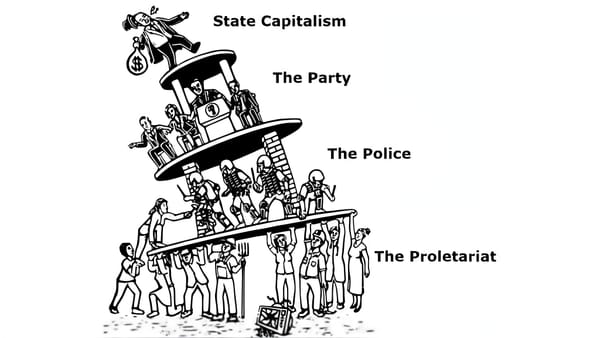
For Anarchists Soviet history speaks to the fact that centralized political power can't achieve communism. Just as private entrepreneurs have to subordinate the workers to the despotic plan of the market party officials have to subordinate them to the despotic plan of the totalitarian state. The despotic plan of the totalitarian state ends up being the despotic plan of the market since no modern state can exist outside the market. Neomarxist sociologist Immanuel Wallerstein referred to the way in which Marxist-Leninist regimes existed in the capitalist world-economy as neomercantilism. This is because they did not remove themselves from the world market (they couldn't if they wanted to survive). Instead they utilized strong protectionist measures to gain a competitive advantage within it.
Sources
History of the Soviet Union from Beginning to End, Kenez
Soviet Century, Lewin
The Russian Revolution, Tompkins
Political Thought of Joseph Stalin, Ree
Stalin, Read
Western Marxism and the Soviet Union, van der Linden
Stalin and Stalinism, McDermmott
1936, Rees
1956, Radchenko
Stalin as Historical Personality, Harris
The Rise and Demise of World Communism, Breslauer
Communism: A very Short Introduction, Holmes
Marxism, Marxism-Leninism, and Socialist Experiences in the Modern World-System, Wallerstein
Socialist States, Mercantilist Strategies and Revolutionary Objectives, Wallerstein
State-Capitalism, Buick and Crump
Marxism and Freedom, Dunayevskaya
Antisystemic Movements, Wallerstein, Hopkins, Arrighi
The Development of Capitalism in Russia in the Works of Marx, Danielson, Voronstov, and Lenin, White
The Great Famine of 1932-3 in Soviet Ukraine, Krawchenko