133 Days of Classical Marxism

Marx's corpus not only produced the most detailed critical analysis of capitalism to ever be produced, but it immediately spawned, with the help of his collogue Friedrich Engels, a new system of thought and practice that would become dominant in the radical labor movement through the second international workers' association. Scholars of Marx and Marxism refer to this framework as 'classical Marxism'. This is because it was the form of Marxism that predominated before Stalin's takeover of the world communist movement through the Soviet controlled communist third international and thereby was different both from Marx's own views and the Marxism-Leninism that would come to dominate the 'communist' bloc of regimes in the 21st century. This form of Marxism like Marxism-Leninism was strategically directed toward the ultimate goal of commandeering centralized political power for the socialist/communist movement, but unlike Marxism-Leninism expected that this conquest of power would only be successful if it took place in conjunction with a wider international revolution which immediately broke down national barriers to the global solidarity of the proletariat against capitalism. This was the kind of Marxism that guided the Bolsheviks' initial seizure of power in Russia.
This kind of Marxism went through three crucibles, two of which are well known, the other not. The first crucible came with the first world war. Since there was no prospect of an international social revolution on the immediate horizon from the end of the 19th century to the beginning of the 20th when classical Marxism attained its solidified form the immediate objective became the formation of a socialist party at a national level to represent the workers in bourgeois parliament and raise their consciousness with the ideas of 'scientific socialism'. The second international would in 1896 expel the Anarchists who opposed state power and the socialist parties which came to predominate in it, crucially the German Social Democratic Party (SPD), would go on to create bureaucratic political apparatuses presiding over trade unions, cultural functions, publications, and the administration of state benefits to the working class. The socialist parties, while preaching the downfall of world capitalism, thus became part of the nationalist political mechanisms which provided benefits to members of the working class considered rightful 'citizens' of their nations which thereby and by design cultivated national loyalties among the workers.
The tragic result was that the parties generally voted for and supported their own governments participation in the general fratricide of the world proletariat that kicked off in 1914 despite having verbally committed themselves to radical internationalism. The international collapsed and although it still technically exists, would never again be dominated by revolutionary Marxism. The second crucible came with the Russian Revolution. Counting on a corresponding revolutionary upsurge in the west the Bolsheviks rode a movement for worker-peasant control of society in Russia that had overthrown both the Tsarist empire and the bourgeois provisional government that replaced it to power.
They completely subordinated the council organizations of the workers, peasants, and soldiers, replaced worker control of factories with one man management, and replaced worker and soldier militias with a regular hierarchical military. With the failure of revolutionary workers' movements in western countries like Germany and Italy the Bolshevik state transformed into a dictatorship over, rather than of, the proletariat. Workers and peasants now had to produce for state controlled industry and agriculture hooked up to the world market under a communist political autocracy. The process of constraining the class struggle ultimately led Stalin to execute a take over of the autocracy and institute a totalitarian project of forcibly mobilizing the workers and peasants for break neck industrialization, collectivization (herding peasants on to state controlled farms to meet grain targets for the state), and capital accumulation justified by a new Marxist-Leninist ideology that dispensed with the requirement of an immediate international revolution and maintained that socialism would be made possible only through national military and economic development.
The third crucible took place before the full playing out of the second. In 1918 the fall of the Austro-Hungarian Monarchy precipitated by world war led to the creation of the Hungarian Soviet Republic to last 133 days. The Hungarian labor movement had its down historic connections to a socialist party that led the way in achieving bread and butter gains for the workers. It was also host to a much more militant social movement centered around Anarchism and revolutionary syndicalism. Syndicalism which aimed to achieve socialism through self-organized revolutionary labor unions and Anarchism which argued that a precondition for socialism is the immediate negation of centralized political power constituted the main alternative in the global north and south to classical Marxist 'social democracy' and often merged with each other to form the Anarcho-Syndicalist movement.
Often the presence of large and healthy revolutionary syndicalist and Anarchist movements such as in France and Spain translated into an absence of success for Marxist social democracy. So if classical Marxism was to dominate in Hungary the syndicalists would have to be marginalized. This is exactly what happened when in February 1918 the syndicalists precipitated a general strike which was met with government repression of syndicalist leaders. Thereby the militant alternative in the workers' movement to the conciliatory socialists during the war was excised.
Meanwhile the Transylvanian journalist Bela Kun had been captured as a prisoner of war by Russia and then set free by the Bolsheviks as a result of his reputation as a prominent social democrat. Kun would return to the country leading a band of communists influenced by the Bolshevik revolution in Russia. The Autumn Rose Revolution replaced the collapsed monarchy with a liberal republic which the socialists would come to dominate. The communists and socialists would engage in ultra sectarian conflicts over control of the government and movement.
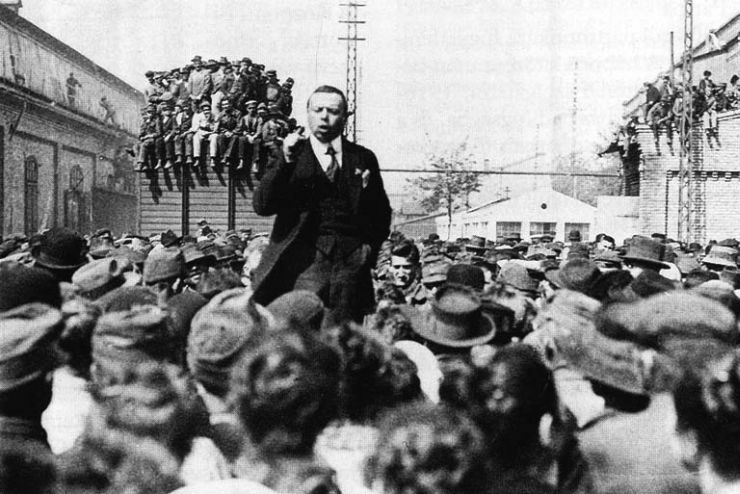
The culmination of these conflicts was a wave of repression against the communists by the government in response to an Anarchist assassination of four police officers. Bela Kun was detained and in an act of recrimination police visited his cell and beat him. This act was widely publicized owing to the presence of a journalist at the beating unbeknownst to the police carrying it out. The public outcry forced a rehabilitation of the communists and ultimately the two factions merged into the United Socialist Party under the communists' ideological objectives leading to the proclamation of the Soviet Republic on March 21st.
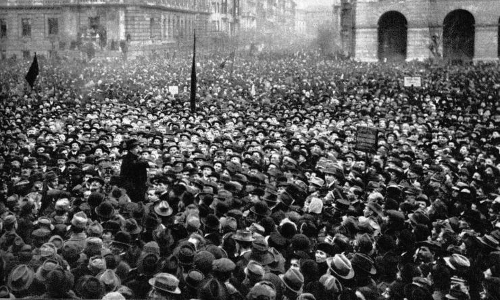
Neither party was a contributor to revolutionary social change in Hungary. The socialists shied away from a full revolutionary transformation based on the the workers' council movement that had developed from the syndicalists despite the fact that Budapest workers' and soldiers' councils had taken defacto power in the aftermath of Autumn Rose. The communists made a virtue out of the Bolsheviks' contradictory combination of a vision of all power to the workers' councils, state controlled industrial production, and party autocracy, the latter of which being enforced in Hungary like it was in Russia; via an aggressive secret police force. During the factional squabbles of different groups of communists and socialists the syndicalists continued to be a genuine revolutionary opposition calling for the party to become fully subordinate to the workers' councils which could have taken place given that agricultural and industrial workers continued to seize control of land and factories while making recalcitrant criticisms of the socialists as "counterrevolutionary".
Despite the fact that the syndicalists had control of the Budapest workers' and soldiers' councils these councils were thereby forced to reverse the election of the syndicalists in the eighth district. Similarly something of an Anarchistic agricultural workers movement developed to push for their interests as the most disadvantaged section of the working class. Instead of land redistribution to rural workers, however, the communists made a vague decree in favor of the nationalization of land, and abolished the land tax while inflating food prices which only benefited well to do peasants. The agricultural association was couped out of the government by the socialists and received no support from the communists. The agricultural movement thereby went conservative ultimately delivering the rural masses into the arms of the antisemitic counterrevolution.
The counterrevolution was made possible in the first instance by the fact that neither the Soviet Republic, nor the socialist led bourgeois republic before it, altered the state directed form of capitalism based on the bureaucratic exploitation of the rural workers and the subordination of non-Maygar ethnicities, in particular the Jewish minorities. The biggest gains the communists had tossed the workers was the reduction of the working day, the abolition of piece work, and increasing wages. Piece work was reintroduced and the working day lengthened however in the aftermath of the suppression of an attempt by Admiral Horthy to mount a counterrevolutionary uprising. This was part of a general roll back of revolutionary gains in response to that uprising when antisemitic raids were conducted on Polish Jewish refugees, officers from the ancien regime were brought back to fix up a disintegrating army, and an ill-conceived wheat barter program ended up benefiting nobody.
Like the Bolsheviks the Hungarians paid for their expectation of a general revolution in the west. Not even the Bolsheviks themselves were able to come to the Hungarians aid. Bela Kun saw the Bolshevik Brest-Litovsk peace as a concession to counterrevolution and so faced with the prospect of having to conclude his own punishing peace with Germany and Romania he pushed it off until it was too late. After a failed communist backed coup in Austria and the Hungarians managing the military establishment of a Slovak Soviet Republic Kun was finally forced to concede and retreat. The Soviet Republic was ultimately dissolved and the Horthy led counterrevolution triumphed in the construction of an antisemitic authoritarian conservative regime.
The lesson to be learned, I would argue, is that the classical Marxist marriage of strident internationalism and a strategic fixation on centralized political power cannot be made to work. Whenever classical Marxists have relied on participation in politics as a separate sphere of social life they have found that, like all projects within that sphere, itself the product of a society divided between ruling and nonruling classes, they had to use repressive mechanisms to discipline the laboring masses into accepting their power within that sphere. This meant betraying both the socialism and internationalism of their programs: having to try to maintain political power in isolation as a result of broader working class defeats, make concessions to nationalism in the absence of an international working class mobilization, and sustain the subordination of living labor (workers) to dead labor (industrial capital accumulation), or simply be wiped off the map all together. In doing so they had to suppress and dismiss on the ground possibilities for the self-organization of the working masses and their control over industry and agriculture given fullest theoretical articulation in the Anarchist and revolutionary syndicalist movements. Thus classical Marxism contributed substantially to the defeat of the world working class in the 20th century whether in western Europe, Russia, or Hungary.
Sources
The Russian Revolution: An Anarchist View, Tompkins
The USSR: An Anarchist View, Tompkins
Anarcho-Syndicalism in the 20th Century, Damier
Revolution in Perspective, Janos
Bela Kun and the Hungarian Soviet Republic, L. Tokes
The Second International, Decange
Marxism and Social Revolution, Eley