Green On Paper, Grey On The Ground
Green Colonialism in Indonesia
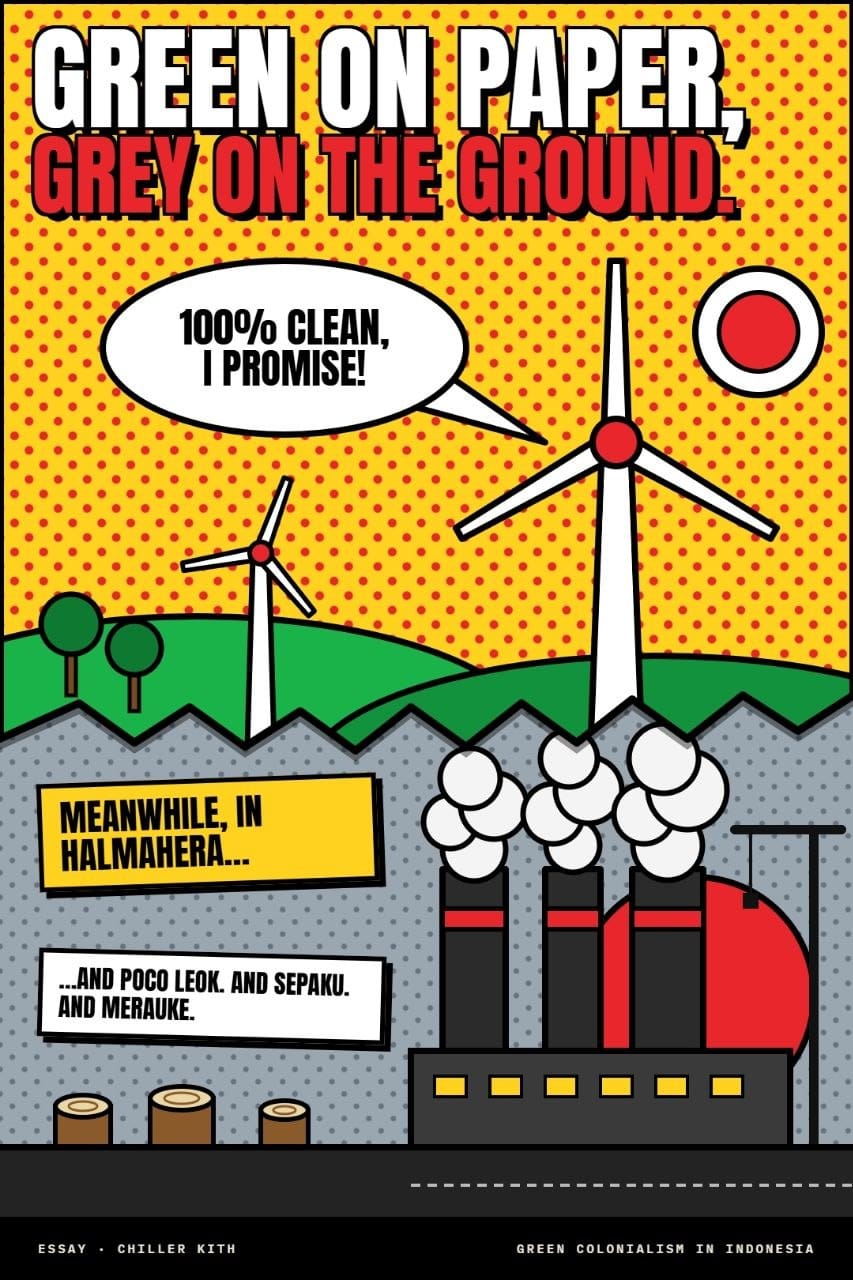
In the brochures, everything looks clean. Geothermal turbines line up neatly on green slopes, electric cars glide by without a sound, and a new city in the middle of the Kalimantan forest is drawn complete with flowering gardens on every corner. The story being trumpeted never changes: a sustainable transition, environmentally friendly, the future. Who could refuse the future? On the ground, the story is different. In Poco Leok, in Manggarai, residents who oppose a geothermal project face armed security forces escorting workers onto the land where they live. In Central Halmahera, a river that once ran clear now runs murky brown, and an open-pit mine presses up against the edge of the village. The people who say no are not invited to talk. They are escorted, warned, and some are criminalized.
This essay tries to set those two sides next to each other, then asks why the gap between them is so wide. The hypothesis is simple: “green” is not an ethical guarantee. It is new packaging for an old pattern, in which the state and capital seize the living space of the people who live on it, then call it the national interest under the label of National Strategic Project (Proyek Strategis Nasional, or PSN). The color changes; the hands stay the same. I am not saying that renewable energy is evil, or that coal should be kept. The more fundamental question is this: a transition for whom, decided by whom, and paid for with whose life? As long as that question goes unanswered by the people most affected, the word “green” works only as lubricant.
Green colonialism: not a new term
Richard Grove, in Green Imperialism (1995), shows that Western-style nature conservation is rooted in colonialism. Protecting forests and land in colonized territories also meant regulating who could use them and who could not. Environmental protection and control over populations have gone hand in hand from the start, long before the phrase “energy transition” was coined. That history matters because it shows that residents’ suspicion of green projects is neither new nor baseless. In many Indigenous communities, collective memory holds a long experience of projects that arrived promising good and left damage behind. That wariness is knowledge, not backwardness.
In today’s language, the pattern repeats on a global scale. Buseth (2021) reads the relationship between the Global North and the Global South sharply: the North needs minerals for batteries and forests as carbon sinks, while the South is positioned as the supplier. Lang, Manahan and Bringel, in Geopolitics of Green Colonialism (2024), add that the modern energy transition in fact preserves old global inequalities. Only the commodity has changed, from spices and rubber to nickel and geothermal. Hamouchene and Sandwell, in Dismantling Green Colonialism (2023), call this phenomenon green extractivism: extractivism with a green face. Dejonghe and Van de Graaf use the same term for energy transitions that carry on old power relations. The point is consistent from one author to the next: change the fuel, keep the owner.
At this point my position differs from many eco-socialist critiques. They often stop at the question of who profits, foreign companies or state-owned enterprises. From an anarchist perspective, that is not the heart of the problem. The problem is the structure: a state and capital working together, with PSN status as their legal instrument. Whoever the owner is, as long as decisions about land are made far from the people who live on it, the pattern will stay the same. Changing the owner does not touch the root of the problem; it only changes the sign on the gate. PSN status is important to understand. It gives a project a fast lane: permitting is cut back, land acquisition is made easier, and residents’ objections are treated as obstacles to development. In other words, PSN is the way the state turns dispossession into procedure. When different projects in distant places follow a similar pattern, the explanation is usually not coincidence or local error but design.
Four faces of green colonialism in Indonesia
Geothermal: clean energy that costs lives
Geothermal power is often marketed as a star performer. Indonesia has potential of about 23,965 megawatts (MW), the second largest in the world, but only about 8.9% of it is being used. The government is targeting 9,300 MW by 2035. A number that large sounds like good news. Until a question comes to mind: whose land is that potential under? Geothermal energy does not exist in a vacuum. It lies beneath gardens, springs, and land regarded as sacred by people who have lived there for a long time. In Poco Leok (Manggarai, East Nusa Tenggara), residents have opposed the project since 2011. Instead of listening to them, authorities have pushed the project forward under armed escort for three years. In all, 22 residents and journalists have been criminalized. Imagine what it feels like when people in uniform show up at your own garden and, when you protest, you are the one who is prosecuted. In Atakore (Lembata), a forum billed as an “independent investigation” was held unilaterally, and residents walked out. People know when they are being invited to pretend to deliberate.
That fear is not excessive paranoia. In 2021 at Sorik Marapi (North Sumatra), a hydrogen sulfide (H2S) gas leak killed people. The incident became a precedent, a shadow that now clings to every similar project that arrives in another village. Residents are not rejecting electricity. They are refusing to be made test subjects. Then there is Tana Rongkong in North Luwu. The project is being built by PT Ormat (a company from the United States), has PSN status, is valued at 1.5 trillion rupiah, and covers an area of 43,690 hectares. A regional regulation recognizing Indigenous communities does exist, but its implementation is slow. On paper, their rights are recognized. On the ground, that recognition has not had the chance to become power, while the project moves ahead at an entirely different speed.
It should be noted that the opposition in Poco Leok, Atakore, and Rongkong is not born of an anti-electricity stance. Residents are asking something entirely reasonable: are our water, our gardens, and our village safe, and who is responsible if they are not? That question has not received a satisfying answer, and that is where the projects lose their legitimacy. The energy may be clean on the carbon ledger. But that ledger does not record a village’s anxiety.
Nickel: for electric vehicles with zero tailpipe emissions
Indonesia produced more than half of the world’s nickel in 2024, according to the U.S. Geological Survey. Warburton calls new extractive industries like this nationalist enclaves: pockets of industry wrapped in the language of national sovereignty but still operating on the logic of extraction. The red-and-white flag is flown above the smelter, and that is enough to make criticism sound like betrayal. In Central Halmahera, the Indonesia Weda Bay Industrial Park (IWIP) and the PT Weda Bay Nickel mine are described as one of the largest open-pit mines in the world. A report by Climate Rights International (CRI), titled Nickel Unearthed, documents land grabbing and intimidation by police and military. The impact is felt in people’s bodies. Acute respiratory infection (known in Indonesia as ISPA) is the dominant illness in the five villages around the mine, with 2,745 cases in 2024. That figure covers just one year and only the villages closest to the mine.
In Lelilef Sawai, 66 families came together to refuse. Today the mine sits about 100 meters from the village. A distance that short shows who is given room and who is steadily squeezed. The river once used for everyday life can no longer be relied on. The irony stings. The smelter, which is claimed to be environmentally friendly and supplies raw material for electric vehicles, is powered by captive coal-fired plants. According to a report by Ember, the region is one of the largest hubs of captive coal power in Southeast Asia. The electric car is clean on the streets of rich, advanced cities. But the smoke still billows over Halmahera and causes respiratory illness. The pollution has been relocated, not removed.
This supply chain is long and distant. The person who buys an electric car never sees Lelilef, and the people of Lelilef never see the end product. That distance works like a curtain. The damage happens in one place, the comfort is enjoyed in another, and no one has to connect the two. Colonialism has always worked with distance of this kind.
IKN Nusantara: Smart Forest City
Nusantara, Indonesia’s new capital (known by its Indonesian acronym, IKN), is promoted as a “forest city” (a smart forest city) built on the principles of the Sustainable Development Goals (SDGs). Sepaku, where IKN is being built, is home to the Balik and Paser peoples. For them, this is not the story of a new city. It is a continuing story: their land has been taken in stages, from forest concessions (HPH) to industrial timber plantations (HTI), and now IKN. Each time the brand changes, the new label looks friendlier. Meanwhile the underlying pattern has not changed: community land is handed over to whoever the state considers more productive.
The Nusantara Capital Authority once sent residents of Pemaluan a letter with a seven-day (7 x 24 hours) ultimatum to demolish their own buildings. Officials of the authority deny any coercion, but residents’ testimony on the ground says otherwise. In a conflict like this, who is easily heard? An official with a spokesperson and press releases, or residents without land certificates who must wait for a reporter to show up?
The Indigenous Peoples’ Alliance of the Archipelago (AMAN) has warned of the risk of depopulation and cultural extinction for the Balik people. If the new city succeeds in rising but the community that has long kept its forest vanishes, who will tell people that this place used to be forest? The concern AMAN voices is not only about the loss of physical living space, but about the extinction of narrative, collective memory, and the cultural identity of the Balik as the original guardians of that forest. A forest city that has lost its forest guardians is only a slogan. IKN also reveals another side of green colonialism: aesthetics. Trees are planted and gardens designed, then put on display as proof of care. But a forest is not merely green cover. It is a long relationship among people, land, and knowledge. A forest designed from above has no such relationship.
Merauke: food and bioethanol in the name of green energy
The fourth face is newer and larger. The food estate and bioethanol project in Merauke (South Papua) has been described by AP News as one of the largest deforestation projects in the world, on a scale of millions of hectares. The Financial Times has reported that the military was deployed to speed up forest clearing. This part connects to a theme I have written about before: the militarization of Papua. Soldiers no longer arrive only as security forces but also as land-clearing labor, and their presence is justified in the name of food and energy security. The forest being cleared is not empty space; it is the living space of Indigenous Papuans. When bioethanol is called green energy, the question left lingering in the mind is: green for whom, and on whose land are the crops being planted?
Merauke’s scale shows how the same logic can be enlarged without limit. In Poco Leok, what is at stake is a hill; in Merauke, it is a landscape of millions of hectares. The larger the scale, the easier it is to call it the national interest, and the smaller the room for voices of objection.
How the four cases connect
These four cases span different sectors, but the pattern is similar, and the similarity is no coincidence. PSN status strips away the approval process. When a project is designated strategic, free, prior, and informed consent (FPIC) becomes a formality that can be skipped. Strategic for whom? That question is rarely answered, because the answer is uncomfortable. Next, armed forces are called investment security. The presence of police and military is justified as protecting the project, not protecting residents. Residents’ resistance automatically becomes a security disturbance, and refusal becomes a criminal matter.
Then, altruistic language covers extraction. Clean energy, forest city, food security, transition. These terms are noble, and because they are noble they are hard to argue with. People who refuse are branded as obstructing progress. The victims are those without formal certificates. Ancestral land is managed across generations but is not always recorded at the land office. To the state, land without a certificate is empty land, and empty land can be allocated. The recipients are transnational corporations and domestic elites. Profit flows up and out; the risk stays in the village. Those who bear the damage rarely sit at the table where the proceeds are divided. Put together, these five elements form a single mechanism: land is declared strategic, residents are separated from their voice, armed forces guard the project’s progress, and the destruction is named a necessary sacrifice. It works much like old colonialism, only with updated language and equipment.
The constitutional perspective
Our constitution actually has fine language. Article 33 of the 1945 Constitution states that the earth, water, and natural resources are controlled by the state and used for the greatest possible prosperity of the people. In practice, state control has meant concessions for private and foreign firms. Article 18B, paragraph 2, recognizes customary law communities, but that recognition trips over tangled procedures (as seen in Tana Rongkong). Legal critique of this kind is useful. It provides language and a basis for making demands. But law does not enforce itself. Without coercive force from below, a fine article remains an ornament in a book, and the state that wrote the article is also the state that permits its violation.
For anarchists, this paradox is not a flaw that can be patched with a more progressive interpretation. A state that is both guarantor of rights and issuer of extraction permits has a conflict of interest that does not disappear through revising articles. Even so, we need not dismiss these articles. Residents use them as a temporary shield while building power that does not depend on them.
The anarcho-syndicalist perspective: those who run the machine can also stop it
So far we have been talking about residents whose land is being taken. Yet every project has another group that rarely enters the story: the people who work inside it. Those who lay pipe at geothermal sites, operate heavy equipment at the mines, tend the smelter furnaces, or pour concrete in Sepaku. Anarcho-syndicalism starts here. The power to stop extraction exists not only outside the project fence but inside it as well.
The logic is simple. A project of any size runs only if there are hands to run it. And those hands are often in a vulnerable position. Wages are set by the company, workplace safety is often sacrificed to production targets, and unions tamed through official procedures are easier to coax into compromise than into resistance. This is where the old trick of state and capital comes in. “This project creates jobs” becomes the sentence used to silence residents’ objections, as if residents who refuse were robbing their own neighbors of a livelihood. Pitting residents who defend their land against workers who need wages is one of the most effective ways to break resistance. Syndicalists refuse to pick a side. What is needed is a workers’ organization that is empowered on its own terms and dares to stand in solidarity with residents, through direct action: strikes, slowdowns, refusing to do dangerous parts of the work, even refusing to work on the project at all.
This is not fantasy. In the early 1970s in Sydney, building workers’ unions imposed green bans, refusing to demolish neighborhoods and green spaces at residents’ request. The lesson we can draw is clear: strikes can be used to defend living space, not only to demand wages. This perspective also changes the meaning of a “just transition.” For the state and companies, it means severance packages and retraining for affected workers. For syndicalists, it means energy and mining workers helping decide for themselves what gets dug, for whom, and on what terms, together with the communities living around them. Not nationalization that hands control to bureaucrats, but direct control by those who work and live there.
Of course, this is not easy. In Indonesia, strikes and organizing in large industrial zones face legal risk and pressure from security forces, and some workers come from far away, so their ties to local residents are very thin. That is precisely why building bridges between workers and communities is the most urgent political work, long before anyone speaks of a “green future.”
Conclusion
“Green” today is a new brand for an old pattern. In Poco Leok, Tana Rongkong, Sepaku, Dieng, Halmahera, and Merauke, what is happening is not merely an environmental problem that better regulation could fix. It is a struggle over territory and power over people’s lives. This essay does not offer an instant way out. But before talking about solutions, we need to stop using the language of those doing the seizing. To call something “green” is already to accept their definition of what is worth protecting, and who may be sacrificed for it.
That is why support for these communities is better understood as anticolonial and anti-state resistance, not just solidarity on an environmental issue. We can begin by amplifying their voices, backing local movements, refusing to call anything “green” that is guarded by guns, and, for those who work inside these projects, refusing to be the hands that make them run. A future worth defending is one decided together by the people who live there, not one shipped in from a distant boardroom.