Sorry to Bother You, We Just Want a Future

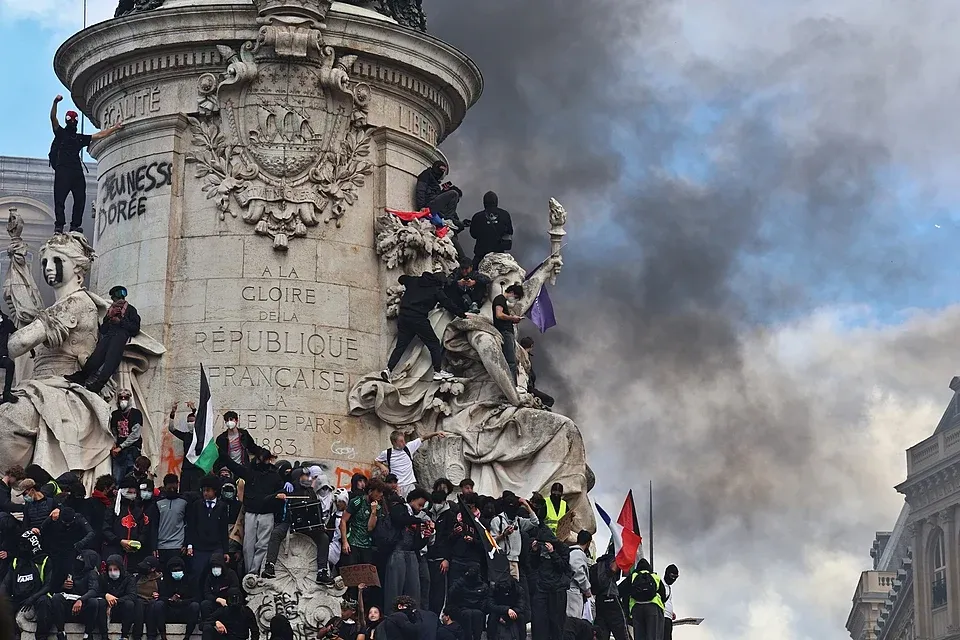
Youth protests have taken hold across Europe. They have resulted in clashes with police, looting, and with violent confrontations particularly pronounced in France seeing the burning of a historic Limoges building. Police have arrested droves of people including minors. The French government has attempted to confine the protests to preapproved areas in order to tamp them down. Far-right Italian Prime Minister Meloni has sent thousands of troops to keep order in Milan.
In Albania youth protestors have organized a broad horizontal movement in rejection of both the sitting Socialist Party and the opposition Democratic Party, declaring all political elites anathema and demanding the resignation of long tenured Prime Minister Edi Rama. Housing protests in Spain set off by the eviction of an elderly woman from an apartment she had lived in for decades and made worse by her death before she could sign the new lease the protests had secured for her have forced snap elections to deal with the hike in housing costs far above wages. The violence in France has been particularly widely publicized by tourists. The far-right in France has blamed the protests on migrants and the far-right in the United States have taken the opportunity to associate it with the policies of the Democratic Party ahead of midterm elections. The political establishment in France has taken the normal centrist tact of endorsing the democratic right to protest while justifying police repression (and the police in France are known for being heavy handed) on the basis that any sort of violence what so ever is unacceptable (violence which they have without evidence blamed on the 'far-left').
This antipathy to violent resistance can be seen in the comments of foreigners on social media to the effect of "how could burning your community help your cause?!". However, the cost of living problems faced by European populations, particularly their young people, are very real. While their governments spend money on military build up and confrontation they are left unable to afford rent, unable to buy a house, unable to find employment and the trend continues despite every promise made by those in power. The handwringing over political violence might as well read 'we can squander your future on death and destruction, but you can't break windows, or throw rocks at police to take it back!'. Such are the scruples of liberal democracy.
Yet the fact that protestors have refused to confine their activities to acceptable bounds is what has put pressure on authorities. Trump can sit pretty in the United States during 'No Kings' protests because that movement was 'defending democracy', i.e. spending the resources of mobilization on what were essentially glorified campaign adds for the democrats. Thus they posed no immediate threat to the Trump regime despite their heated opposition to it. Meanwhile, Macron has to pay attention when protestors move toward the presidential palace.
The protests are a natural response to the consequences of capitalism's structural crisis. Since the early 70s the creation of new goods and services has declined relative to financial speculation whose function is to move around money. This is problematic for capitalism because capitalism requires the continual production of new commodities that bring a return on investment, whereas speculative movement of money through finance in the absence of this real production simply produces speculative bubbles cycling debt around until someone defaults. Earlier bubbles were related to the debt of multinational corporations, whereas the housing bubble that popped in 2008 related to the debt of individuals. Since, the accumulation of government debt has pointed the world-economy in the direction of a bubble the bursting of which would implicate the sovereign debt of states.
The signs of this oncoming crisis are what precipitated the protests across Europe with the accelerant of the war in Ukraine driving up fuel prices. The basic problem for governments right now is that they are facing a choice between dramatic scale backs in social spending which already faced decades of assault from neoliberal policies running from the 80s to the 2010s, in order to service their debts, or continuing to take out more debt in order to fund those services. The unrest is the result of governments attempting to make cut backs, or being reticent to engage in new social spending. The choice becomes make everyone's lives worse and weather the storm of unrest, or increase the debt burden.
Not all governments are as hard hit, perhaps the reason France's unrest has been the most dramatic and visible is because it is particularly hard hit by these concerns. Nevertheless, all governments feel it to one degree, or another. With the exhaustion of rural zones full of cheap labor, the historical running up of the tax bill to service state functions, and the increased demands of specialist middle managers in terms of compensation, real production has no room to increase again creating a spiral of financialization and deglobalization via protectionism as governments try to shield themselves from the oncoming storm. Governments and and the capitalist world-system in general have no solutions to offer, which is why youth unrest in Europe has tended to reject the political establishment entirely, a symptom of what social scientist Immanuel Wallerstein called global antistatism; a tendency for populations to loose faith in the ability of governments to change their lives for the better.
Unfortunately, the protests have not yet produced a conscious Anarchism. The default assumption remains trying to rest some solution from the state. In France the demands of protestors tend to be limited to more funding for schools and political anger is being funneled into left and right of center political parties. Even in Albania the protestors have called for a 'technical government' to replace the Socialist Party. Since there can be no solution in terms of government Anarchists need to embed ourselves in these struggles and agitate for the formation of self-organized labor associations whose ultimate mission is to seize control of society from the capitalist class and the capitalist state creating a world without government beyond capitalism; a world-socialist confederation.
Sources
https://www.youtube.com/watch?v=M85Uh6rLiPA&t=1s
https://youtube.com/shorts/sF1J0Vd_ZDM?si=djm1E-D4EBmSck90
https://youtube.com/shorts/gndlhm3pSNI?si=wjdb-H0SAP5ExJC3
https://youtu.be/4Rpgof79y_M
https://youtu.be/c0q2vAS9KjU
https://youtu.be/fEyAAGW2XJY
https://www.aljazeera.com/news/2026/10/21/what-are-italys-new-measures-against-violent-protests
https://www.cnbc.com/2026/10/20/france-protests-europe-cost-living-violence.html
https://www.theguardian.com/us-news/2026/oct/22/trump-maga-media-europe-protests
https://www.aljazeera.com/news/2026/10/20/horizontal-revolt-why-albanias-young-protesters-want-pm-rama-to-go
https://www.aljazeera.com/video/newsfeed/2026/10/20/satirical-ai-video-of-paris-protests-mirrors-real-life-tourist-experiences
https://www.theguardian.com/world/2026/oct/21/will-europe-protests-lead-to-real-political-change
https://www.theguardian.com/world/2026/oct/22/macron-ban-illegitimate-demonstrations-france-unrest