N(e→o)W
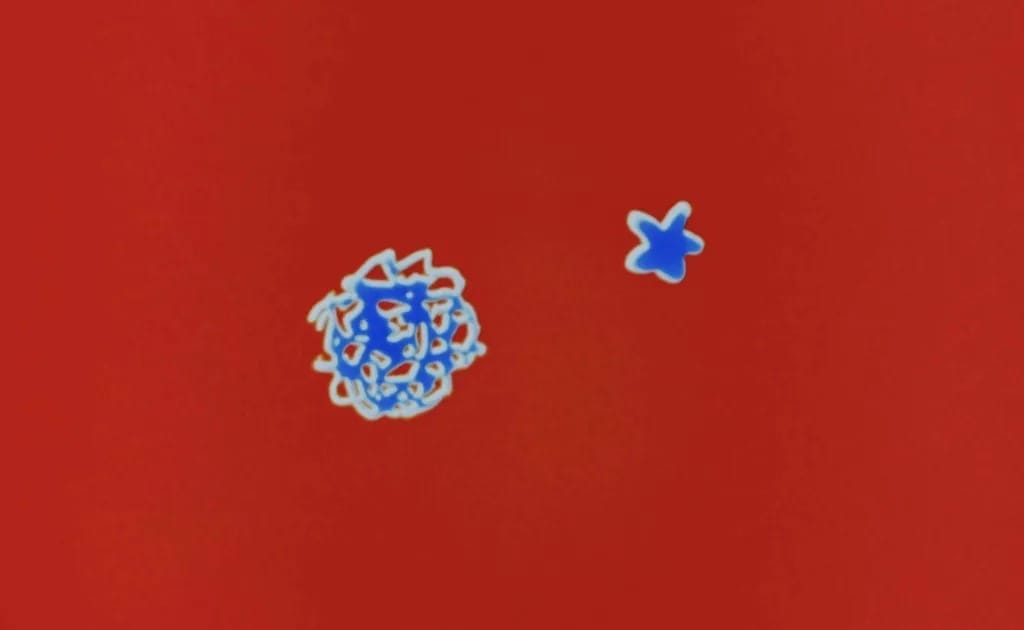
“Pointillist time is broken up, or even pulverized, into a multitude of ‘eternal instants’ – events, incidents, accidents, adventures, episodes – self-enclosed monads, separate morsels, each morsel reduced to a point ever more closely approximating its geometric ideal of non-dimensionality.” - Zygmunt Bauman (Consuming Life)
.1
The history of time can be broadly divided into two dominant conceptions: cyclical time and linear time. Zygmunt Bauman proposed “pointillist time” as a new, third dominant temporality that had replaced linear time in late commercial society. However, Being would argue that linear time remains dominant for as long as capitalism remains, with one important caveat: its increasing compression, particularly over the last few decades, has allowed point-like elements and appearances to emerge within it. These phenomena will be referred to as pointilloid.
Instead of using Bauman’s term “pointillist time,” which explicitly describes this supposed temporality that has come to dominate late capitalism, we will use the term pointed time to refer to an approaching new and alienating temporality that might replace linear time, modernity, and capitalism as they enter their final decades, assuming communism is not established before then. Pointed time will retain much of what Bauman describes as pointillist time, but with this important distinction. In this sense, pointilloid phenomena are not themselves evidence that pointed time has already dominated. Rather, they are early manifestations produced by the increasing compression of linear time, which may foreshadow its eventual replacement.
Cyclical time is the temporality of the recurrent: repeating cycles. It is the time of premodernity. Linear time is the temporality of the new: horizontal progression. It is the time of modernity and the resulting attempts to close its alienation by imposing a variety of “newness” on modernism. Pointed time, now slowly emerging, is the temporality of the now: sporadic instants of random value and potential. No longer an endless, flat emptying of meaning, the new is overthrown by the now: discrete, randomized instants with varying values of importance. Each disconnected point is its own big bang of potentiality. A polygenous, partitive time. This speculative period after modernity will be called instaneity, and the imaginative response to its alienation termed instantism.
People moved along in cycles, then across lines; they might well close the gaps between time and space, and move through time as spacetime becomes one to be constantly penetrated by and as well as penetrating those who might experience it in the future. The emergence of pointed time comes out of the compression of linear time, the crushing and puncturing of threads into points spread across an open sky. Late modernity, from 1945 to the present, has seen a hyper-intensification of both intrusively privatized and extrusively public modernization. More specifically, the 2010s and 2020s have seen the widespread adoption of technologies that have significantly disrupted linear time: the smartphone in every pocket, and now the rise of artificial intelligence.
You don't even have to search for something when you can simply ask AI for the information; it searches for you, then responds with an answer. The compression of digital surfing is right before us. Why go out and find a companion? When one is right there, in the now, waiting for you to say hello. It's all coming, but not later; why wait for the new, when it's about to happen now? Want to paint? Want to film? Do it now! Create a painted landscape and cinematic operas with a prompt.
Generative AI operates stochastically based on the data given and responds through time, unlike a calculator, which provides clear answers after you’ve input the numbers you’re adding or subtracting. To generate is to puncture a picture into place, whereas to calculate is to determine a picture into place. One moves through time, while the other moves across it. Calculation is deterministic and progressive in this sense, while generative AI is not. It operates less on progression and is more concerned with the now. Generative AI, in its more ideal form, would house enough information within itself to be independent, allowing the user to generate freely without requiring continuous amounts of new data. Generative AI would itself become the thing it does: the machine would be a generation of generations.
.2
The emergence of pointed time creates for humanity the unique experience of a second temporal transition. The first, cyclical to linear, involved chronostretching, to take the cycles of time and push them out on both ends. And chronocrushing, to flatten out the cycles. The liminal shape between a circle and a line is the clothoid, spin-like, winding the threads at the ends of spirals. Early capitalism connected the heterogeneous cyclical societies across the spacetime of Earth by first taking one initial cycle, flattened and stretched until the circle seemingly breaks off, spiraling at one end and a floating curved edge on the other, using that open edge to connect into another cycle so that the spiral could unwind it. This process goes on until only a single continuous, homogeneous linear society has attained global dominance. Linear to pointed time involves chronocontraction and chronopenetration, to shorten and to pulverize the single homogeneous line of the global into discontinuous flashes of superpresents.
Train stations and airports allow people to move across spacetime on Earth over increasingly shorter amounts of time. Initially, this spreads out time in the first instance: passengers on trains and planes watch through their windows as geography passes before them while they themselves remain seated, the triumph of an object at rest within a greater object in motion. Yet these lines are shortened over and over again as people continually refine them, seeking to make them quicker and more direct, compressing rail lines and flight paths. Modernity, in its later stage, has come not only to compress itself physically but also mentally. To break apart established narratives, to become “postmodern,” “post-structuralist,” or post-anything, is to reshuffle continuity and discontinuity into an increasingly shorter framework, compressing narratives through greater relativity, immediacy, and locality. Relativism is pointilloid in this respect because of its harsh reflexivity, yet it remains very much locked within the linear.
The novelization of fiction through the widespread use of the printing press was a major flattener of time. In the early period, the long and drawn-out process of writing, typesetting, and printing a novel created an elongated line across time. As writing and printing became increasingly standardized and efficient, this line slowly became shorter and shorter. The radio became a major compressive force on this elongated line, as stories could now be automated and delivered through recordings. The audience no longer had to read and process every individual word; much of this process was automated through sound. Yet the visual side of storytelling still required considerable processing effort from the audience, although techniques such as sound effects, music, and vocal tones could help guide and focus the listener’s visual imagination. Radio dramas allowed, for the first time, the widespread use of serialized and non-serialized episodic storytelling starting in the 1920s and reaching popularity in the 1940s as radios became more affordable to lower-income households. The film camera then compressed the visual alongside the audio, although, initially, the audio side of film had been a separately accompanied device before a single device could capture and record audio and visuals. Film goes from being shown in specific spaces of the coin-operated parlors and theaters, to being shown in households on televisions, to now being shown on mobile smartphones through streaming apps.
The long-running sitcom Family Guy made use of and popularized the cutaway gag as a comedic device. Throughout its episodes, characters (typically the protagonist, Peter Griffin) would periodically begin to say something like “this reminds me of X” or “that time X happened,” only for the narrative to cut away to a brief, non-sequitur, and ultimately inconsequential scene that momentarily breaks from the episode’s main story. Seth MacFarlane, the creator of the show, is rather famous (or infamous) for writing fiction in a way that lends itself easily to being broken into clips. The Ted films, particularly Ted 2, can similarly be broken down into dozens of short clips that remain consumable even when removed from their original narrative context. MacFarlane arguably anticipated, and helped popularize, the imagination of clipped media that would later become widespread through YouTube, Vine, and TikTok, where short-form content could be rapidly circulated and consumed. Unsurprisingly, Family Guy clips frequently appear in YouTube Shorts feeds. It is therefore tempting to call Family Guy pointilloid for its contribution to this emerging mode of media consumption: a form of storytelling increasingly structured around detachable, self-contained moments rather than sustained narrative continuity.
A particularly notable “pointed moment” from 2026 alone is the announcement that PlayStation will phase out the release of physical copies of games on its platform. This is a consequence of the increasingly reduced rate of physical production and the resulting acceleration of digitization. The absence of physical objects represents a reduction in continuity. Since the purpose of physical tools, toys, and other objects is partly the externalization of subjectivity into forms capable of carrying meaning across generations, their reduction will disrupt linearized notions of legacy, inheritance, and tradition. This global (deglobalized) experience of dematerialization will not simply empty out or make continuity vanish, as modernity typically does already, but rather further impose the impression onto people that continuity (the past into the present), and possibility (the present into the future) is no longer found in unilateral thinking, that belonging, where you come from, comes from what can be immediately constructed and disregarded, not from previous spaces and times.
This disposability and dematerialization have come to dominate sociality as social media has intensified the overthrow of community by network, long anticipated by the newspaper, which allowed people to quickly find their place in calendrical time and to separate themselves from the exterior world by hiding their faces in its pages on their way to work or at the breakfast and dinner table. The newspaper stretched time by constantly reminding you of the specific date and geography you were located in, and it crushed time by relocating you as a passive individual reader who was just one of millions reading along. You don’t merely read the news; it also reads you. As you quickly dispose of the day’s paper, the day’s paper quickly disposes of you, as it does with all days and places equally. Now, however, the news is far more parasitically attached to you at all times, as is the clock. The newspaper is less materially real but far more omnipresent in its digital form. Community (involuntary interpersonal connections) and network (voluntary interpersonal connections) have, with social media, spawned the contradictory involuntary-voluntary community network (invol-vol com-net), which the physical newspaper, by comparison, only lightly introduced to its readers. You can link up with anyone, but with most people you can hardly connect. You can block and mute anyone with a tap of your finger, but anyone can do the same to you. Worse, if motivated enough, they can inspire entire crowds to stalk and harass you. The physical news also allowed for the incitement of mob violence and for spontaneous community connections, but its material construction and delivery limited its reach, in comparison to news distributed through social media.
The growing ecological crisis, compared with the growing information crisis, produces an oversaturation of knowing and an undersaturation of readiness, creating an atmosphere filled with infinite possibilities and infinite happenings, but also infinite stagnations as capitalism clings on. Society is ever at risk of drowning, drying, freezing, and frying, but also never at risk of having nothing to do. The only boredom comes from freezing before countless choices, whereas before, boredom was born out of running in search of any choices at all. With so many non-local avenues through which to pick one’s mind, the widespread adoption of the internet has produced an ever-chaotic resource pool for maze-way construction and resynthesis, generating a myriad of worldviews. More and more of these worldviews become so hyper-private that, instead of creating new means of belonging, cosmology is weaponized into new means of self-isolation.
.3
The internet also accelerates avatarization: the ability to become someone else to a far greater extent and with far greater diversity than before. Humanity has always played with masks, but now people are expanding their collections of personas. Then came advancements in full-body virtual reality; people can now use their bodies to inhabit entirely new ones. They can have entire families, lifestyles, deaths, births, and so on, as they become more and more people. Humans are not only assuming alternative personas, as they have for thousands of years; humans themselves are multiplying and splitting as a means of identity formation itself.
The we-subject of premodernity became the I-subject of modernity, as Newton’s laws of gravity dictated that individuals collided with one another and stood still when alone. Then Einsteinian relativity began to seep its way in, and as quantum computing becomes more of a reality, it is only a matter of time before the atomization of people becomes the subatomization, and eventually the quarkification, of people.
The I-subject is scattered, but not into a new “x-subject,” as subjectivity itself has become so greatly transformed. We will suggest instead that each “individual” will be a quantum cloud, or q-cloud: a person in constant superposition, capable of becoming or being any number of varying kinds of people before collapsing into a given identity to handle one fraction of a moment, only to scatter and become another in the next. Expansive biological engineering would no doubt be used to further the advent of cloning as a more overt physical response to this demand the q-cloud puts on humanity. To become a system-of-systems, a mass of masses, and approach a wider sphere of superposition of possibilities to handle. The conclusion of seeking security in an ever-prone society of terminal risk would be to multiply a given life itself, as to allow for the possibility of death without permanent end, to recover from as many failures as possible.
The Q-cloud is the only crew capable of serving aboard the starshipization of planet Earth as a self-contained pocket of possibilities, as architecture and the ecology itself are transformed by both climate catastrophe and human counter-catastrophe, bringing humanity head-to-head against the cyclical Earth and its response to the previous era of anthropogenic linearity, with the warming of the oceans and the bleaching of coral life coming to threaten the organisms on the planet. Large swaths of the Earth become uninhabitable, and so a resettlement of the Earth is conducted. The research used to solve issues of surviving outer-space travel and moon colonization will be worked out most extensively on the Earth itself. The most immediate fruit borne from space exploration is the re-exploration of the Earth itself in a time of it becoming a scarce habitat.
Unlike the previous settlement and colonization over the Earth, which brought with it the newness of modernity that stamped and marked itself most overtly in the names of places such as New York, New Orleans, and New Jersey, pointed time does not produce newness through continuity. These places pronounce their modern-hood by proclaiming themselves to be the “new” versions of presumed old and outdated places, while nevertheless maintaining a continuous line of historical connection to Europe. But there will be no Now York, Now Orleans, or Now Jersey erupting from within pointed time, since these names would still point backward toward continuity. Instead, there will simply be a Now Here and a Now Over There. Since pointed time consists of disconnected and desynchronized points, its spaces must likewise reflect this discontinuity in their naming conventions.
You won’t live in places anymore, since to live somewhere is to build and leave behind a legacy for another generation to build upon, to construct a continuous familial line. The nuclear family, suburbia, white picket fences, and the milkman were early late-modern images of ideal living and intensifications of the I-subject. Their late-late-modern counterparts are the information polycule, digiurbia, text-chat bubbles, and the lactosperson, in which the hyperspeed quicksands of community shred themselves into network. This is not to suggest that polycules are inherently bad or new, but rather that, within a pointillized atmosphere, the spaces in which romance and sex occur will become increasingly networkized and relations increasingly rotational. You will no longer have a choice between monogamy and polyamory so much as a succession of relational configurations: whoever you are with now is how your partner exists now. Who your partner will be later, however, remains undecided, unpredictable, and out of sight. Whoever your now-partner is must therefore be prepared to become, simultaneously, your now-lover, now-friend, now-acquaintance, and potentially your no-longer-anything, for the relationship to puncture through spacetime rather than simply be disposed of when the next point appears. No doubt the lines between what a friend is, what a lover is, what an acquaintance is, and what a partner is will continue to blur, not merely into ambiguity, but into a scattering of all of these relations together within a compressed whole of simultaneous relational possibility.
.4
The change in subjectivity accompanies changes in the mode of production, the form of polity, and a whole range of other material and imaginative conditions. The We-Subject, which emerged with the mode of production in the early hunter-gatherer world, came to be paired with the early modes of production in which surplus was extracted toward the center during premodernity. This centripetal motion was likewise reflected in the earliest political forms, particularly the dynastic realm.
This pairing of subjectivity, production, and polity continues into modernity. The I-Subject pairs with capitalism and the nation-state, in which surplus is extracted with the expectation of generating a return on investment, producing a centrifugal motion. In this sense, the transformation of subjectivity is not merely psychological or imaginative; it corresponds to a broader transformation in the organization of production, political authority, and the movement of surplus itself.
The nation-state’s dismantlement through time-compression means that the nation-state dies, as it is currently dying out. The question then is what new polity and mode of production comes next?
The quantum world-system, or simply quantism, is the speculative mode of production for instaneity. A social formation in which the physical, virtual, and imaginative worlds are dictated by the emergence, creation, and collapse of quanta (discrete packets of energy and materials) as used by q-clouds to establish, maintain, or dissolve a natatorian-ecumene in response to the needs of complex habitability and the physical and social transformation required constantly to make a space habitable and interchangeable. The use of alghorhisms, probablity, and indeterminacy by artifical intelligence not to calculate livability but to aim for it, to engage in a sort-of “quantum tunneling” to travel through time and create and collapse places of belonging.
Concerning instaneity, surplus is extracted for immediate survival goals. This brief openness, centromotive, moving through with the center: the ability to be as many things as possible within as short a period of time as possible. To use resources and their surpluses as much as possible before they become quickly disposable, and to create as many resources and surpluses as quickly as possible.
The polity’s obsession therefore becomes focused on habitability, adaptation, mobility, and survivability within a given area and moment. The Natatorian-Ecumene emerges from this condition, as technologies developed to explore and settle other planets are instead used to resettle an Earth that is becoming increasingly inhospitable to life.
How do we avoid this new formulation of alienation? How do we avoid instaneity? Basically, what is the means by which we jump away from this death of progress toward the end—and new beginning—of history as a place of aionios, complete meaning?
If a movement were to take these pointilloid, or point-like, technologies and harness their puncturization away from disconnection and toward reconnection of consciousness, then perhaps pointed time could be avoided. But this requires explicitly seeking a time beyond the linear, away from the pointed: an explicitly conscious time.
.5
A pet dog experiences and lives its life within a field of perspective that is, in many respects, cyclical, even if it cannot articulate its cycles or represent them through abstract symbols. From a selfish field of human perspective, however, the dog becomes one among many companions, instruments, and resources incorporated into the continuous, linear flow of time. It is a living creature whose rhythms must be accommodated, managed, or subordinated to the schedules and purposes of another species who themselves are in a similar time prison.
If a human organ could formulate its own experience of time, the heart or kidney might describe a strange and exhausting existence: a cyclical body with recurring needs, trapped within an organism increasingly subjected to the demands of the linear outside. The dog might express a similar bewilderment. Its biological rhythms persist, yet it finds itself compelled to keep pace with a world whose temporal demands do not originate in its own nature. Both inhabit a confused state in which the cyclical and the linear coexist (more co-parasitic) in an uneasy, antagonistic relationship.
Such observations would not be unfamiliar to the ecologist or the primitivist. Both have taken this temporal disjunction as a source of inspiration for projects aimed at recovering equilibrium, restoring organic rhythms to the biosphere by subordinating human society to the "wilds", or renewing the spirit of a nonhistoric humanity: paleogenesis, the imagined reconstitution of a humanity before its subordination to historical time into a new "future primitive" form.
From the perspective of this transhumanist, however, the opposite conclusion emerges. The ultimate perversion, the ultimate heterodoxy, is to abolish unconscious nature and refuse to remain bound by these temporal orders. To rethink nature as a union of thought and action at the discretion of self-activity. The cyclical and the linear are not opposing conditions to be reconciled; they cannot be, as attempts to "restore the cyclical" are themselves linear projects, but constraints to be overcome. Biological recurrence and historical progression alike obstruct the emergence of a freedom that is at once free-form and free-minded: a mode of existence no longer obligated to reproduce the past and advance toward the future.
Here, the alien enters the human spirit as it echoes across the ages: the possibility of conscious time, a temporality that does not merely repeat itself or proceed toward what comes next, but can be apprehended, inhabited, and perhaps transformed through thought.
The aliens in question are humans from the future. They do not travel along time, across time, or through time. They travel spacetime by thoughtaction.
Sources and further readings:
- Modernism and fascism - Roger Griffin
- Consuming Life - Zygmunt Bauman
- Imagined Communities - Benedict Anderson
- World-Systems Analysis: An Introduction - Immanuel Wallerstein
- Primal Modernism - Post-Comprehension
 Post-Comprehension

Q-Notes from Oddbeing
Spaceships move through spacetime.
The raw visual experience of looking outside a spacecraft, which is thrusting at high speeds through space via bursts and impulses of discontinuity, seeing a vast darkness where hundreds of thousands of glowing dots of light are all around you, imposes the impression onto the mind that time itself is a constellation of disconnected points. Time flashes through you, trillions and trillions of tiny beams of light penetrating your whole being, and so you must penetrate it back to find hope and meaning. Your life is a tapestry of sporadic and violently made and created holes, some forced onto you and others you made in an attempt to find relief.
In pointed time, spacetime becomes rapetime.