The Evolution of Consciousness and the Anthropology of God

1. The Origin of Consciousness: The Illusion of Explanation
From the very inception of the division of labor in history, we observe two distinct forms of human existence—manual labor on one side, and mental labor on the other. It was during this initial phase, when mental labor emerged as a separate class, that the individual representing this labor first perceived that they embodied something which exists yet remains invisible to the naked eye. In the view of Karl Marx, the consciousness of perceiving consciousness itself as an independent and distinct entity germinated from this very point.
Although this theory of a body-less, immaterial consciousness provides rich food for thought, its historical veracity remains questionable. Primitive humans emerging from the animal realm to utilize tools and establish a division of labor was undoubtedly a monumental revolution in society and the realm of thought. However, this was not some magical event that would overnight render human beings so intelligent as to comprehend the abstract form of consciousness.
2. Darwinian and Psychological Interpretations: Nature through the Eyes of the Ignorant
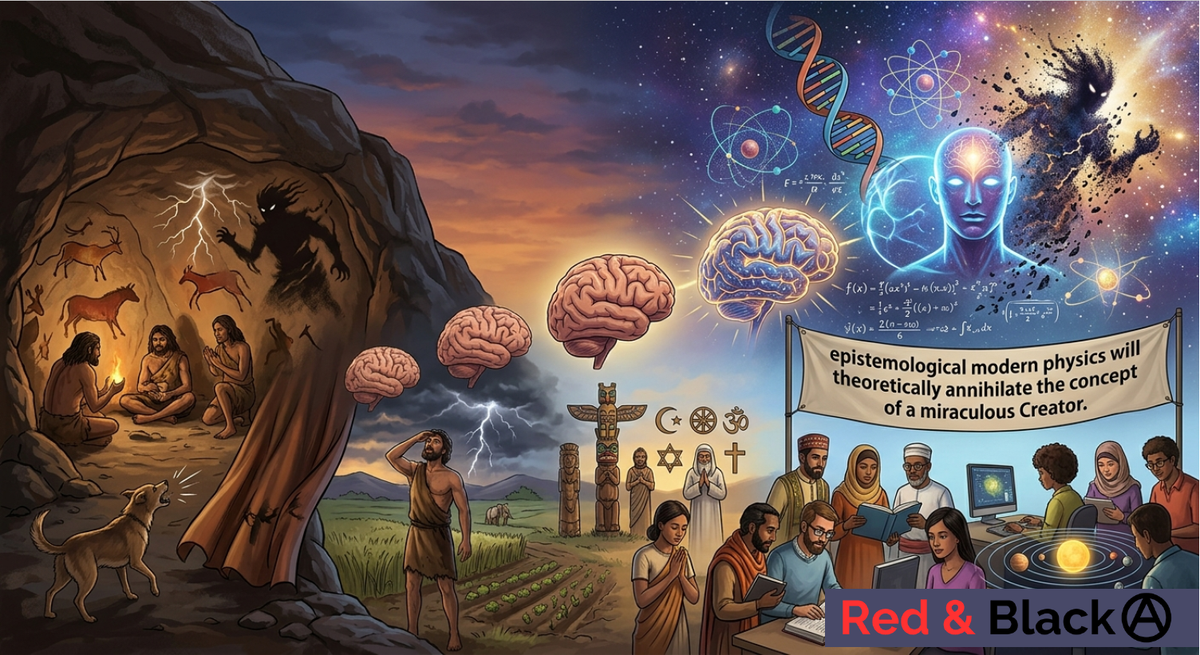
To unravel this mystery of consciousness, we can instead look toward the theories of Stephen Hawking and Charles Darwin. In primitive times, humans believed that nature was static because, relatively speaking, this appeared to be the truth to their eyes. This stagnation aligned perfectly with the instincts of human beings existing at an animal level. Therefore, whenever they witnessed any sudden change in nature, they assumed that there must be an invisible "agent" or driving force behind it.
In the concluding section of his book 'The Descent of Man', Darwin shared a wonderful example concerning his pet dog. When the leaves of trees or a window curtain shook violently due to a gust of wind from afar, the dog began to bark in an unfamiliar fear. Analyzing this through canine psychology, it becomes evident that the dog believed some invisible entity, which could not be seen, was moving the curtain. This psychology corresponds exactly with the limited boundaries of primitive human knowledge. It was in this manner that the concept of a "body-less, distinct consciousness" first took root in the human mind.
Darwin asserted that even today, there are many people on Earth who live in primitivism far removed from modern civilization and cannot differentiate between dreams and reality. The distortion of dreams explained in Sigmund Freud's 'The Future of an Illusion' and 'Introduction to Psychoanalysis', when synthesized with the concept of "Complex Ideas" in David Hume's 'An Enquiry Concerning Human Understanding', further enriches this theory.
When a person sleeps, their self-consciousness vanishes. Upon waking, they become conscious once again. During this interim period, the body lies on the bed, but where does the consciousness go? Does it leave the body to wander elsewhere? Furthermore, when consciousness is permanently lost after death, where is its abode? These primitive questions reinforced the concept of a "distinct soul" detached from the body within the human mind.
3. Modern Physics and the Science of Consciousness
When we synthesize today's modern physics with Hegelian dialectics, the history of evolution, the anthropology of language and culture, the development of hydrocarbon organic compounds and protoplasm, Freudian psychology, Karl Popper's evolutionary epistemology, and Immanuel Kant's moral philosophy, we find the scientific answer to this primitive mystery.
In the light of modern physics and chemistry, we know that within the sequence of the quantitative transformation of matter in this expanding universe, a complex illusion called "life" and "desire" was created on Earth through a prolonged chemical process (Colloidal Solution). The quantum world of consciousness and our vast solar system operate under the same laws.
Therefore, today we can easily arrive at the conclusion that—the operation of consciousness is fundamentally a complex biochemical reaction; it is nothing miraculous. Consciousness is not something whose creation required a "conscious cosmic force," nor is it contrary to the natural behavior of matter.
If we compare our sensory experiences with the higher mathematical equations of the four-dimensional world, it becomes clear that—a "wrong question" of the past gave birth to a "wrong answer." Judged through the "Butterfly Effect," it is apparent how profound and long-lasting an impact that small delusion of primitive humans and the imaginary concept of a "distinct God-entity" have exerted on the entire history of mankind.
4. The Law of Cause and Effect and the Crisis of God
In this tangible world of cause and effect, the concept of the universe suddenly originating from nothingness is profoundly paradoxical. To find an easy solution to this puzzle, many present the concept of a "supreme consciousness" or God. Hegel, too, repeatedly stumbled upon this question in his text 'Phenomenology of Spirit'. Friedrich Engels, in his works 'Dialectics of Nature' and 'Anti-Dühring', did not provide the core answer directly either. However, although we do not find the primal cause of the creation of the world in Kant's theory of causal perception, we can at least understand this much—how disconnected from mathematics and how afflicted by primitive instincts our quest for God truly is.
For ages, we have sought the answer to a mystery that the rational mind cannot accept. The concept of the existence of a Creator, in attempting to solve one mystery, inadvertently gives birth to yet another new mystery. The late linguist and iconoclastic writer Humayun Azad therefore aptly remarked:
"Instead of demystifying the secrets of the universe, primitive cosmology has shrouded everything in a dense blanket of mystery."
Nevertheless, through hundreds of centuries of painstaking scientific endeavor, humanity has today replaced that "miraculous randomness" of nature with the law of cause and effect. We have learned that the "agent" or man himself is a unique byproduct of nature's cause and effect. Consequently, the path for theorists advocating for God is now blocked. Particularly, now that the material relationship between inert matter, the organic world, and ultimately consciousness has been scientifically proven, the theoretical existence of God as a "Supreme Agent" has been decimated.
Yet, a strange irony is that—even though the logical justification for the existence of God has been exhausted, the scriptures written in His name survive seamlessly. Primitive cosmology and "totemic" tribal morality persist. And yet, the historical origins of these are well known to us today.
5. The Evolution of Religion: Fear, Agriculture, and Sociology
Humans in primitive agrarian societies lacked vast worldly knowledge. Their primary requirement for crops was rain. What reaction would occur in the minds of those primitive, ignorant humans upon witnessing sudden lightning strikes or rain falling from the sky? They thought that behind this colossal phenomenon, there must be a tremendous power and someone's mercy working toward them. But to whom did this power and mercy belong? The answer was found—the one who cannot be seen, but who sits in that distant sky controlling everything, He is the All-Merciful Creator! Without whose will, not even a leaf of a tree stirs.
The exploiting and priestly classes, or these "sons of the earth" of the Creator, gradually began to attribute various human and supernatural attributes to God. Thus was born institutional modern God, whose rule-enwrapped books we continue to read to this day.
On the other hand, pastoral societies knew how to domesticate animals. They viewed natural disasters as expressions of God's wrath. Consequently, to appease God and protect themselves, they initiated various rituals, which in the course of time manifested as "religion". The etymological meaning of the word 'Dharma' (religion) itself is—that which holds or protects. Sri Krishna said the same in the Karna Parva of the Mahabharata.
Similarly, the English word 'Religion' originates from the Latin 'Religare', which means 'to rebind' or 'to reconnect'. Due to the creation of private property ownership, human beings began to lose humane qualities—empathy, forgiveness, kindness, and love—from society and themselves; religion seemingly sought to reconnect humans with those virtues once again.
In Arabic, it is called 'Deen'. According to the Prophet's claim in 'Kitab al-Iman' of Sahih Muslim, 'Deen' is sincere advice for humanity. The word 'Nabi' (Prophet) means a guide. In an era of profound moral crisis, the great man Muhammad (PBUH)—who was the bearer of the Quran—came to show humanity the path of peace. Analyzing the Quran reveals that it is a condensed and revised form of the Bible of the Abrahamic tradition. He desired to show mankind the path of the sky's benevolence and love, but instead of looking at the beacon, humans kept staring at his finger! Disregarding the philosophy of love, faith, and empathy he demonstrated, we became engrossed in his style of attire, manner of walking, or posture of sitting. As a result, while external rituals increased in society, true peace never arrived.
In the same manner, in the commentary of the Chaturveda, Krishna imparts religious knowledge through the meditation of sages to protect mankind. The word 'Veda' itself means knowledge. Later, Krishna Dvaipayana (Vedavyasa) divided this vast knowledge into four volumes for the benefit of humanity. A similar alignment of thought is found in the philosophies of the ancient Persian 'Avesta' and the Indian 'Rigveda'. (This subject demands a lengthy discussion, which may perhaps be written in detail later). Today, however, we only need to understand that while the creation mythologies of the Vedas or the Bible are wonderful as literature or stories, they are terrifying as blind faith and represent a historical misunderstanding about the universe and life.
6. Chastity, Property, and the Future of God
When it became impossible to sustain ancient primitive totemic beliefs in the face of natural laws and the advancement of science, humans, driven by their natural instincts, began to break primitive social laws. The rulers viewed this as "adultery" or sin. Consequently, strict punitive measures were born. However, human primitive instincts could not be suppressed by worldly punishments alone; hence, as a final resort, 'God' and the 'Afterlife' were introduced. It was proclaimed—if you commit a sin, your soul will find no peace, and God will punish it in hell. Though the body is mortal, the soul is immortal.
It is noteworthy here that the judgment process of the afterlife described in the scriptures is entirely analogous to the judicial system of the feudal era. This is because those who fabricated these stories lived in the feudal era themselves, and they possessed no concept of any modern democratic system outside of royal or feudal judicial structures. Therefore, they could not associate the attributes of God with the judicial characteristics of any new era.
Not only in the afterlife, but this "sin" or adultery was also blamed as the cause of suffering in earthly life. If crops failed in the field or a drought occurred—it was assumed that God was angry with us! Therefore, appease God, offer sacrifices, perform penance. The movie 'Life of Brian' serves as an excellent aid in understanding this psychological history behind the origin of prophets.
God is angry, and from this human anguish of repentance emerged practices like Sawm (fasting), Qurbani (sacrifice), or the ancient custom of 'human sacrifice'. What is the history behind human sacrifice? Primitive humans, unaware of the scientific causes of a lunar or solar eclipse, thought that a demon was swallowing an entire sun! The sun must be displeased due to some human sin. (Mel Gibson's movie 'Apocalypto' beautifully depicts this primitive anthropology).
In the name of appeasing this imaginary wrath, a primitive atrocity began—killing, killing, and more killing! This blind notion of pleasing the Creator once turned the world into a slaughterhouse, where countless humans, ranging from innocent newborns, were sacrificed. What an absolute catastrophe of belief!
The social code built upon the concept of female chastity was also backed by the economic realities of a class-divided society. It was precisely to ensure the inheritance of private property that monogamy and such immense emphasis on female chastity were enforced. It is through the convergence of this defense of property rights and the invisible fear of God that institutional modern religion was born.
Therefore, God was born in the womb of human ignorance and error; and the historical progress of human knowledge and civilization will one day drive the final nail into God's coffin. Epistemological modern physics will theoretically annihilate the concept of a miraculous Creator, while the equitable distribution of wealth and communism will eradicate ancient totemic superstitions. One day, breaking through this blind shell of religion, higher mathematics, modern cosmology, and a scientifically grounded sense of humane duty will take its place.