The Nature of Putinism

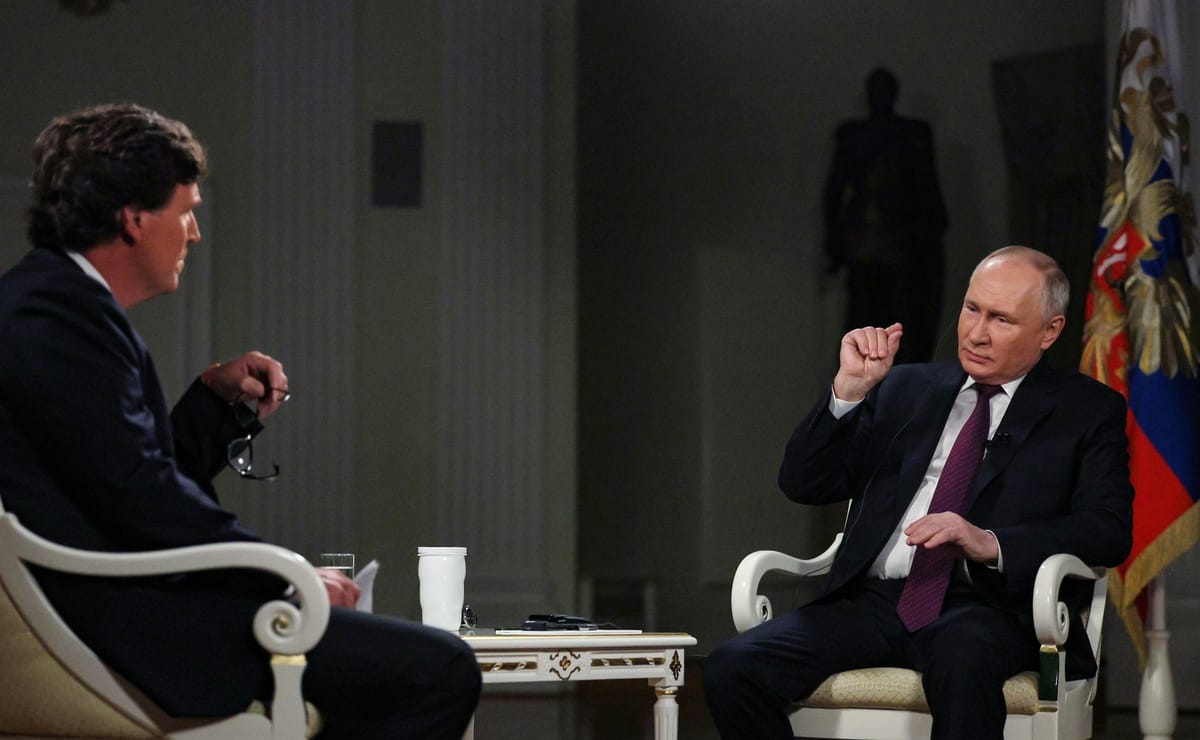
For the west Putin is an enigma wrapped in a mystery. He seems altogether too concerned with his own power to be really principled while also displaying a clear moralistic tendency toward castigating western liberalism paradoxically as both a source of imperialism and moral chaos. He rejects the liberal norms of the world order based on rule of law and human rights, but castigates the west for violating this order in its global conduct. Many western observers also see Putin as a kind of rank irredentist looking to rebuild the Russian Empire, Soviet Union, or both.
This is particularly so since his annexation of Crimea in 2014 and invasion of Ukraine in 2022. This picture is a picture that is largely self-serving to the liberal order. The fact is that like any other world leader Putin is pursuing wealth and power for his country within the capitalist world-system, just in fact, as his western opponents are. In fact Putin’s actual ideology resembles the populist resurgence of conservative nationalism against liberalism in the west itself that can be seen in the far-right parties of Europe and the MAGA movement in the USA.
To understand this we will need to wind the clock back to the aftermath of the dissolution of the Soviet Union. When the Soviet Union existed Russia had managed to escape two world wars with much of its old imperial territory intact and sat atop a federation of nominally equal and autonomous states as its leader which could enforce its control by sending tanks into insubordinate republics as happened in 1956 and 1968. The Soviet economy had been stagnating since the 70s, if not the 60s, and citizens of the Soviet Union thereby had to endure visions of a wondrous consumer life in the west while barely being able to access quality consumer goods of any kind. However, when the Soviet Union collapsed (Putin was a KGB officer at the time) the western sponsored market shock therapy which rapidly privatized state controlled industries and abolished price controls destroyed even the basic standard living Russians had been accustomed to with life expectancy contracting and widespread poverty and corruption taking hold. On top of this the dissolution of the Soviet Union meant that Russia had lost its historic imperial territory.
Even worse, the market reforms didn’t come with the vaunted political democracy that they were supposed to ultimately produce. The first post-Soviet Russian president, Boris Yeltsin, was a strongman who attacked his own parliament building using the military and was seriously threatened with losing reelection to the now non-ruling communist party. So instead of a democratic consumer cornucopia the market reforms and the collapse of the socialist state led to a massively corrupt form of capitalism in which Russia had been knocked down a rung on the geopolitical ladder. Most people could barely survive and the government maintained a kind of authoritarian liberal approach to rule in which a repressive state was used to depoliticize the masses in order to make way for a new legal order that guaranteed property and business activity.
Putin, as Yeltsin’s successor and protege, took on the project of bringing Russian back from the brink. While he rolled back freedom of expression which had been achieved with the downfall of the USSR’s communist party dictatorship he created a sprawling state backed network of welfare policies, occupations, and businesses which secured support by providing for the Russian people (at least those that supported him) in a way that Yeltsin’s authoritarian liberal order had failed to. This slate of paternalistic institutions was accompanied by the standardization of tax collection (a big problem in the immediate post-Soviet period) and the establishment of United Russian as the party with the monopoly on parliamentary politics on behalf of Putin's leadership. Elections tended to become corrupt and designed to keep Putin in power such that even when Dimitry Medvedev was president from 2008-12 Putin ruled behind him as prime minister. Thus, as BBC documentarian Adam Curtis points out, Putin had managed to sell the Russian people on a trade off of autocracy for increased security.
Putin’s early run as head of state consisted in an attempt to renew the authoritarian liberal project in Russia. This can be seen in the fact that Putin, at this stage, concentrated on liberty as the key goal of his authoritarian state. Like Pinochet in Chile, the Mexican PRI, or the Shah in Iran Putin would use the authoritarian state’s depoliticizing efforts to stabilize Russian society so that citizens could enjoy the kind of liberty that comes with economic growth and law and order. In 2012 and 13 Putin carried out an ideological revolution where his paternalistic autocracy would be turned toward populist and *illiberal* conservative ends. This turn was precipitated by both domestic and international developments.
Contrary to widespread scholarly and lay person belief the cold war was not a competition between the United States and Soviet Union for world domination. The ideological rhetoric of the cold war, which most ordinary people and elites did in fact believe, was a mechanism for both the Soviet Union and the United States to exercise social control over their political subordinates. After WW2 the United States and Soviet Union had divided the world into spheres of influence with Soviet control over one third and US control over the other two being tacitly agreed upon with provision in these unspoken agreements for fiery ideological rhetoric against each other. As such even though things came to blows between the two sides in ways that could have threatened the larger division of the world between them (e.g. the Berlin Blockade, Korean War, and Cuban Missile Crisis) the outcome was always that one side or the other backed off to avoid a nuclear holocaust given the nuclear weapons possessed by both sides.
The fact that the US was guaranteed control over two thirds of the world meant that the US had achieved hegemon status within the capitalist world-system where it had monopolized geopolitical power vis-a-vis the other states. This means that when the Soviet Union collapsed, despite the triumphant rhetoric of the United States, US hegemony had collapsed with it. It no longer had its sub-imperialist to enforce the division of the world in its favor. This put the United States in a desperate position where it would have to carry out draconian measures abroad in order to cling on to geopolitical influence (a process called imperial overreach).
The war on terror and wars in the middle east in the aftermath of 9/11 as well as US backing of Syrian rebels and the NATO overthrow of Gaddafi were ways in which the United States carried out imperial overreach while Russia looked on.
Instead of NATO being abolished at the end of the Cold War, as one of many institutions constructed to exercise liberal democratic geopolitical supremacy within the US’ sphere of the world, it was preserved as a mechanism for projecting US power after the collapse of Communism. Not only did NATO under US leadership prolong the Yugoslav wars in order to ensure NATO influence and a place for western multinationals in the former Yugoslavia, it also expanded up to Russia’s borders by taking in the Czech Republic, Hungary, and Poland and has not ceased to display its military capabilities in the region as such. Russia under Putin thereby rightly judged that it was confronted with an unwieldy United States acting like a cornered tiger all while it had been demoted in geopolitical influence as a result of the USSR’s collapse. This led Putin to think that what mattered was no longer cultivating a domestic commercial order backed by a depoliticizing paternalistic state, but rather doubling down on the defense of Russia as a unique civilization autonomous from western control.
As Russia took on the new millennium it developed its own nationalist and irredentist far-right which believed that the key to Russia’s autonomy as a unique cultural polity depended on Russia casting aside any concern for the liberal international order and claiming the wider Slavic culture and its continuous territory as its own. Famously Alexander Dugin offers a neofascist interpretation of this irredentism in which Russia is to undergo a cultural revolution that purifies it of the polluting elements of the multi-cultural and cosmopolitan world order. However, Putin refused to adopt the irredentist approach as such, leading many of its activists and thinkers to regard him at best as a lesser evil. Putin, like his master Yeltsin, still sees Russia’s presence in the world-system as a crucial element of the preservation of its civilization and had thus preserved economic connections to the west as far as he could while presenting Russia as an alternative power block that has a better claim on the right to influence Eastern European developments than NATO, or the EU.
This is why, even when he annexed Crimea in response to NATO’s proclamation of an eventual invitation to the block for Ukraine, he did not go the full way to conquering and partitioning the entire contrary as the Irredentists demanded. Part of this conservative turn has been to adopt the culture wars of the Russian Orthodox Christian right which seeks to expunge from Russia all threats to heternormative, ethnocentric, xenophobic, and patriarchal family and spiritual values. As such Putin’s conservatism has shifted from the authoritarian, but liberal version of the pre-2012 period to a populist and illiberal version which declares that the liberal order is a concoction of multicultural global elites to imperialistically dominate the east and the global south. Some observers have wondered how Putin’s statism could be combined with populist anti-elitism.
The answer is the same in the cases of other populist autocrats, or would be autocrats like Trump, or Orban. Autocracy isn’t inherently depoliticizing such that an autocrat can justify their autocracy on the basis that it is necessary for them to confront the corrupt elites on behalf of the morally upright common people. In Putin’s case those are the elites that propagate Russophobic, multicultural, and liberal imperialist justifications for Russian being held under the thumb of the west. The invasion of Ukraine can be put down to the fact that in the crisis conditions of late-capitalism the Russian civilizational project has come to be put on life support. Whereas Putin’s paternalistic political-economy was able to stimulate growth in the Russian economy after the dismal days of the 90s that growth has fallen off.
In the face of that decline and the continued insistence by the west on using NATO to project power in Eastern Europe Putin decided to invade Ukraine, citing the historical-cultural unity of the Ukrainian and Russian people and the rather outlandish claim that the Ukrainian government is controlled by Nazis as justification. Did the Ukraine war pay off as a strategy for projecting the power of Russia as a civilizational nation-state?
It seems that it didn’t. Russia has lost a generation of its commanders on the battlefield and has incurred further economic sanctions on top of what it had to deal with as a result of the Crimean annexation. More recently the stagnating war of attrition has started to turn slightly in the favor of the Ukrainians because of their use of Starlink digital technologies on the battlefield. While Putin would like Russia to be a top contender in the geopolitical battles of the day involving the former Hegemon in the United States and the recent contender to the throne China, it just does not have the geopolitical, or economic might to do so. Thus Putinism’s Russian civilizational project probably won’t be successful in the long haul ignoring that it relies on the demonization of foreigners, the imperial control of non-Russians by Russia, suppression of women and queer people, the subordination of secular politics to a culture war partly in the name of religion, and the permanence of autocracy within Russia itself (something that will become open to question when Putin has to leave office for reasons of age, or death).
The question then is how to handle Putinism while it strikes out in the hopes of winning its cultural and geopolitical struggle. Of course many western opponents of Putinism will call for an expansion of NATO to counter Russia, for instance in continued support for Ukraine which has been crucial in its war effort against the invader. This is to miss militaristic dynamics of the capitalist world-system and play into them, rather than questioning them. Putinism is at root the product of the competitive struggle for geopolitical and economic power in which states are compelled to engage if they are to survive within the capitalist world-economy. Thus states within that world-economy are compelled to constantly jostle for wealth and power with all coercive forces at their disposal. Of course Putin is going to use autocratic and imperial might to respond to the attempts by the United States and NATO to expand and hold on to power.
Calling for more of that expansion is to just fan the flames. In any case that United States has become so desperate as a declining former hegemon under Trump that it has returned to a 19th century style of gunboat diplomacy which is actively alienating the United States from the alliance as can bee seen in the administration’s tariffs, demands for annexing non-US territories like Greenland, and its illegal adventures abroad e.g. kidnapping the Venezuelan president and making war on Iran. With the United States drifting away from the alliance the middle powers will be increasingly at the mercy of China and possibly even Russia anyway for trade and diplomatic cooperation thus diminishing NATO as a geopolitical force. This process has already been at play in Trump’s initial blocking of aid to Ukraine which it paid dearly for on the battlefield. The democratic party has done nothing to effectively oppose the gunboat imperialism of the republicans and so any reversal of this trend is highly unlikely. The only real solution is the fundamental restructuring of the world-system so that it is no longer dependent on militaristic political-economic structures.
Sources
Putin: Populist, Anti-Populist, or Pseudo-Populist?, March
The Morphology of Putinism, Blackburn
Russia's Right and the Putin Regime, Bluhm and Varga
https://www.bbc.com/news/articles/cj0q964851po
Post-Socialist Regions in the World-System, Lane
https://theconversation.com/ukraine-war-follows-decades-of-warnings-that-nato-expansion-into-eastern-europe-could-provoke-russia-177999
https://redandblackanarchists.com.au/russo-ukraine-war-an-anarchist-view/
https://theconversation.com/natos-internal-cohesion-is-being-threatened-again-but-in-pushing-for-support-on-iran-trump-may-risk-eroding-us-influence-on-the-alliance-279623
Inequality and Social Stratification during the Putin Regime, Gerber and Gimpelson