The Goshal Thesis and the Historical Lies of the Communist Party of Burma

According to the Vol. I, No. 7 of CPI’s Periodical named “Communist”, the Central Committee of the Communist Party of Burma passed a political resolution on July 30, 1947 to Communist Party of India on the situation facing the Burmese people immediately after the murder of General Aung San and his colleagues. In their political resolution, the CPB stated that imperialist intrigues could only be "decisively defeated with AFPFL-CP unity.
However, due to the Burmese independence in 1948, CPB had to re-determine whether AFPFL government (along with the socialists inside it) was a “comprador bourgeoisie” or “national bourgeoisie”.
The Goshal Thesis (On the Present Political Situation in Burma and Our Task) by Thakin Ba Tin (Comrade Goshal) answered this question before CPB as a party had reached a conclusion. As a result, the Goshal Thesis became a political line formulated by Thakin Ba Tin (Comrade Goshal), a member of the Political Bureau of the Communist Party of Burma (CPB), which ignited the sparks of the Burmese Civil War.
The original manuscript of the thesis was discovered in research archives kept in Hamburg, Germany, and was published in 1989 by the Verbund Stiftung Deutsches Übersee-Institut (Hamburg) in a compilation titled Documents on Communism in Burma.
The Claims of Communist Party of Burma
However, Communist Party of Burma (CPB) has been denying the existence of such a thesis. In the November 1992 issue (No. 11) of the CPB’s official journal, ‘People's Power’, an article titled "Clarification Regarding the So-Called Goshal Thesis"—written by Comrade Po Than Gyaung, the current spokesperson of the Communist Party of Burma, with informational assistance from the chairperson of the time, Thakin Ba Thein Tin—argued the following:
- "Because this analysis [the Goshal Thesis] was written without informing the party and in opposition to the party's line, Comrade Ba Tin was severely criticized by the Political Bureau and the Central Committee. Just prior to this, Thakin Thein Pe had already faced disciplinary action for attacking the party through The Nation newspaper. Comrade Ba Tin explained that he did not write the article himself, but that a leader of the Communist Party of India (CPI) wrote it under his name. With that explanation, the matter was laid to rest.
- If the Goshal Thesis had truly existed, why would he continuously advocate the concept of a 'general strike and armed uprising' during the nightly Central Committee meetings held throughout March 1948?
- This concept is entirely different from the spirit of the Goshal Thesis. After the enemy began armed suppression on March 28, Comrade Ba Tin consistently opposed the 'encircling the cities from the countryside (Mao’s People's War)' line during the four meetings held in Yangon, Kyaukkyi Pauk, and Swedawmyaing. In reality, the Goshal Thesis never existed—neither verbally nor in writing. Starting a civil war was never the party’s line. Up until the very last moment, the target of the party’s armed struggle was British imperialism, not a civil war. This final combat line was openly distributed across the entire country."
Similarly, in an article commemorating the CPB’s 80th anniversary titled "The Final Beneficial Service in the Twilight Years of Airborne U Ohn Maung for the CPB" published in People’s Power Journal No. 42, the author U Ohn Maung, a member of Communist Party of Burma wrote:
- "The truth is, the letter sent by the Communist Party of India, along with Comrade Goshal, to the CPB stated: 'When Burma gains independence from British colonial imperialism, the AFPFL (Anti-Fascist People's Freedom League) will come to power. Therefore, you must determine the class character of the AFPFL. Defining class character is essential when formulating a party's strategy. The AFPFL government is a bourgeois government. However, the BCP must decide what kind of bourgeoisie they are. Should the AFPFL government be classified as an imperialist bourgeoisie or a national bourgeoisie? (At that time, the global communist movement categorized the bourgeoisie into these two distinct characters.) The CPB must ponder and decide this for itself.
- If you decide they are comprador bourgeoisie, oppose and fight them, because the comprador bourgeoisie unites irreversibly with the imperialists. If you decide they are national bourgeoisie, try to cooperate with them, because the national bourgeoisie possesses anti-imperialist traits.' The Central Committee debated this point until the evening of March 27, 1948, but could not reach a decision. During this time, Prime Minister Thakin Nu and Bo Let Ya reached out through Bo Aung Gyi expressing a desire to meet BCP leader Thakin Than Tun, as mentioned in Bo Aung Gyi's articles. Bo Aung Gyi concluded that the communists were planning to go underground and were stalling the meeting. In truth, the meeting was delayed because a decision on whether the AFPFL was a comprador or national bourgeoisie had not yet been reached."
The same article further claims:
- "When we had to go underground, Comrade Goshal, like a good communist, followed the majority decision and joined the party despite his personal disagreement. Deep in the jungle, during the initial phase, he was removed from his duties and disciplined because he disagreed with the peasant-based armed revolution. He was demoted from Politburo member to a regional organizer. This clearly proves that the allegations made by U Thein Pe Myint and successive ruling regimes—that Comrade Goshal brought back instructions from the CPI to wage armed revolution and that the Politburo decided to go underground based on this—are entirely false. I record this truth: we were forced to wage an armed defensive revolution because the AFPFL government began arresting BCP members nationwide".
The CPB’s Five Core Positions on the Goshal Thesis
From these historical defence narratives, we can distill six core positions held by the BCP regarding the Goshal Thesis:
- Position 1 (claimed by Po Than Gyaung, the current spokesperson of the Communist Party of Burma, and the chairperson of the time, Thakin Ba Thein Tin): The document archived in Hamburg, Germany, titled "On the Present Political Situation in Burma and Our Task," opposes the "general strike and uprising" strategy.
- Position 2 (claimed by Po Than Gyaung, the current spokesperson of the Communist Party of Burma, and the chairperson of the time, Thakin Ba Thein Tin): Thakin Ba Tin supported the "general strike and uprising" concept during Central Committee meetings.
- Position 3 (claimed by Po Than Gyaung, the current spokesperson of the Communist Party of Burma, and the chairperson of the time, Thakin Ba Thein Tin): The Goshal Thesis never existed—neither verbally nor in writing (implying the file in Hamburg is a forgery).
- Position 4 (U Ohn Maung, a member of Communist Party of Burma): U Thein Pe Myint wrote and lectured extensively, claiming that Comrade Goshal brought the armed revolution line back from India.
- Position 5 (U Ohn Maung, a member of Communist Party of Burma). The CPB did not go underground of their own volition, but were forced to do so due to their arrest by the AFPFL government.
- Position 6 (claimed by Po Than Gyaung, the current spokesperson of the Communist Party of Burma, and the chairperson of the time, Thakin Ba Thein Tin): Referring to a defunct Publication of CPI in 1948.
- Position 7 (claimed by Po Than Gyaung, the current spokesperson of the Communist Party of Burma, and the chairperson of the time, Thakin Ba Thein Tin): Did Than Tun attend the Southeast Asian Youth Conference?
Debunking the First historical revisionism of Communist Party of Burma
(claimed by Po Than Gyaung, the current spokesperson of the Communist Party of Burma, and the chairperson of the time, Thakin Ba Thein Tin): The document archived in Hamburg, Germany, titled "On the Present Political Situation in Burma and Our Task," opposes the "general strike and uprising" strategy.
The CPB’s first claim—that the actual Hamburg-archived document opposes a "general strike and armed uprising"—is completely false.
If one were to look at the thesis in its original text, Comrade Goshal clearly stated that the AFPFL government of Thakin Nu was nothing more than a puppet of the imperialist bourgeoisie. To make the state a government that would serve the working class, Goshal says the party must consolidate itself, make a “united front,” and conduct “a general strike and armed uprising.” The issue of whether the AFPFL is a comprador or national bourgeoisie for Goshal is solved already, and only the CPB was left in the dilemma.
Now to prove this point, let us consider the English version of Goshal. In his “Tactics of the United Front in terms of the change in the situation” on page 120, he writes:
- Working class as the leading class.
- United front from below to fight for proletarian leadership.
- Leading mass battles to win the masses for the United Front national rising against imperialism for people's Government, for democratic revolution.
- Building the Party based on the draft prepared
- Education of Marxism-Leninism by using the graded course of training for party members and militants.
The Marxist League was a short-lived political organization established in 1947 by the Socialist Party of Burma and the People's Volunteer Organization.
Interestingly, during the “Youth Conference of Southeast Asian Countries” held in Calcutta on February 27, 1948, the Vietnamese Deputy Minister, Dr. Ram Nook Tak, remarked that the situation in Burma was being led by the "Marxist League" alongside the Communist Party, and that there was no fundamental policy difference between them.
However, in his thesis, Goshal defined this "Marxist League" as an "opportunistic maneuver from above" by the leaders of Socialist Party of Burma designed to divert pro-socialist PVO (People's Volunteer Organ) cadres into reformism and anti-communism. Thus, Goshal advocated a "united front from below" to bypass them, lead mass battles, and launch a national uprising.
If one reads the thesis from beginning to end, there is not a single concept resembling Mao Zedong's "People’s War." Instead, Goshal repeatedly references Leninist theories of the Bolshevik Revolution, including the Kornilov revolt, to justify his "general strike and armed uprising" line.
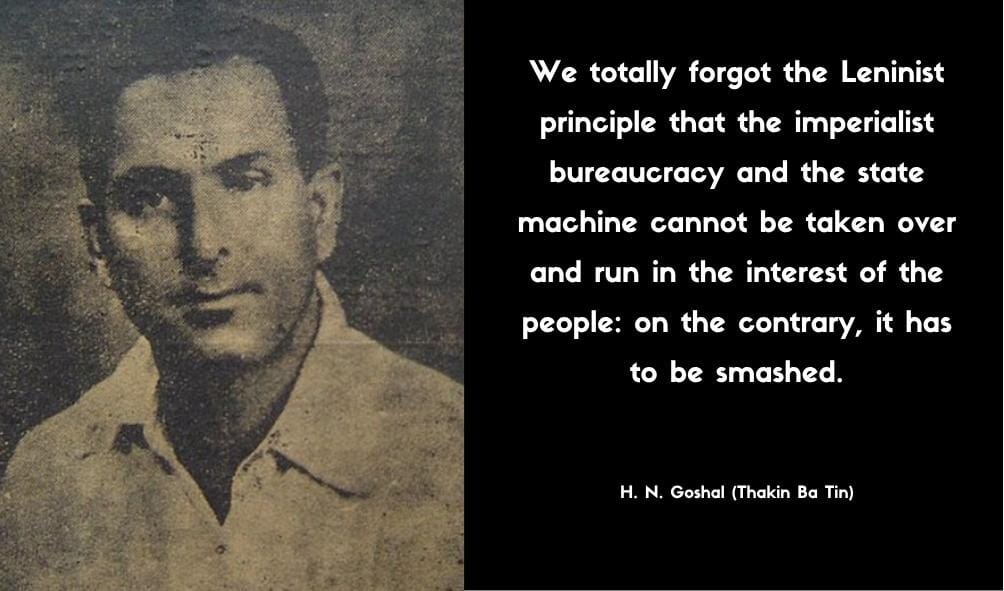
Goshal wrote:
- "We totally forgot the Leninist principle that the imperialist bureaucracy and the state machine cannot be taken over and run in the interest of the people: on the contrary, it has to be smashed."
He further noted:
- "We must realize we are living in the period of the post-war revolutionary crisis. The Thakin Nu government cannot solve a single problem. It will only enable British imperialism to solve their crisis at the expense of the Burmese people. This means as the crisis deepens, unrest and discontent will grow among the masses. There are two sharp alternatives before the masses. The Communists have to go ahead boldly leading workers, peasants, and the common people in struggles in defence of their living conditions, building AFPFL-CP united front, exposing and isolating the present leadership and the Government until we are in a position to unite and raise the whole opposition movement to the pitch of a rising into a national war against the British colonizers, for seizing power and for creating a people's Government based on AFPFL-CP unity and carrying through the democratic revolution.”
The fact that Po Than Gyaung, the current spokesperson of the Communist Party of Burma, and the chairperson of the time, Thakin Ba Thein Tin could not differentiate between the Leninist concept of a "general strike and armed uprising" and the Maoist concept of "Mao's People's War" is an embarrassing display of theoretical ignorance.
Debunking the Second historical revisionism of Communist Party of Burma
(claimed by Po Than Gyaung, the current spokesperson of the Communist Party of Burma, and the chairperson of the time, Thakin Ba Thein Tin): Thakin Ba Tin supported the "general strike and uprising" concept during Central Committee meetings which they claim is completely different from the actual content of the Goshal Thesis.
The second claim—that Goshal's support for a "general strike and uprising" at party meetings contradicts the Goshal Thesis—is built on the false premise analysed above. Because the CPB wrongly assumed the document Goshal Thesis advocated "Mao's People's War," they argued that Goshal's verbal arguments during the Central Committee meetings contradicted his written thesis.
In reality, comrade Goshal's verbal advocacy during the CPB’s recorded meeting for a "general strike and armed uprising" perfectly matched his written thesis. The CPB’s second claim is based on their own fundamental misunderstanding of Marxism-Leninism and Maoism.
Debunking the Third historical revisionism of Communist Party of Burma
(claimed by Po Than Gyaung, the current spokesperson of the Communist Party of Burma, and the chairperson of the time, Thakin Ba Thein Tin): The Goshal Thesis never existed—neither verbally nor in writing (implying the file in Hamburg is a forgery).
The CPB’s third claim—that the thesis never existed in any form—is thoroughly debunked by historical records. The CPB's own 1992 People's Power article admitted: "Comrade Ba Tin explained that he did not write the article himself, but that a leader of the Communist Party of India (CPI) wrote it under his name." If the thesis "never existed," how could Goshal claim someone else wrote it under his name? The CPB’s narrative is riddled with self-contradictions (a dose of common sense is what they don’t have).
In the November 1992 issue (No. 11) of the CPB’s official journal, ‘People's Power’, an article titled "Clarification Regarding the So-Called Goshal Thesis"—written by Comrade Po Than Gyaung, the current spokesperson of the Communist Party of Burma, with informational assistance from the chairperson of the time, Thakin Ba Thein Tin—argued the following:
- "In January 1948, Comrade Ba Tin (Ghoshal) requested permission from the party leadership to visit the headquarters of the Communist Party of India (CPI) for a short period, and the two other members of the political bureau agreed.
Thus, according to CPB’s own records, Goshal had received permission from the CPB to visit the CPI headquarters in India during January and February of 1948. During this time, AFPFL representatives travelled to Calcutta in February 1948 for the Southeast Asian Youth Conference. Aurobindo Bose, the nephew of Subhas Chandra Bose and leader of the "left wing" of the All-India Student Congress, eventually led a walkout of the conference and the AFPFL joined the walkout due to being accused of imperialist puppets and being called the national independence they valued as sham by the communists (Marxist-Leninists). Thus, they likely acquired copies of the publications containing the thesis and brought it back to Burma.
In addition, the original manuscript of the thesis was discovered in research archives kept in Hamburg, Germany, and was published in 1989 by the Verbund Stiftung Deutsches Übersee-Institut (Hamburg) in a compilation titled Documents on Communism in Burma. According to the editorial note of this archive, the document had two sources to cross check. One is from Thein Phe Myint, the third General Secretary of Communist Party of Burma itself. Another one is from Dr. Robert Taylor in 1980.
Debunking the Fourth historical revisionism of Communist Party of Burma
(U Ohn Maung, a member of Communist Party of Burma): U Thein Pe Myint wrote and lectured extensively, claiming that Comrade Goshal brought the armed revolution back from India.
The CPB (particularly Airborne U Ohn Maung) claimed that U Thein Pe Myint wrote that Goshal brought back an "armed revolution line" from India. It is not only false but also a strawman.
However, in U Thein Pe Myint's biographical book of “Minister U Kyaw Nyein” where he discussed this issue in detail, he never used the term "armed revolution line." Instead, Thein Pe Myint, himself being a Marxist-Leninist and the third General Secretary of Communist Party of Burma, described Goshal's strategy correctly as an “uprising” that would inevitably lead to civil war.
The CPB under the later leadership especially those after Ba Thein Tin either intentionally or ignorantly mischaracterized U Thein Pe Myint’s writings to dodge the historical charge of trying to seize power through a coup.
Debunking the Fifth historical revisionism of Communist Party of Burma: Who Started the Burmese Civil War?
(U Ohn Maung, a member of Communist Party of Burma). The CPB did not go underground of their own volition, but were forced to do so due to their arrest by the AFPFL government.
U Ohn Maung, a member of Communist Party of Burma in his article "The Final Beneficial Service in the Twilight Years of Airborne U Ohn Maung for the CPB" published in the official publication of CPB, People’s Power Journal No. 42, wrote as follow:
- "Around the time the civil war broke out, during a report presented by the Executive Committee at the AFPFL (Anti-Fascist People's Freedom League) Central Head Council meeting, it was stated that the communists 'went underground' on March 28, 1948. In response, Bo Aung Nyunt, a leader of the People's Volunteer Organisation (PVO) and a member of the Central Head Council, submitted an amendment proposing that the phrase 'went underground' be changed to 'were driven underground' (forced into hiding). His argument was that they did not go underground of their own volition, but were forced to do so due to their arrest by the AFPFL government."
U Ohn Maung used Bo Aung Nyunt from People's Volunteer Organisation (PVO) and excused that the CPB had to start the Burmese Civil war because the AFPFL government began arresting them on March 28, 1948. It is historically inaccurate.
More ironically, Thakin Ba Thein Tin, First Vice-Chairman of the Central Committee of the Communist Party of Burma (CPB), explicitly stated the following in his speech reported by “Peking Review Vol 29” released on July 14 1967:
- “The armed struggle under the leadership of the Communist Party of Burma headed by Chairman Thakin Than Tun has been going on for 19 to almost 20 years. Ne Win and his gang are the chief culprits who started the reactionary civil war.”
In 1948 (20 years before the year 1967), Ne Win did not have much political power and it was not Ne Win’s BSPP regime that was in power. It was democratically elected AFPFL which ruled the country with social democratic principles. Ne Win even though being the chair of Leftist Unity Council turned down the coup attempt in August 1948, which was engineered by Thein Pe Myint, the General Secretary of Leftist Unity Council and the third General Secretary of Communist Party of Burma.
According to “IRAWAT Sentinel of the East” of Irawat Centre for Marxist Studies Imphal, it can be confirmed that Thakin Than Tun participated in the Second Congress of the CPI (Communist Party of India) in Calcutta which happened from 28 February to 6 March 1948, where he met with Hijam Irawat Singh, a politician and leader of Communist party of India. However, the other participant of the CPB is not mentioned in that report. According to “The Bangladesh Reader: History, Culture, Politics” by Meghna Guhathakurta and Willem van, Thakin Than Tun gave a speech stating “it is through armed struggle only that we will attain liberation, and that is the way we are going now” in the Second Congress of the CPI in Calcutta. This speech of Thakin Than Tun in the Second Congress of the CPI in Calcutta confirmed that Communist Party of Burma was not forced to take up arms but instead they planned to take up arms to conduct a one-party totalitarian state like Stalin’s USSR and Mao’s China before AFPFL started to arrest them for the coup plot.
Months before the arrests, tensions were already boiling between socialists (social democrats from Socialist Party of Burma) and communists (Stalinists from Communist Party of Burma). Thakin Than Tun and his Marxist-Leninist followers had famously threatened the socialists with slogans such as: "We must fill the ‘Valley of Vyakara’ with the bones of socialists" long before the March 28 crackdowns.
When Kyaw Nyein, a leader of Socialist Party of Burma, obtained the published Goshal Thesis detailing plans for a general strike and armed uprising to overthrow the government, he showed it to Thakin Nu, the first Prime Minister of the Union of Burma. Fearing a violent Bolshevik coup like in Russia, Thakin Nu pre-emptively ordered the arrests of communist leaders. The CPB attempted to overthrow a democratically elected government through an uprising, and when the state cracked down, the CPB retreated to the jungles and plunged the country into a full-scale civil war using Mao's People's War strategy. Actually, it was the AFPFL government and the Socialist Party of Burma that were forced to defend the multi-party parliamentary democracy (which Burma cannot afford to get even after several uprisings till now) by driving out the CPB and their coup attempt.
Debunking the Sixth historical revisionism of Communist Party of Burma
(claimed by Po Than Gyaung, the current spokesperson of the Communist Party of Burma, and the chairperson of the time, Thakin Ba Thein Tin): Referring to a defunct Publication of CPI in 1948.
In the November 1992 issue (No. 11) of the CPB’s official journal, ‘People's Power’, an article titled "Clarification Regarding the So-Called Goshal Thesis"—written by Comrade Po Than Gyaung, the current spokesperson of the Communist Party of Burma, with informational assistance from the chairperson of the time, Thakin Ba Thein Tin—argued the following:
- "In January 1948, Comrade Ba Tin (Ghoshal) requested permission from the party leadership to visit the headquarters of the Communist Party of India (CPI) for a short period, and the two other members of the political bureau agreed.
- After he arrived in Bombay, an article titled 'On the Present Political Situation and Our Tasks', attributed to Comrade Ba Tin, appeared in People's Age, a journal published by the Communist Party of India. The article essentially asserted that the line of the Communist Party of Burma was leaning rightist and, therefore, needed to be corrected."
Here, Po Than Gyaung along with Thakin Ba Thein Tin also committed another historical revisionism to those ignorant communists who blindly believed all their words without conducting factchecks. People's Age was the weekly central organ of the Communist Party of India from 1945 to 1947. During the war years it had been published under the name People's War. That means an article titled 'On the Present Political Situation and Our Tasks', attributed to Comrade Goshal cannot be published in People's Age, a journal that was already defunct in 1948.
Debunking the Seventh historical revisionism of Communist Party of Burma
(claimed by Po Than Gyaung, the current spokesperson of the Communist Party of Burma, and the chairperson of the time, Thakin Ba Thein Tin): Did Than Tun attend the Southeast Asian Youth Conference?
In the editorial note of the original manuscript of the thesis discovered in research archives kept in Hamburg, Germany, the following was said:
- “Thakin Than Tun and Goshal participated then also in the Southeast Asian Youth Conference".
The question of whether Than Tun attended the Southeast Asian Youth Conference or not is a misery. In the November 1992 issue (No. 11) of the CPB’s official journal, ‘People's Power’, an article titled "Clarification Regarding the So-Called Goshal Thesis"—written by Po Than Gyaung, the current spokesperson of the Communist Party of Burma, with informational assistance from the chairperson of the time, Thakin Ba Thein Tin—argued the following:
- “As communist leaders, it would not have made sense for them to attend a youth conference, and they did not do so.”
In “Soviet-Vietnam Relations and the Role of China, 1949-64, Changing Alliances” by Mari Olsen, it was reported that Than Tun attended the Southeast Asian Youth Conference. Also in "The Calcutta Conference and the Southeast Asian Uprisings" by Ruth T. McVey, it was reported that Lance Sharkey, the secretary-general of Communist Party of Australia (CPA) and Than Tun of Communist Party of Burma attended the Southeast Asian Youth Conference during their travel for the second congress of the Communist Party of India (CPI). That means several independent scholars are confirming the editorial note of those who archived the Goshal thesis.
Even though Pho Than Chaung from CPB argued that “as communist leaders, it would not have made sense for them to attend a youth conference”, it was kind of ironic that highly influential figures such as Dr. Ram Nook Tak who was the Deputy Prime Minister of Vietnam, along with Marxists such as Vidya Munshi, Ketayun (Kitty) Boomla, and Ashok Mitra from India attended the same youth conference. Moreover, Aurobindo Bose, the nephew of Subhas Chandra Bose and leader of the "left wing" of the All-India Student Congress, who eventually led a walkout of the conference, attended the same Southeast Asian Youth Conference as well.
CPB’s claim of not sending their communist leaders is not that convincing given that other communist parties indeed sent their leadership or high ranking cadres.
Final Days of Comrade H. N. Goshal
Thakin Than Tun, the chairperson of the Communist Party of Burma during the "Cultural Revolution" era, took the side of the bureaucratic gang of four in China's cultural revolution. H. N. Goshal, leading a minor faction, reminded them of the importance of maintaining the democratic centralism within the party. Ultimately, the theoretical debate has turned into personal conflict and the executions of H. N. Goshal, his faction, and those who sympathize with him became inevitable. Comrade Htay and H. N. Goshal was compared to "Burma's Deng Xiaoping and Liu Shaoqi" and was executed by the Communist Party of Burma in Pegu Yoma on 18 June 1967 during the "Cultural Revolution", organized by people who followed the instruction of the gang of four. It is claimed that racial slurs such as “Kalar” were used negatively against H. N. Goshal (since he is Bengali) when he was persecuted. Besides, it is stated that H. N. Goshal sang "the Internationale" till his death while he was executed.
Conclusion
The CPB desperately tries to deny the existence of the Goshal Thesis till today because doing so is the only way to escape historical culpability as the instigator of the Burmese Civil War, which they don’t want to affiliate themselves with as they were the first in modern Myanmar’s history to endorse the one-party totalitarianism and socialism in one country model which traumatised all the classes of Myanmar (including the working class itself). However, their lies are deeply contradictory and sometimes even self-contradictory towards their other claims.
By assuming the working-class public could neither read English nor comprehend communist theory, the leaders of the Communist Party of Burma (CPB)—including Thakin Than Tun, Thakin Ba Thein Tin, and Po Than Gyaung—fabricated the history surrounding the Ghoshal Thesis to manipulate the masses, a deception that modern archival research and theoretical analysis have since fully exposed. Ironically, while these leaders themselves lacked even a basic grasp of their own ideology—unable to distinguish Marxism-Leninism from Maoism—they ultimately executed Comrade H. N. Ghoshal precisely because he truly understood Marxism-Leninism and defended democratic centralism.